The hardest engineering challenge | Barry Barish and Lex Fridman
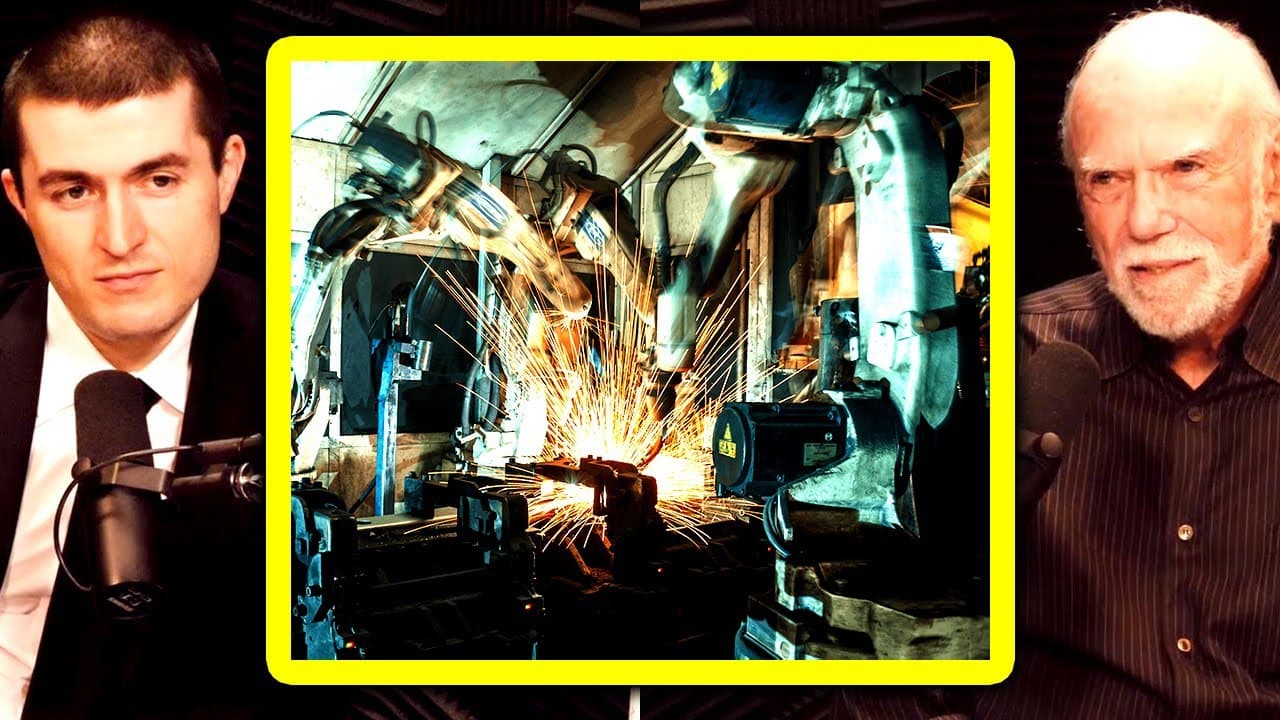
TL;DR
After years of hard work and technological advancements, the team at LIGO successfully detected gravitational waves, opening up a new era in astronomy and providing insight into the universe's most powerful events.
Transcript
what was uh to you kind of the darkest moment of what was the hardest stumbling block to get over on the engineer side like was there any time where there's a doubt where it's like i'm not sure we'll be able to do this a kind of uh engineering challenge that was hit do you remember anything like that i think the one that that my colleague at mit ra... Read More
Key Insights
- ✋ Building the high vacuum system for LIGO was one of the most challenging tasks, with potential leaks posing a significant concern.
- 🎚️ High vacuum requires extremely low pressure levels, making it crucial for LIGO to achieve an exceptional level of precision.
- 👋 The successful detection of gravitational waves opened up new possibilities for gravitational wave astronomy, similar to how Galileo's telescope revolutionized traditional astronomy.
- 🤩 Overcoming engineering obstacles and managing egos were key factors in leading the LIGO team towards their groundbreaking achievement.
- 😀 The limitations faced by LIGO are primarily technical rather than scientific, showing promise for further advancements in the field.
- 👋 The detection of gravitational waves is an exciting milestone in human evolution, showcasing the capability of descendants of apes to create such precise instruments.
- 👋 The discovery of the Higgs boson and the detection of gravitational waves are two remarkable scientific achievements, with the latter offering more room for further advancements.
Install to Summarize YouTube Videos and Get Transcripts
Explore YouTube Video Summarizer or Get YouTube Transcript Extractor
Questions & Answers
Q: What were some of the biggest challenges faced by the LIGO team during the engineering process?
One major challenge was creating a four-kilometer-long high vacuum system that required a spiral weld on a stainless steel roll. The team also had to find a way to detect potential leaks in the large system without surrounding it with helium.
Q: What is the difference between high vacuum and regular vacuum?
High vacuum refers to an extremely low-pressure environment where particles are less likely to scatter. Regular vacuum systems typically have higher pressure levels.
Q: How did the detection of gravitational waves coincide with human advancements?
The detection of gravitational waves occurred 1.3 billion years after the collision of the black holes that caused them. At that time, humans were transitioning from single-cell to multi-cell life forms.
Q: What qualities are necessary to lead a team like LIGO?
It is crucial to create an environment where the combined talents of the team can achieve more than what individuals could accomplish alone. Attracting the best possible people and providing them with a sense of purpose and excitement are also essential.
Summary & Key Takeaways
-
LIGO, led by a team of brilliant theoreticians and engineers, faced numerous challenges in their quest to detect gravitational waves, including engineering obstacles and potential leaks in the high vacuum system.
-
The difference between high vacuum and regular vacuum is the level of pressure, with high vacuum requiring incredibly low pressure.
-
An important factor in leading a successful team like LIGO is the ability to create an environment where the sum of individual contributions is greater than the individual parts.
Read in Other Languages (beta)
Share This Summary 📚
Summarize YouTube Videos and Get Video Transcripts with 1-Click
Try YouTube Summary with ChatGPT & Claude or YouTube Transcript Generator
Explore More Summaries from Lex Clips 📚




Summarize YouTube Videos and Get Video Transcripts with 1-Click
Try YouTube Summary with ChatGPT & Claude or YouTube Transcript Generator