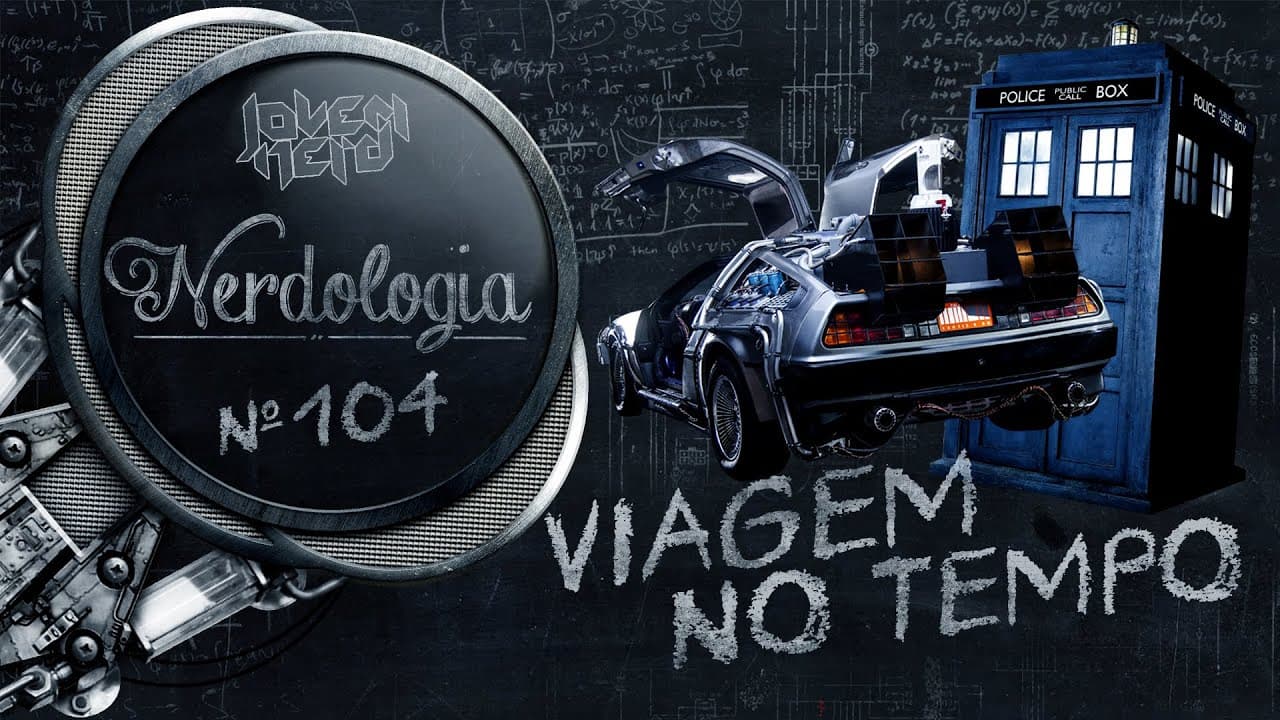
Viagem no tempo | Nerdologia
TL;DR
Explores time travel theories and paradoxes using pop culture references.
Transcript
Welcome to Nerdologia! I'm Atila, biologist, researcher and we still need roads Today we are finally going to talk about time travelling After all October 21st is the day in which Marty comes to visit us in the future We still have no flying cars Nor dehydrated pizza and thankfully we don't wear that lot of colors or two ties But the most important... Read More
Key Insights
- Time travel to the future is theoretically possible by moving at high speeds or increasing gravity, as explained by the theory of relativity.
- Stephen Hawking questioned the absence of future tourists as evidence against time travel, while Carl Sagan suggested they might be in disguise.
- The grandfather paradox presents a major challenge to time travel, questioning the implications of altering past events.
- Various fictional narratives propose solutions to time travel paradoxes, such as single timelines, alternate realities, and immutable timelines.
- Quantum mechanics allows for the possibility of particles interacting with themselves in the past, leading to a state of quantum overlay.
- Current physics laws permit time travel without violating principles, but practical implementation would require creating a wormhole.
- Time travel narratives highlight the complexity of reality compared to fiction, as real-world physics presents many challenges.
- The motion of celestial bodies complicates time travel, as returning to a previous time requires accounting for their movement through space.
Install to Summarize YouTube Videos and Get Transcripts
Explore YouTube Video Summarizer or Get YouTube Transcript Extractor
Questions & Answers
Q: How does special relativity allow for time travel to the future?
Special relativity suggests that as an object moves closer to the speed of light, time slows down for it relative to an outside observer. This means that if someone travels at such high speeds, they would age more slowly compared to people on Earth, effectively traveling into the future.
Q: What is the grandfather paradox in time travel?
The grandfather paradox is a hypothetical scenario where a time traveler goes back in time and kills their grandfather before their parent is born. This creates a contradiction because, without the grandfather, the time traveler could never have been born to travel back in time and commit the act, questioning the consistency of time travel.
Q: How does quantum mechanics relate to time travel?
Quantum mechanics allows for the possibility of particles interacting with themselves in the past, leading to a quantum overlay where multiple timelines exist simultaneously. In this state, paradoxes are resolved as only coherent outcomes remain, suggesting a complex relationship between quantum mechanics and time travel.
Q: What are some fictional solutions to time travel paradoxes?
Fiction offers various solutions to time travel paradoxes. Some narratives propose immutable timelines where changes in the past do not alter the future, like in 'Harry Potter.' Others, like 'Back to the Future,' suggest alternate realities where each change creates a new timeline, allowing for different outcomes.
Q: Why don't we see tourists from the future if time travel is possible?
Stephen Hawking posed this question to challenge the feasibility of time travel, suggesting that if it were possible, we should encounter visitors from the future. One explanation is that time travelers might be in disguise to avoid altering the past, as proposed by Carl Sagan.
Q: What role do wormholes play in theoretical time travel?
Wormholes are theoretical passages through space-time that could connect distant points, allowing for time travel. To time travel using a wormhole, one would need to create a fold in space-time, connecting different points in time. However, creating and stabilizing a wormhole presents significant scientific challenges.
Q: How does the motion of celestial bodies affect time travel?
The Earth's rotation and its orbit around the Sun, along with the movement of the solar system and galaxy, complicate time travel. Returning to a previous time would require accounting for these movements, as the Earth and other celestial bodies are constantly in motion through space.
Q: What are some challenges in making time travel a reality?
Time travel faces numerous challenges, including the need to reconcile it with the laws of physics, such as relativity and quantum mechanics. Practical implementation would require technologies like wormholes, which are currently theoretical and would need to be created and stabilized, posing significant scientific hurdles.
Summary & Key Takeaways
-
This episode of Nerdologia delves into the concept of time travel, discussing its theoretical possibilities and challenges. It references popular culture, including movies like 'Back to the Future' and 'Terminator,' to illustrate various time travel paradoxes and solutions proposed by fiction.
-
The discussion highlights how time travel to the future can be achieved by traveling at high speeds or through gravitational effects, as per Einstein's theory of relativity. However, traveling to the past presents challenges, such as the grandfather paradox and the absence of future tourists.
-
Quantum mechanics introduces the idea of particles interacting with themselves in the past, leading to a quantum overlay of timelines. Current physics allows for time travel without violating known principles, but practical implementation requires creating a wormhole, posing significant challenges.
Read in Other Languages (beta)
Share This Summary 📚
Summarize YouTube Videos and Get Video Transcripts with 1-Click
Try YouTube Summary with ChatGPT & Claude or YouTube Transcript Generator
Explore More Summaries from Nerdologia 📚



Summarize YouTube Videos and Get Video Transcripts with 1-Click
Try YouTube Summary with ChatGPT & Claude or YouTube Transcript Generator