Mono pulse tracking radar | Phase comparison | Radar Systems | Lec-50
TL;DR
The video explains phase comparison monopole stacking radar, focusing on its mechanics and calculations.
Transcript
hi everyone in this video I am going to explain about phase comparison Monopoly starting radar so in the concept of monopol striking radar this is the second type first type is amplitude comparison monopol striking data in the amplitude comparison Monopoly stacking data are so we have seen two types of radar systems one is one coordinate system wit... Read More
Key Insights
- 💗 Phase comparison monopole stacking radar utilizes two antennas transmitting single pulses to track targets through phase difference.
- ❓ The method contrasts with amplitude comparison radar, highlighting a more refined approach to tracking.
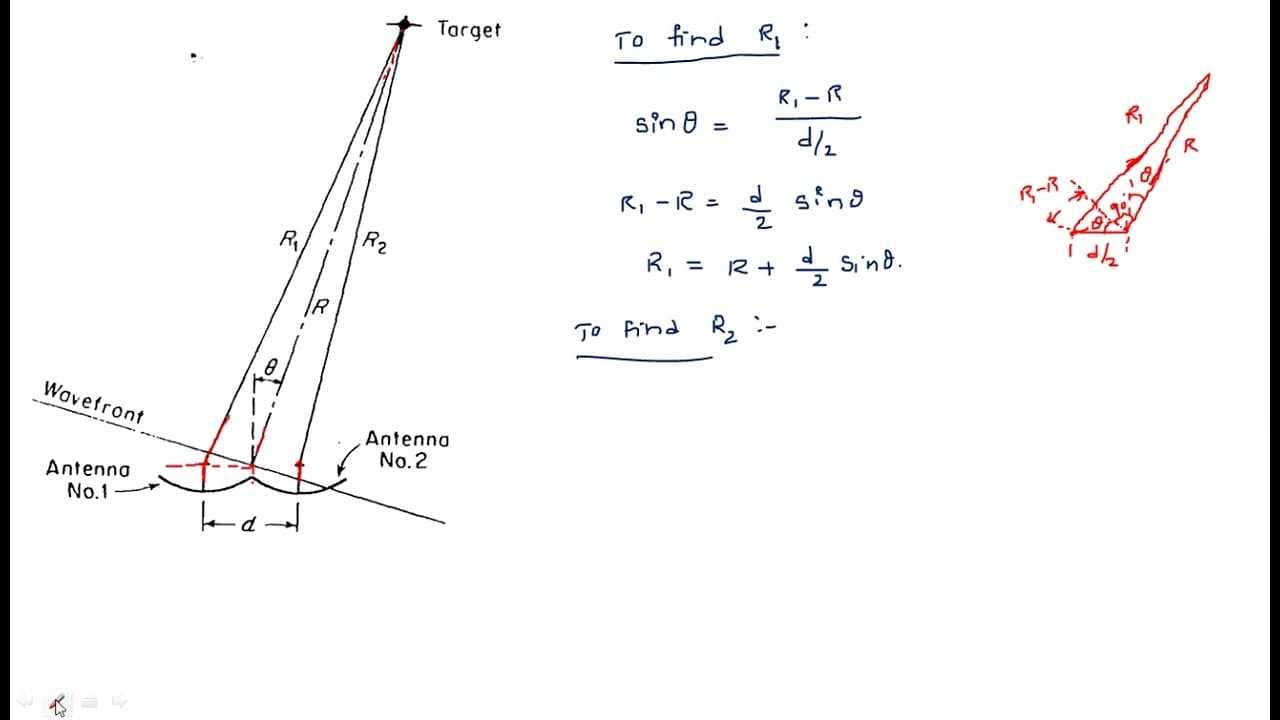
- 📡 Accurate calculation of distances R1 and R2 is fundamental for determining phase differences between antennas.
- 🎯 The concept of wavefronts is integral to this radar system, ensuring signals focus on the same target location.
- 🖐️ Trigonometric calculations play a crucial role in establishing distances and angles related to the antennas and target.
- 👣 Maintaining a phase difference of zero enhances tracking precision by ensuring antennas are oriented toward the target.
- 🖐️ Signal processing plays a vital role in interpreting phase changes to maintain proper target tracking.
Install to Summarize YouTube Videos and Get Transcripts
Explore YouTube Video Summarizer or Get YouTube Transcript Extractor
Questions & Answers
Q: What is the main purpose of phase comparison monopole stacking radar?
The primary purpose of phase comparison monopole stacking radar is to track targets efficiently by comparing the phase of signals received from two antennas. This method allows for more precise positioning and movement detection, as it utilizes the phase difference created by the target's distance from the antennas, ensuring that tracking is both accurate and reliable.
Q: How does phase comparison monopole stacking differ from amplitude comparison monopole stacking?
Unlike amplitude comparison monopole stacking radar, which relies on the amplitude of the received signals, phase comparison monopole stacking radar uses two antennas to transmit separate single pulses, focusing on the phase differences that arise from the distance to the target. This enables more effective tracking of targets by ensuring that both antennas are aligned directionally toward the target.
Q: What is the significance of the calculation of R1 and R2?
The calculations of R1 and R2 are crucial for determining the distances from each antenna to the target, which are essential in calculating the phase difference. Accurate distances allow for optimal alignment of the antennas, ensuring that phase differences are minimized to zero, which is vital for effective tracking and positioning of the radar system relative to the target.
Q: Why is it important to achieve a phase difference of zero in this radar system?
Achieving a phase difference of zero is critical because it indicates that the two antennas are perfectly aligned with the target. When the phase difference is zero, the signals received by both antennas constructively interfere, maximizing tracking accuracy. This alignment helps maintain the target's position within the radar's vicinity, allowing the system to adjust dynamically as the target moves.
Summary & Key Takeaways
-
The video discusses phase comparison monopole stacking radar, a technique that uses signals from two antennas to track a target.
-
It contrasts this method with amplitude comparison monopole stacking radar, highlighting the use of single pulses and the importance of phase difference in target tracking.
-
The speaker details the calculations for determining distances (R1 and R2) from antennas to the target, emphasizing the significance of maintaining a phase difference of zero for effective tracking.
Read in Other Languages (beta)
Share This Summary 📚
Summarize YouTube Videos and Get Video Transcripts with 1-Click
Try YouTube Summary with ChatGPT & Claude or YouTube Transcript Generator