How to Solve Polynomial Equations Using Factoring
TL;DR
To solve polynomial equations, use factoring by grouping when coefficients align, substitution for quadratic forms, and the rational zero theorem to find potential solutions. Synthetic division helps identify remaining zeros, enabling both real and imaginary solutions across various polynomial degrees.
Transcript
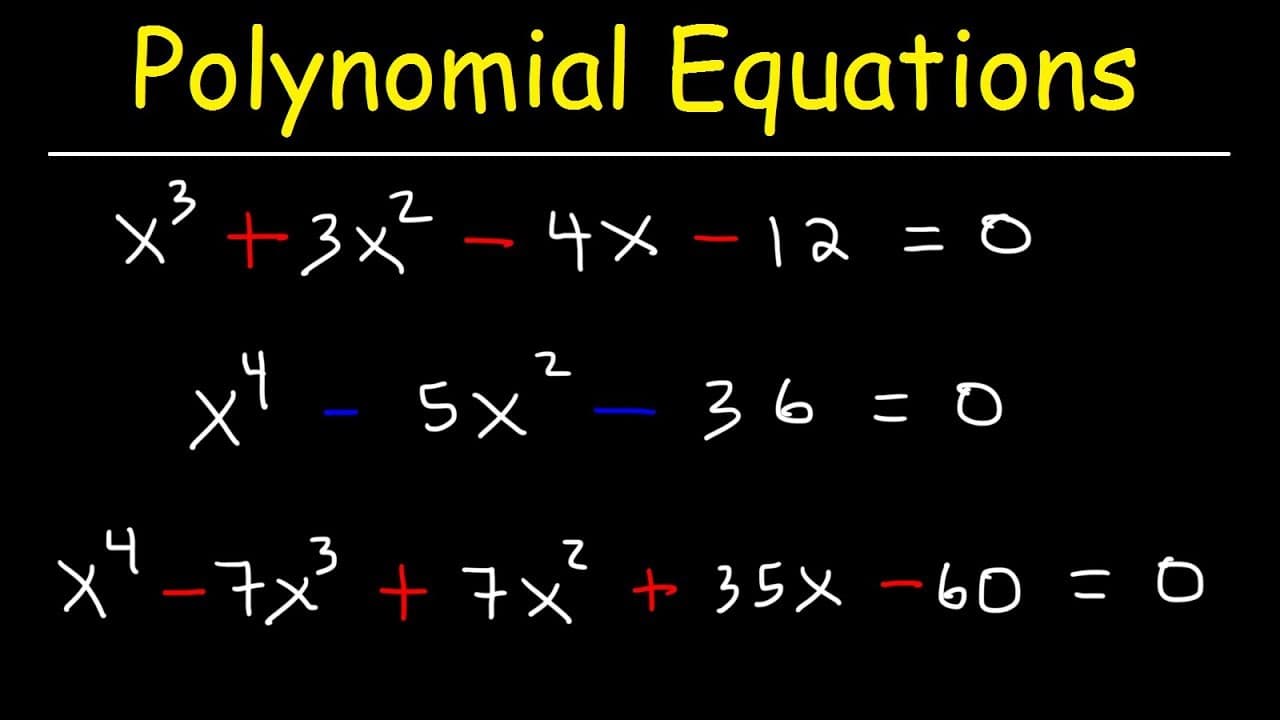
in this tutorial i'm going to focus on solving polynomial equations so let's start with this one x cubed plus 3x squared minus 4x minus 12 is equal to zero go ahead and solve this particular equation now notice that the ratio of the first two coefficients is the same as the ratio of the last two so for example one and three has the same ratio as ne... Read More
Key Insights
- 🥳 Factoring by grouping is efficient when the coefficients' ratios match.
- 💁 Substitution can be used to transform a polynomial into quadratic form for easier factoring.
- 0️⃣ The rational zero theorem helps identify possible rational solutions.
- ➗ Synthetic division is an effective method for finding the remaining zeros of a polynomial equation.
- ✋ A polynomial equation with a higher degree can have multiple real and imaginary solutions.
- 0️⃣ Factoring by grouping, substitution, and the rational zero theorem are valuable techniques in solving polynomial equations.
- ✋ Synthetic division simplifies finding zeros, especially for higher-degree polynomials.
Install to Summarize YouTube Videos and Get Transcripts
Explore YouTube Video Summarizer or Get YouTube Transcript Extractor
Questions & Answers
Q: What is the first step in solving polynomial equations using factoring by grouping?
The first step is to check if the ratio of the first two coefficients is the same as the ratio of the last two. If they match, factoring by grouping is the appropriate method to use.
Q: How do you factor a polynomial in quadratic form using substitution?
By replacing variables with simpler expressions, such as letting a = x^2, you can transform the polynomial into a trinomial with a leading coefficient of one. Then, you can factor the trinomial using traditional methods.
Q: What is the rational zero theorem and how does it help solve polynomial equations?
The rational zero theorem allows you to determine the possible rational solutions (zeros) of a polynomial equation by examining the factors of the constant term and the leading coefficient. This narrows down the search for solutions.
Q: How does synthetic division work in finding the remaining zeros of a polynomial equation?
Synthetic division is a method for dividing a polynomial by a linear divisor. By repeatedly applying synthetic division and factoring the resulting lower-degree polynomials, you can find all the zeros of the original equation.
Summary & Key Takeaways
-
Factoring by grouping is a fast and efficient method for solving polynomial equations when the ratios of the coefficients match.
-
The substitution method can be used to factor polynomials in quadratic form by replacing variables with simpler expressions.
-
The rational zero theorem helps identify possible rational solutions, and synthetic division can be used to find the remaining zeros.
Read in Other Languages (beta)
Share This Summary 📚
Summarize YouTube Videos and Get Video Transcripts with 1-Click
Try YouTube Summary with ChatGPT & Claude or YouTube Transcript Generator
Explore More Summaries from The Organic Chemistry Tutor 📚


Summarize YouTube Videos and Get Video Transcripts with 1-Click
Try YouTube Summary with ChatGPT & Claude or YouTube Transcript Generator