Lecture 10: Survey of Difficulties with Ax = b
TL;DR
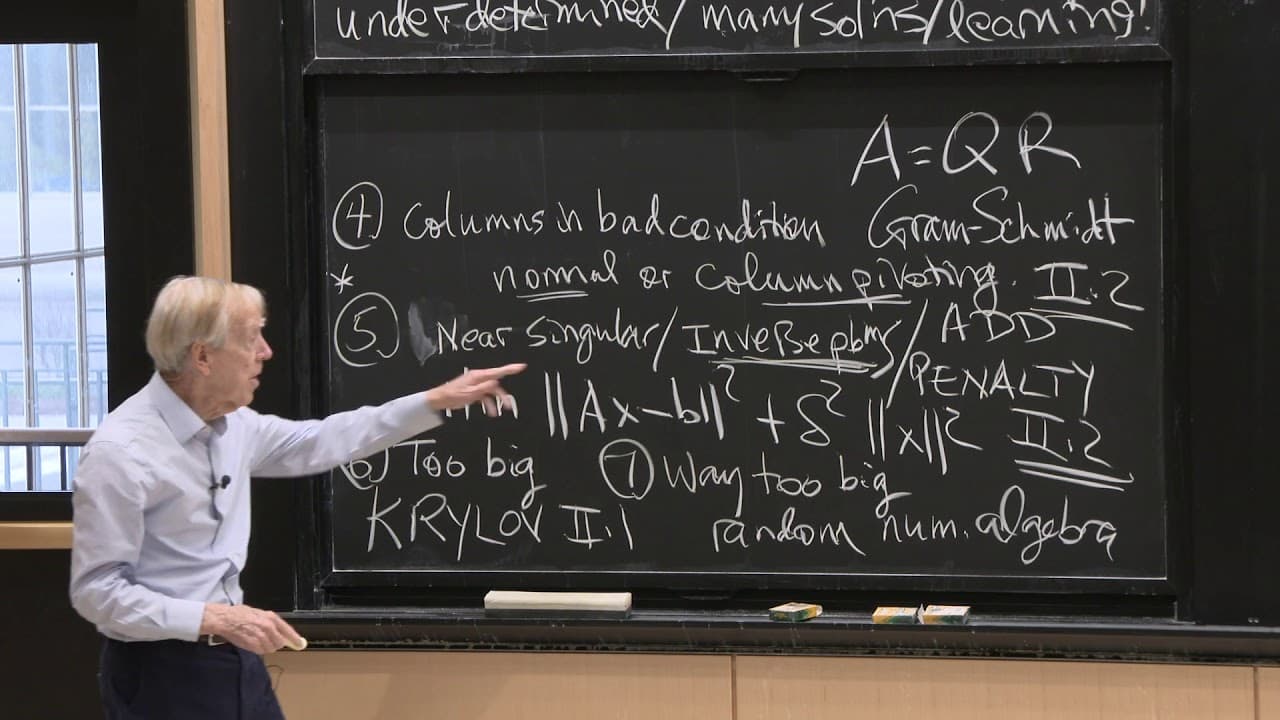
This lecture discusses various numerical linear algebra methods, including solving linear equations, least squares problems, and the pseudo inverse.
Transcript
The following content is provided under a Creative Commons license. Your support will help MIT open courseware continue to offer high quality educational resources for free. To make a donation or to view additional materials from hundreds of MIT courses, visit MIT OpenCourseWare at ocw.mit.edu. PROFESSOR: Let's go. So if you want to know the subjec... Read More
Key Insights
- ❓ Different categories of linear equations require different methods and techniques for solving them.
- 🖐️ The condition number of a matrix plays a crucial role in determining the solvability of a linear equation.
- ◾ The use of penalized least squares with a small penalty term can approach the behavior of the pseudo inverse.
- 🍵 Randomized linear algebra is an approach for handling large matrices when direct computation is not feasible.
Install to Summarize YouTube Videos and Get Transcripts
Explore YouTube Video Summarizer or Get YouTube Transcript Extractor
Questions & Answers
Q: What is the main problem addressed in this lecture?
The main problem addressed in this lecture is solving the linear equation Ax = b, where A is a matrix and x, b are vectors.
Q: How does the lecture classify different cases of linear equations?
The lecture categorizes different cases based on the properties of the matrix A, such as square matrices, over-determined and under-determined systems, and nearly singular matrices.
Q: What is the significance of the condition number in solving linear equations?
The condition number, which is the ratio of the largest to smallest singular value of A, determines the difficulty of solving the linear equation. Lower condition numbers indicate easier solvability.
Q: How is the pseudo inverse used in solving nearly singular matrices?
In nearly singular matrices where the inverse is unreasonably large, the lecture suggests using the pseudo inverse as a solution. The pseudo inverse is a regularization technique that balances the problem and avoids numerical instability.
Q: What are some methods discussed for solving under-determined systems?
For under-determined systems where there are more unknowns than equations, minimum norm solutions such as L2 or L1 norms are considered. The lecture also mentions the topic of deep learning in under-determined systems.
Q: What is the significance of Gram-Schmidt orthogonalization?
Gram-Schmidt is discussed as a method to orthogonalize columns of a matrix, particularly when the columns are nearly dependent. It is a useful technique in various applications in linear algebra and is connected to other concepts in course 6.
Summary & Key Takeaways
-
The lecture introduces the problem of solving the equation Ax = b and explores different scenarios that arise depending on the properties of the matrix A and vector b.
-
Different cases discussed include square matrices, over-determined systems, under-determined systems, and nearly singular matrices.
-
The lecture highlights various methods to solve these different scenarios, such as normal elimination, least squares, and the use of the pseudo inverse.
Read in Other Languages (beta)
Share This Summary 📚
Summarize YouTube Videos and Get Video Transcripts with 1-Click
Try YouTube Summary with ChatGPT & Claude or YouTube Transcript Generator
Explore More Summaries from MIT OpenCourseWare 📚


Summarize YouTube Videos and Get Video Transcripts with 1-Click
Try YouTube Summary with ChatGPT & Claude or YouTube Transcript Generator