RL and RLC circuits | Low pass & High pass | PDC | Pulse Digital Circuits | Lec-19
TL;DR
The video explains the design and functionality of low pass and high pass RL circuits compared to RC circuits.
Transcript
hi everyone in this video I am going to introduce a different circuit design like RL circuit previously we have seen RC circuits like low pass RC circuit and high pass RC circuit but in this video I am saying instead of capacitor we can also use an inductor to make a low pass or high pass circuitry okay that means the filter can be made up of any o... Read More
Key Insights
- 😘 RL circuits can replace capacitors with inductors to create low and high pass filters, similar to RC circuit configurations.
- ✋ Low pass RL circuits capture low frequencies, while high pass configurations capture high frequencies, showcasing their filtering capabilities.
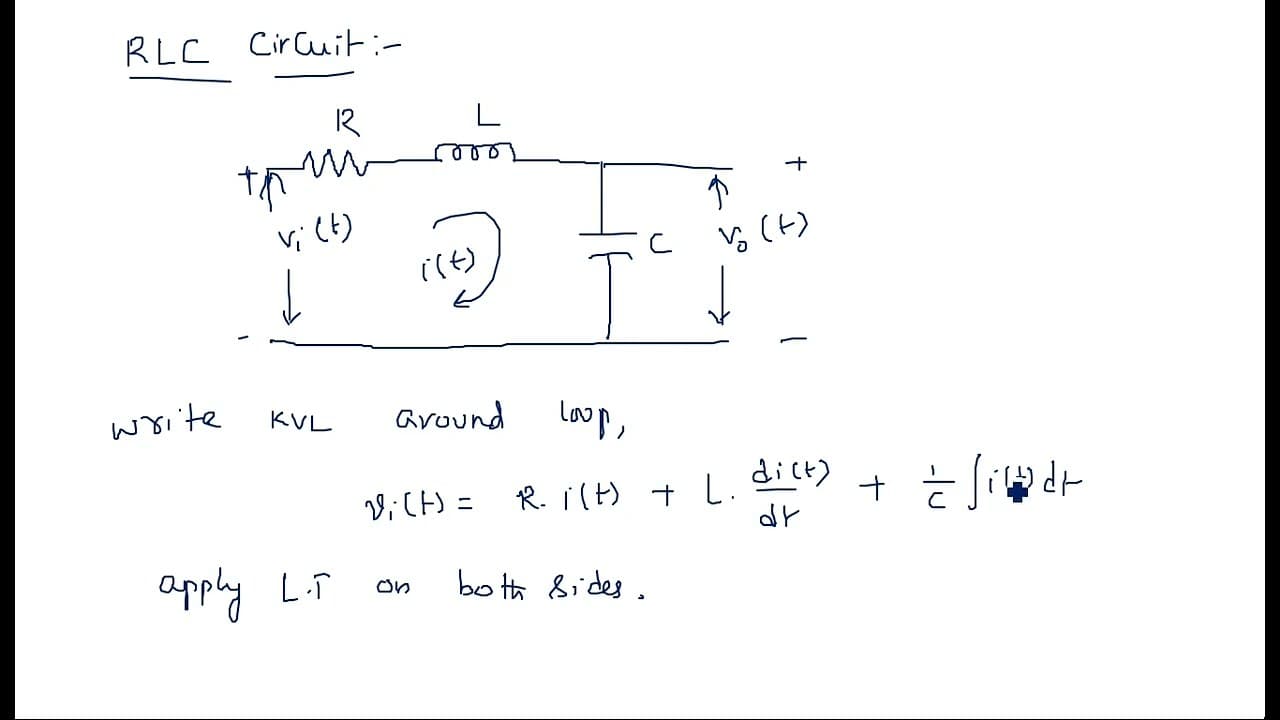
- 🈸 RLC circuits combine the properties of resistors, inductors, and capacitors, enhancing application versatility in filtering and resonance.
- 🈸 Resonance in RLC circuits enables specific frequency selection, which is crucial in many electronic applications.
- ⚾ Output behaviors of RLC circuits vary significantly based on damping conditions, affecting applications in various electronic systems.
- ⌛ Visual representations of input and output responses help clarify how RLC circuits react over time with different damping levels.
- 👻 Understanding circuit behavior under step input allows for designing circuits that perform optimally for specific applications, particularly in oscillators and filters.
Install to Summarize YouTube Videos and Get Transcripts
Explore YouTube Video Summarizer or Get YouTube Transcript Extractor
Questions & Answers
Q: What is the difference between low pass and high pass RL circuits?
Low pass RL circuits consist of an inductor followed by a resistor, allowing low frequency signals to pass while attenuating higher frequencies. In contrast, high pass RL circuits have a resistor followed by an inductor, enabling high frequency signals to be transmitted while blocking low frequencies.
Q: How does the configuration of RLC circuits impact their functionality?
RLC circuits incorporate resistors, inductors, and capacitors, and their specific arrangement determines their filtering characteristics. The interactions between these components can create resonant frequencies, affecting both the magnitude and phase of output signals in response to various inputs.
Q: What is the significance of damping in RLC circuits?
Damping affects the oscillatory behavior of RLC circuits. Overdamped circuits do not oscillate and stabilize slowly, while critically damped circuits also avoid oscillation but stabilize quicker. Underdamped circuits oscillate with diminishing amplitude, requiring specific conditions for such behavior.
Q: How do you determine the damping conditions for an RLC circuit?
Damping conditions can be derived from the relationship R/(2√(L/C)). Depending on whether R is greater than, equal to, or less than 2√(L/C), the circuit is classified as overdamped, critically damped, or underdamped, respectively, influencing its output response.
Summary & Key Takeaways
-
The video introduces the concept of RL circuits, explaining how they can function as low pass and high pass filters, similar to RC circuits.
-
It outlines the distinctions between low pass and high pass configurations in RL circuits, specifying the arrangement of inductors and resistors.
-
The discussion includes RLC circuits, focusing on their behavior, resonant qualities, and applications in filtering and oscillatory systems.
Read in Other Languages (beta)
Share This Summary 📚
Summarize YouTube Videos and Get Video Transcripts with 1-Click
Try YouTube Summary with ChatGPT & Claude or YouTube Transcript Generator