L9.7 Nuclear Physics: Fission
TL;DR
Nuclear fission is a process in which heavy nuclei break apart into smaller daughter nuclei and can be induced or occur spontaneously, leading to a release of energy.
Transcript
MARKUS KLUTE: Welcome back to 8.701. So in this lecture, we talk about nuclear fission. Already seen the process when we discussed empirical mass formula. Nuclear fission occurs in very heavy nuclei, as you can see in this plot here, fission processes, and this part of the spectrum. But what happens, and what can happen spontaneously, is that the p... Read More
Key Insights
- ❣️ Nuclear fission is the process of breaking heavy nuclei into smaller daughter nuclei.
- 👪 Fission can occur spontaneously or be induced by bringing a parent nucleus above its activation energy.
- 🖐️ Neutrons play a vital role in initiating and sustaining the fission process.
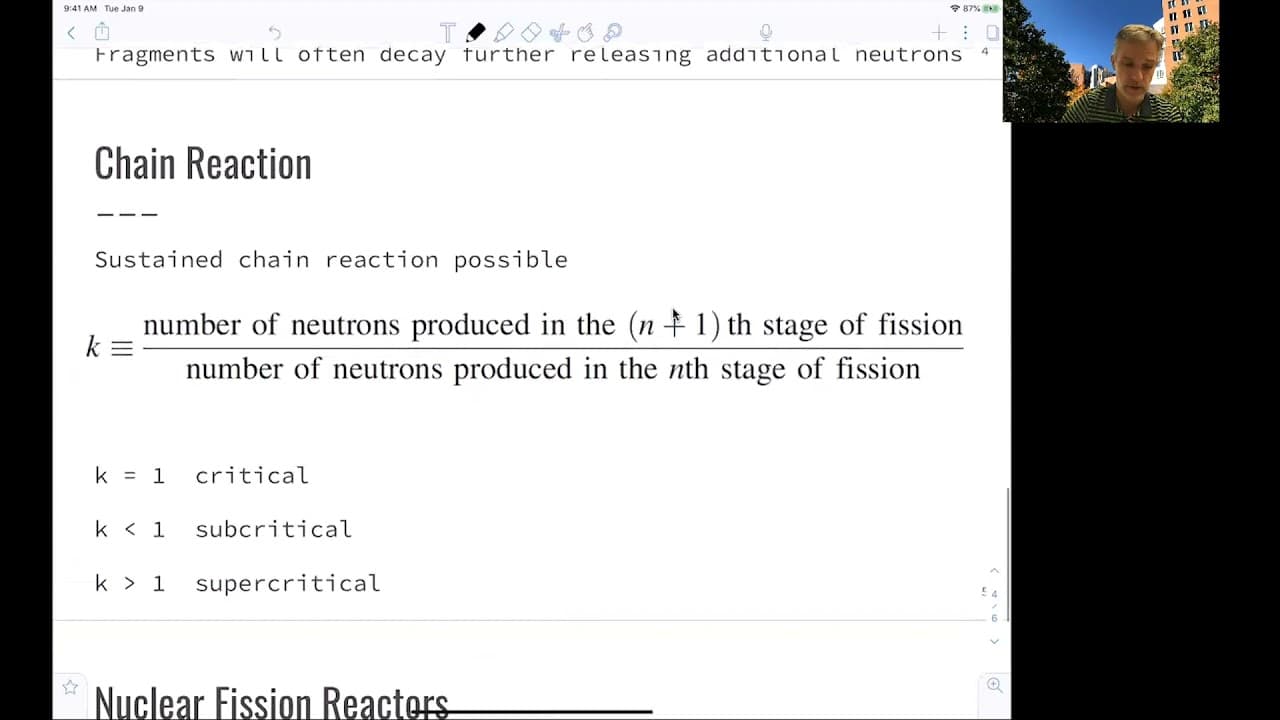
- ⛓️ The number of neutrons produced in each stage determines whether a chain reaction will occur.
- ⛽ Nuclear fission reactors utilize fuel elements, moderator materials, and retractable rods to control the fission process.
- 😘 Thermal reactors, which use low-energy neutrons and uranium fuel, are one type of nuclear fission reactor.
- ❣️ Slowing down neutrons is important for efficient fission reactions, and materials like heavy water can be used as moderators.
Install to Summarize YouTube Videos and Get Transcripts
Explore YouTube Video Summarizer or Get YouTube Transcript Extractor
Questions & Answers
Q: What is nuclear fission?
Nuclear fission is the process in which heavy nuclei break apart into smaller daughter nuclei, releasing energy and additional neutrons.
Q: Can nuclear fission occur spontaneously?
Yes, some heavy nuclei can naturally undergo the process of fission without external interference.
Q: What is the role of neutrons in nuclear fission?
Neutrons play a crucial role in nuclear fission as they can be absorbed by a parent nucleus, causing excitation and leading to the fission process.
Q: How does nuclear fission lead to a chain reaction?
If the number of neutrons produced in each stage of the fission process is greater than the previous stage, a self-sustained chain reaction can occur.
Summary & Key Takeaways
-
Nuclear fission is the process of breaking apart heavy nuclei into smaller daughter nuclei and can result in the release of additional neutrons.
-
Fission can occur spontaneously or be induced by bringing a parent nuclei above its activation energy.
-
The number of neutrons produced in each stage of the fission process determines whether a self-sustained chain reaction will occur.
Read in Other Languages (beta)
Share This Summary 📚
Summarize YouTube Videos and Get Video Transcripts with 1-Click
Try YouTube Summary with ChatGPT & Claude or YouTube Transcript Generator
Explore More Summaries from MIT OpenCourseWare 📚



Summarize YouTube Videos and Get Video Transcripts with 1-Click
Try YouTube Summary with ChatGPT & Claude or YouTube Transcript Generator