Lecture 11: The Lebesgue Integral of a Nonnegative Function and Convergence Theorems
TL;DR
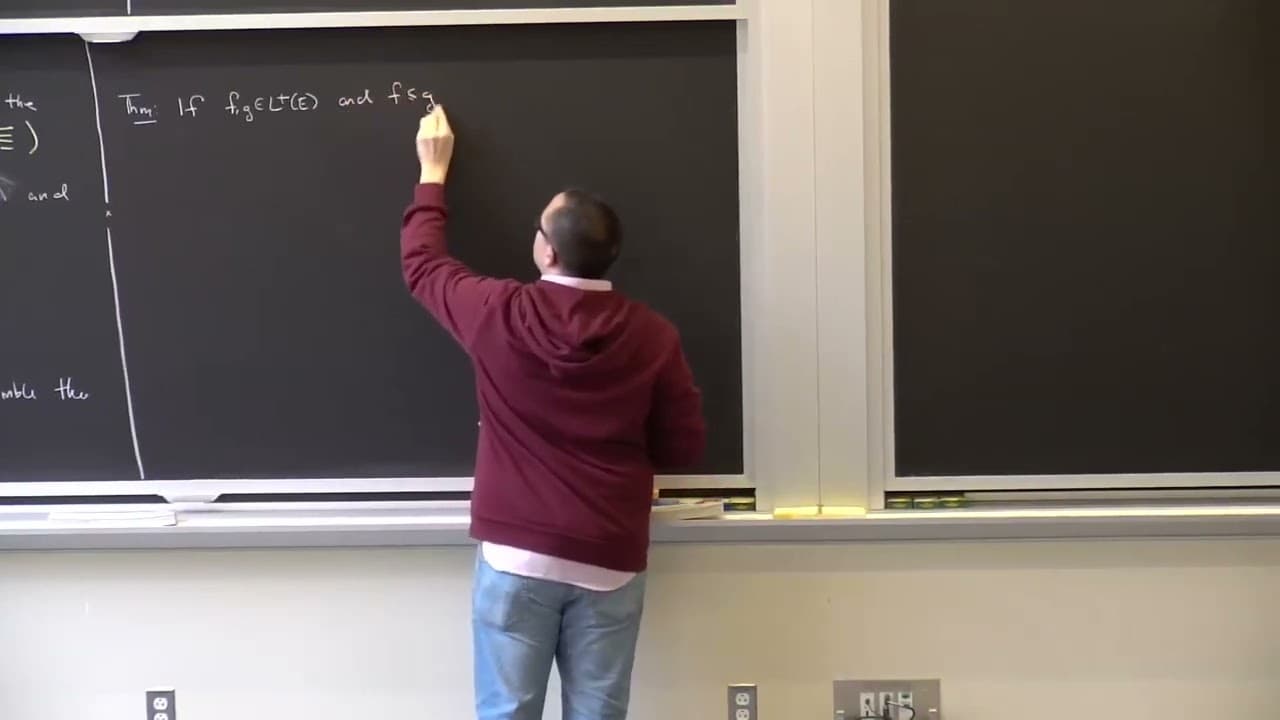
Lebesgue integration allows for the calculation of integrals for non-negative measurable functions. The integral is linear and can be computed using sequences of simple functions. The monotone convergence theorem, Fatou's lemma, and the dominated convergence theorem provide useful tools for analyzing the convergence of integrals.
Transcript
[SQUEAKING] [RUSTLING] [CLICKING] CASEY RODRIGUEZ: We defined the Lebesgue integral for simple functions, which have this canonical representation as a finite linear combination of indicator functions on sets which are pairwise disjoint and whose union gives me E. We defined their integral-- the integral of phi was defined to be the sum from j equa... Read More
Key Insights
- 👻 Lebesgue integration allows for the integration of a wider class of functions compared to Riemann integration.
- 💻 The integral of a non-negative measurable function can be computed using sequences of simple functions that approximate the function.
- 🔨 The monotone convergence theorem, Fatou's lemma, and the dominated convergence theorem are powerful theorems that provide tools for analyzing the convergence of integrals.
Install to Summarize YouTube Videos and Get Transcripts
Explore YouTube Video Summarizer or Get YouTube Transcript Extractor
Questions & Answers
Q: What is the difference between Riemann and Lebesgue integration?
Riemann integration is limited to functions that are bounded and have a finite number of discontinuities. Lebesgue integration allows for the integration of a wider class of functions, including functions with unbounded and infinite values, as well as functions with a countable number of discontinuities.
Q: How is the Lebesgue integral of a non-negative measurable function defined?
The Lebesgue integral of a non-negative measurable function is defined as the supremum (the smallest upper bound) of the integrals of all simple functions that are less than or equal to the function, where a simple function is a finite linear combination of indicator functions.
Q: What is the monotone convergence theorem?
The monotone convergence theorem states that if a sequence of non-negative measurable functions is increasing and converges pointwise to a limit function, then the integral of the limit function is equal to the limit of the integrals of the sequence.
Q: What is Fatou's lemma?
Fatou's lemma states that if a sequence of non-negative measurable functions converges pointwise to a limit function, then the integral of the limit function is less than or equal to the limit of the integrals of the sequence.
Q: How can the dominated convergence theorem be used to analyze the convergence of integrals?
The dominated convergence theorem states that if a sequence of functions is dominated by an integrable function, and the sequence converges pointwise to a limit function, then the integral of the limit function is equal to the limit of the integrals of the sequence. This theorem provides a useful tool for determining when the limit of a sequence of integrals can be computed by first taking the limit of the function and then integrating.
Summary & Key Takeaways
-
Lebesgue integration allows for the calculation of integrals for non-negative measurable functions using sequences of simple functions.
-
The integral is linear, meaning that the integral of the sum of two functions is equal to the sum of the integrals.
-
The monotone convergence theorem states that if a sequence of non-negative functions is increasing and converges pointwise to a limit function, then the integral of the limit function is equal to the limit of the integrals of the sequence.
-
Fatou's lemma states that if a sequence of non-negative functions converges pointwise to a limit function, then the integral of the limit function is less than or equal to the limit of the integrals of the sequence.
-
The dominated convergence theorem states that if a sequence of functions is dominated by an integrable function, meaning that the absolute value of each function is less than or equal to the integrable function, and the sequence converges pointwise to a limit function, then the integral of the limit function is equal to the limit of the integrals of the sequence.
Read in Other Languages (beta)
Share This Summary 📚
Summarize YouTube Videos and Get Video Transcripts with 1-Click
Try YouTube Summary with ChatGPT & Claude or YouTube Transcript Generator
Explore More Summaries from MIT OpenCourseWare 📚


Summarize YouTube Videos and Get Video Transcripts with 1-Click
Try YouTube Summary with ChatGPT & Claude or YouTube Transcript Generator