L06.2 Variance
TL;DR
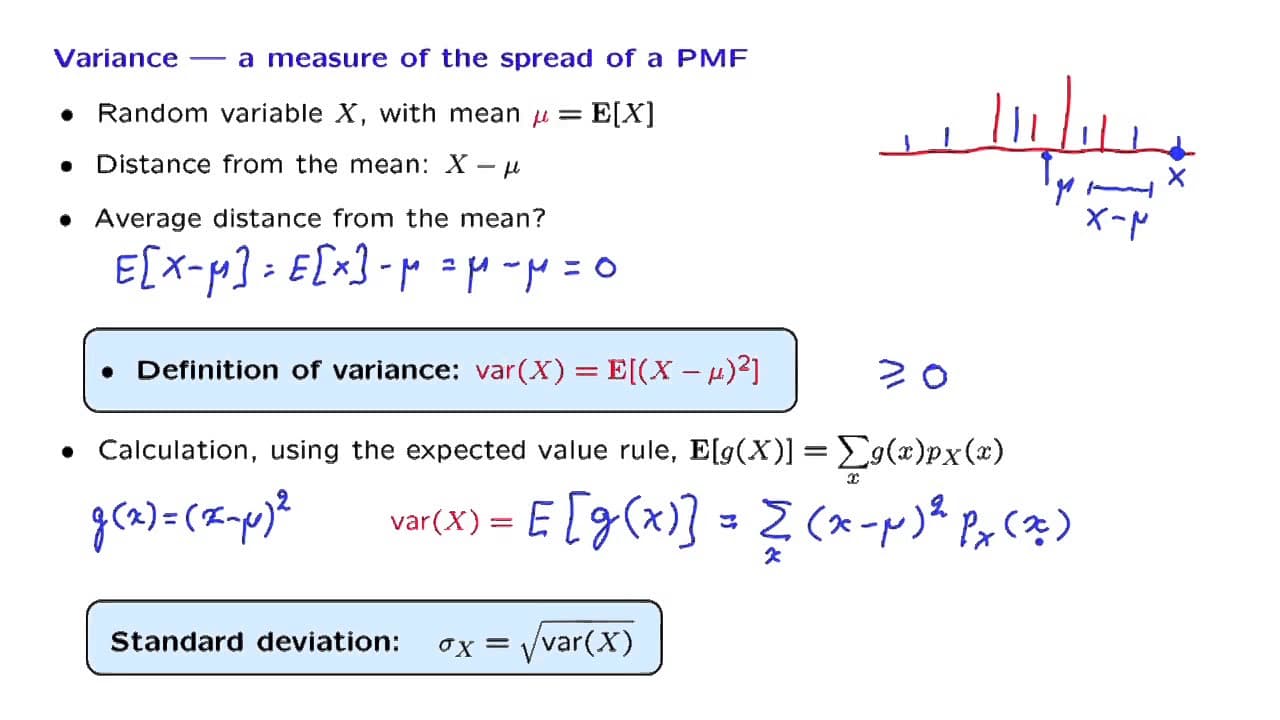
Variance measures the spread of a random variable's distribution, and it is calculated as the average of the squared distance from the mean.
Transcript
We have introduced the concept of expected value or mean, which tells us the average value of a random variable. We will now introduce another quantity, the variance, which quantifies the spread of the distribution of a random variable. So consider a random variable with a given PMF, for example like the PMF shown in this diagram. And consider anot... Read More
Key Insights
- ❓ Variance quantifies the spread of a random variable's distribution.
- 🚱 The variance is always non-negative.
- ❎ The average value of the distance from the mean is uninformative, so the average of the squared distance is used instead.
- 🏋️ Variance can be computed by summing the squared distance from the mean for each numerical value of the random variable, weighted by their probabilities.
- 🪜 Adding a constant to a random variable does not change its variance, while multiplying a random variable by a constant multiplies its variance by the squared value of the constant.
- 🫚 The standard deviation, which is the square root of the variance, is a more intuitive measure of spread as it has the same units as the random variable.
Install to Summarize YouTube Videos and Get Transcripts
Explore YouTube Video Summarizer or Get YouTube Transcript Extractor
Questions & Answers
Q: What does variance measure and how is it calculated?
Variance measures the spread of a random variable's distribution. It is calculated as the average of the squared distance from the mean.
Q: How does the spread of two random variables with the same mean but different distribution affect their variances?
The second random variable with a more spread-out distribution will have a higher variance compared to the first random variable, even if they have the same mean.
Q: Why is the average value of the distance from the mean uninformative?
The average value of the distance from the mean is always zero, indicating that, on average, outcomes are equally likely to be below or above the mean.
Q: What is the difference between variance and standard deviation?
Variance is the average of the squared distance from the mean, while the standard deviation is the square root of the variance. The standard deviation has the same units as the random variable and represents the width of the distribution.
Summary & Key Takeaways
-
Expected value or mean tells us the average value of a random variable, while variance quantifies the spread of its distribution.
-
Variance is always non-negative and is calculated as the expected value of the squared distance from the mean.
-
The square root of the variance is called the standard deviation, which captures the width of the distribution.
Read in Other Languages (beta)
Share This Summary 📚
Summarize YouTube Videos and Get Video Transcripts with 1-Click
Try YouTube Summary with ChatGPT & Claude or YouTube Transcript Generator
Explore More Summaries from MIT OpenCourseWare 📚


Summarize YouTube Videos and Get Video Transcripts with 1-Click
Try YouTube Summary with ChatGPT & Claude or YouTube Transcript Generator