What Is a Decision Tree and How Does It Classify Data?
TL;DR
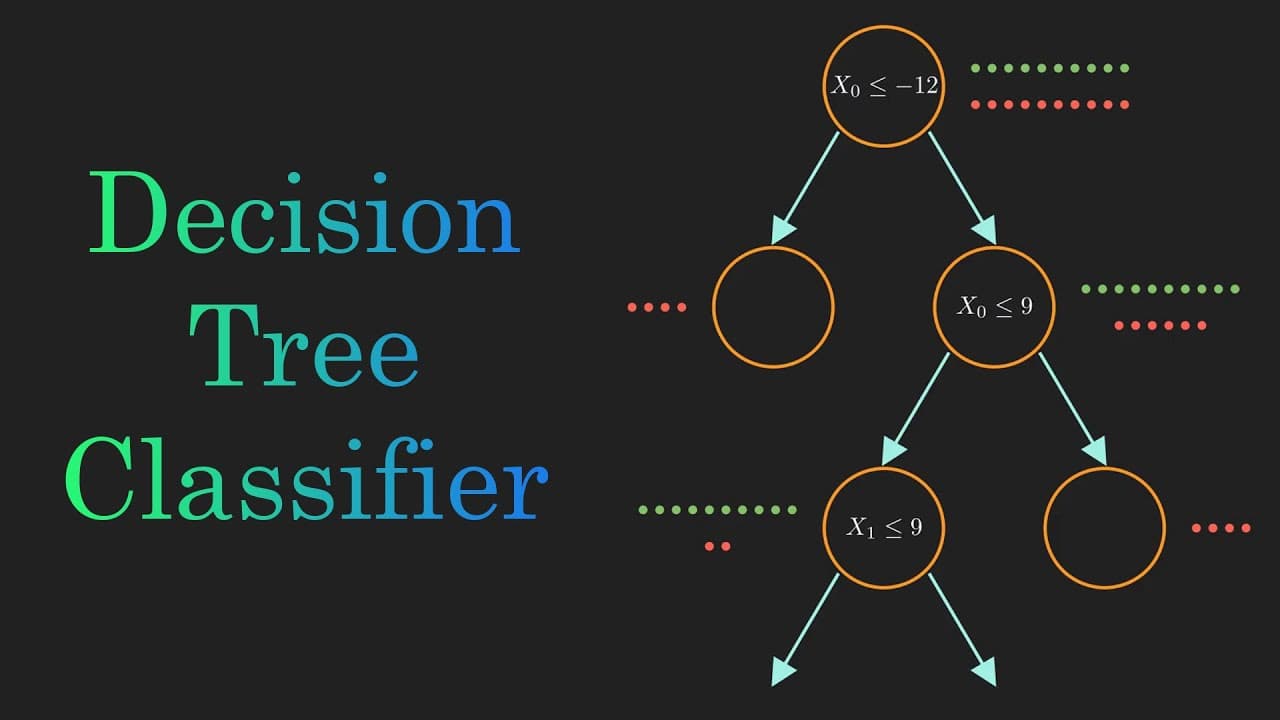
A decision tree is a binary tree that recursively splits data based on feature conditions to create pure leaf nodes for classification. It classifies new data points by traversing from the root through decision nodes until reaching a leaf node, which determines the class. The tree's optimal splits are chosen based on information gain, calculated using entropy.
Transcript
hello people from the future welcome to normalized nerd today i will explain the concept behind decision trees to be more precise classification using decision trees as you know me obviously i will discuss the intuition and the underlying math behind training a decision tree and this video will contain a lot of visualizations so i hope you are supe... Read More
Key Insights
- 🌲 Decision trees are binary trees used for classification, recursively splitting datasets until pure leaf nodes are formed.
- 💁 The decision tree algorithm is considered a form of machine learning because it learns optimal splitting conditions and thresholds.
- 👋 Information gain, calculated using entropy, is used to determine the best splits in a decision tree.
- 👋 Greedy search in decision tree training selects the current best split based on information gain, without backtracking or changing previous splits.
- 🌲 Visualizations can help understand the decision boundaries created by decision tree classifiers.
- ✊ Decision trees can handle non-linearly separable classes, showcasing their power compared to linear classifiers.
- 😥 Leaf nodes in a decision tree can be impure, requiring majority voting to determine the class of new data points.
Install to Summarize YouTube Videos and Get Transcripts
Explore YouTube Video Summarizer or Get YouTube Transcript Extractor
Questions & Answers
Q: How does a decision tree classify new data points?
A decision tree traverses from the root node, checking conditions at each node to determine which child node to follow. The leaf node reached at the end determines the class of the new data point.
Q: What happens when a leaf node is not pure?
In cases where leaf nodes are not purely one class, a majority voting approach is used. The majority class of the leaf node is assigned as the predicted class for the new data point.
Q: How does a decision tree choose which features and thresholds to split on?
The decision tree maximizes information gain to determine the optimal splits. Information gain is calculated using entropy, a measure of uncertainty in a state. The model compares all possible splits and selects the one with the highest information gain.
Q: Is the decision tree algorithm considered a form of machine learning?
While a decision tree is essentially a set of if statements, it is considered machine learning because it learns the correct conditions and thresholds for optimal data splitting. The model uses information gain and entropy to make intelligent decisions.
Key Insights:
- Decision trees are binary trees used for classification, recursively splitting datasets until pure leaf nodes are formed.
- The decision tree algorithm is considered a form of machine learning because it learns optimal splitting conditions and thresholds.
- Information gain, calculated using entropy, is used to determine the best splits in a decision tree.
- Greedy search in decision tree training selects the current best split based on information gain, without backtracking or changing previous splits.
- Visualizations can help understand the decision boundaries created by decision tree classifiers.
- Decision trees can handle non-linearly separable classes, showcasing their power compared to linear classifiers.
- Leaf nodes in a decision tree can be impure, requiring majority voting to determine the class of new data points.
- Decision tree algorithms can be implemented from scratch using code, allowing customization and application to various datasets.
Summary & Key Takeaways
-
Decision trees are binary trees that recursively split datasets until pure leaf nodes are formed.
-
The video demonstrates a trained decision tree for a dataset with two features, x0 and x1.
-
Decision nodes contain conditions for data splitting, while leaf nodes help classify new data points.
Read in Other Languages (beta)
Share This Summary 📚
Summarize YouTube Videos and Get Video Transcripts with 1-Click
Try YouTube Summary with ChatGPT & Claude or YouTube Transcript Generator
Explore More Summaries from Normalized Nerd 📚
Summarize YouTube Videos and Get Video Transcripts with 1-Click
Try YouTube Summary with ChatGPT & Claude or YouTube Transcript Generator