12.2.1 Procedures
TL;DR
High-level languages provide the abstraction of procedures, which are sequences of instructions that perform specific tasks, hiding their implementation details.
Transcript
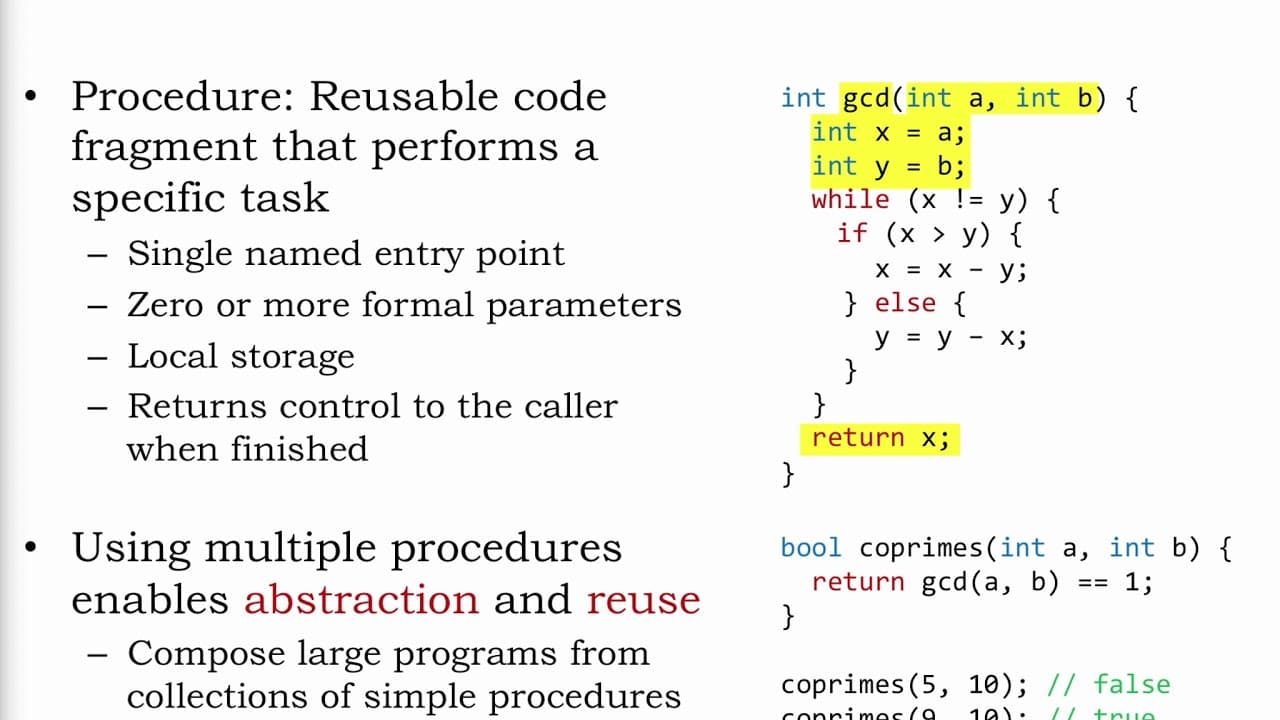
One of the most useful abstractions provided by high-level languages is the notion of a procedure or subroutine, which is a sequence of instructions that perform a specific task. A procedure has a single named entry point, which can be used to refer to the procedure in other parts of the program. In the example here, this code is defining the GCD p... Read More
Key Insights
- 😥 Procedures in high-level languages are abstractions that provide a named entry point and allow for encapsulating complex computations.
- 😑 Procedure calls are expressions that pass arguments to the formal parameters of a procedure, allowing for code reuse and modularity.
- 😑 Libraries in high-level languages offer a collection of pre-built procedures or "black boxes" that provide various functionalities for easier and more efficient programming.
- 🤙 The procedural abstraction is a fundamental concept in object-oriented languages, where procedures are encapsulated within objects called methods.
- 🥺 Inlining procedures can lead to increased code size and is not practical for lengthy procedures or recursive calls.
- 🤙 Linking to procedures involves having a single copy of the procedure code and using a calling convention to store argument values and return addresses.
- 🤙 A calling convention specifies where to store argument values during procedure calls and where the procedure should store the return value.
Install to Summarize YouTube Videos and Get Transcripts
Explore YouTube Video Summarizer or Get YouTube Transcript Extractor
Questions & Answers
Q: What is a procedure in high-level languages?
A procedure is a sequence of instructions that performs a specific task and can be referenced in other parts of the program. It has a named entry point, formal parameters, and can return a value or have side effects.
Q: How are procedures invoked in high-level languages?
Procedures are invoked through a procedure call, where the name of the procedure is followed by a list of values called arguments. These arguments are matched with the formal parameters of the procedure, and their values are used during the execution of the procedure.
Q: What is the purpose of the procedural abstraction?
The procedural abstraction hides the implementation details of a procedure, making its functionality available as a "black box" to other parts of the program. This allows for the encapsulation of complex computations, promoting code reusability and modular design.
Q: What are libraries in high-level languages?
Libraries are collections of pre-built procedures that come with high-level languages. They provide a wide range of functionality, such as arithmetic operations, data manipulation, file input/output, and more. Libraries serve as ready-made "black boxes" that programmers can utilize in their programs.
Summary & Key Takeaways
-
Procedures in high-level languages are abstractions that perform specific tasks and have a named entry point, formal parameters, and local variables. They can return a value or have side effects.
-
The GCD procedure is shown as an example, being invoked by the COPRIMES procedure to compute the greatest common divisor of two numbers.
-
High-level languages come with pre-built procedures or libraries that provide a wide range of functionality, making programming easier and more efficient.
Read in Other Languages (beta)
Share This Summary 📚
Summarize YouTube Videos and Get Video Transcripts with 1-Click
Try YouTube Summary with ChatGPT & Claude or YouTube Transcript Generator
Explore More Summaries from MIT OpenCourseWare 📚


Summarize YouTube Videos and Get Video Transcripts with 1-Click
Try YouTube Summary with ChatGPT & Claude or YouTube Transcript Generator