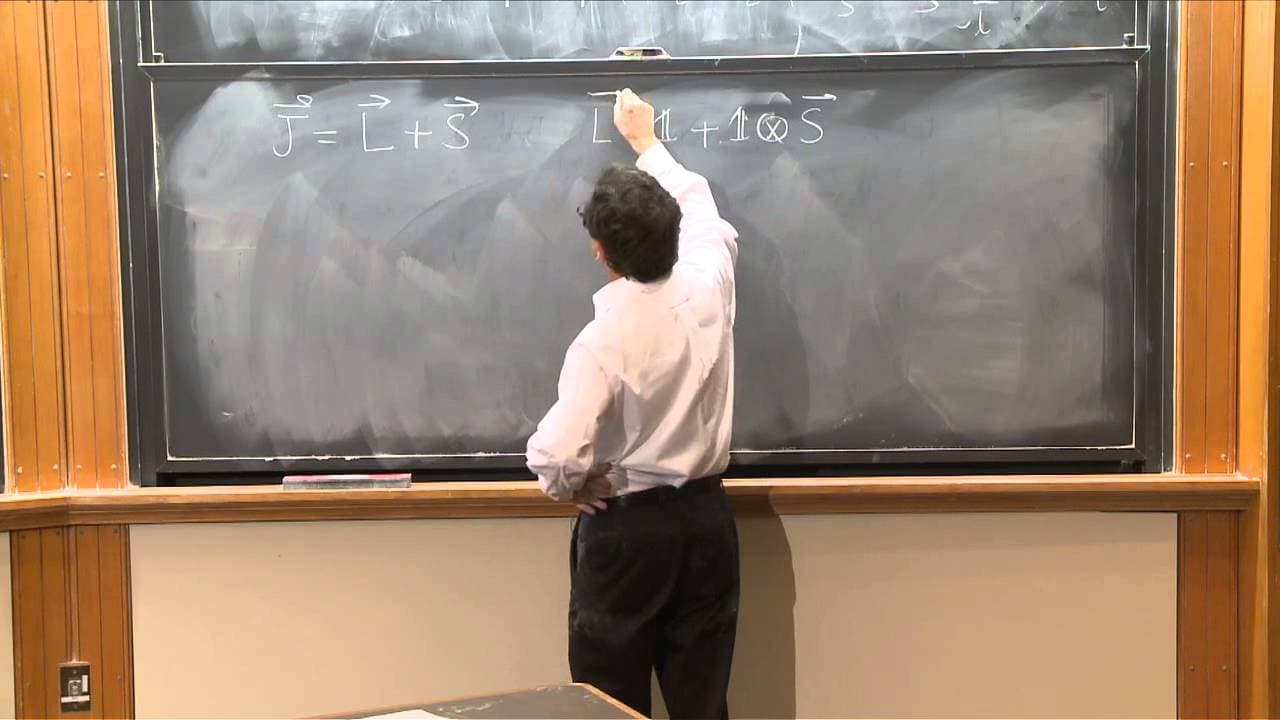
24. Addition of Angular Momentum
TL;DR
Spin-Orbit Coupling is a small correction to the hydrogen atom's energy spectrum caused by the interaction between the electron spin and its orbital motion.
Transcript
The following content is provided under a Creative Commons license. Your support will help MIT OpenCourseWare continue to offer high quality educational resources for free. To make a donation or to view additional materials from hundreds of MIT courses, visit MIT OpenCourseWare at ocs.mit.edu. PROFESSOR: Today we have plenty to do. We really begin ... Read More
Key Insights
- 🫀 Spin-orbit coupling describes the interaction between the electron's spin and its orbital motion in the hydrogen atom.
- 🫡 The Feynman-Hellman theorem is a useful tool in perturbation theory to calculate the rate of change of energy with respect to a parameter in the Hamiltonian.
- 🥺 The hydrogen atom's energy levels can be described by the addition of angular momenta, leading to the formation of multiplets.
Install to Summarize YouTube Videos and Get Transcripts
Explore YouTube Video Summarizer or Get YouTube Transcript Extractor
Questions & Answers
Q: How does the electron's magnetic dipole moment interact with the proton in the hydrogen atom?
The electron's motion around the proton creates a magnetic field, to which the electron's magnetic dipole moment responds. This interaction is known as spin-orbit coupling.
Q: How does the Feynman-Hellman theorem relate to perturbation theory?
The Feynman-Hellman theorem provides a way to calculate the rate of change of the energy eigenvalues with respect to a parameter in the Hamiltonian. It is useful in perturbation theory to determine how small perturbations affect the energy spectrum of a system.
Q: What is the significance of the fine structure in the hydrogen atom?
The fine structure represents the small correction to the energy spectrum of the hydrogen atom due to spin-orbit coupling. Although the correction is small, it is important in understanding the behavior of atomic spectra.
Q: How can the addition of angular momentum be used to describe the hydrogen atom's energy levels?
By considering the addition of the angular momentum of the electron's orbital motion and its spin, the hydrogen atom's energy levels can be organized into multiplets. These multiplets represent different total angular momentum states and can help explain the splitting of the energy levels due to spin-orbit coupling.
Summary & Key Takeaways
-
Spin-orbit coupling describes the interaction between the electron's spin and its orbit around the nucleus in the hydrogen atom.
-
The Feynman-Hellman theorem is used to calculate the rate of change in energy with respect to a small perturbation in the Hamiltonian.
-
The Hamiltonian for spin-orbit coupling is given by delta H = (ge/2mc) * S .dot. L, where ge is the electron's g-factor.
-
The energy correction due to spin-orbit coupling is small, on the order of 1/137^2 (1/19,000) times the ground state energy of the hydrogen atom.
Read in Other Languages (beta)
Share This Summary 📚
Summarize YouTube Videos and Get Video Transcripts with 1-Click
Try YouTube Summary with ChatGPT & Claude or YouTube Transcript Generator
Explore More Summaries from MIT OpenCourseWare 📚


Summarize YouTube Videos and Get Video Transcripts with 1-Click
Try YouTube Summary with ChatGPT & Claude or YouTube Transcript Generator