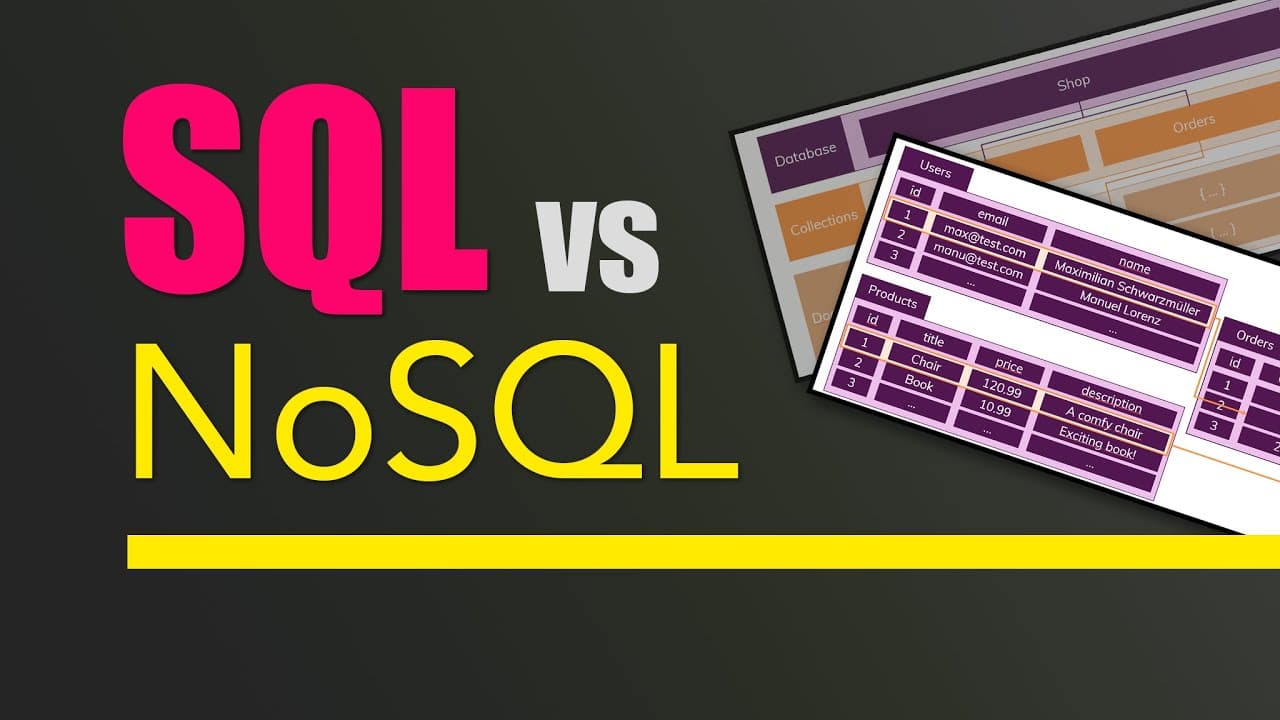
SQL vs NoSQL or MySQL vs MongoDB
TL;DR
SQL and NoSQL databases have different strengths and weaknesses, and the choice depends on the specific project requirements.
Transcript
hi welcome to this video sql or nosql that is a question you get a lot or often the question is mysql or mongodb either way let's have a look at when you might want to choose which database and what the differences actually are so let's dive into that and to understand whether you want to choose a sql or a nosql database for your next web project o... Read More
Key Insights
- 🈸 SQL databases rely on a strict schema and are suitable for applications with complex data relationships.
- 💨 NoSQL databases offer flexibility in data schema and excel in applications with fast data retrieval and scalability needs.
- ❓ SQL databases provide better performance for frequent data updates and complex join queries.
- 🚥 NoSQL databases simplify horizontal scaling by distributing data across multiple servers.
- ⚾ Both SQL and NoSQL databases have their strengths and should be chosen based on project requirements.
- 😒 In larger applications, it is common to use both SQL and NoSQL databases for different data types and needs.
- 🏪 NoSQL databases, like MongoDB, can store related data within a collection, reducing the need for complex join queries.
Install to Summarize YouTube Videos and Get Transcripts
Explore YouTube Video Summarizer or Get YouTube Transcript Extractor
Questions & Answers
Q: What is SQL and how does it work?
SQL is a language used to write queries for relational databases. It allows you to retrieve, insert, update, and delete data from the database. It follows a strict schema, meaning each table has predefined fields, and data must adhere to this structure.
Q: How are data relationships managed in SQL databases?
SQL databases use tables to store data, and relationships between tables are established through key fields. For example, a user and product can be connected through an orders table, which stores the user and product IDs.
Q: What are the advantages of NoSQL databases?
NoSQL databases, like MongoDB, offer schema flexibility, allowing different documents in a collection to have different fields. They excel in applications where fast data retrieval and scalability are crucial.
Q: How does horizontal scaling differ between SQL and NoSQL databases?
SQL databases have limitations in horizontal scaling since data cannot easily be split across multiple servers. In contrast, NoSQL databases, like MongoDB, can scale horizontally by distributing data across multiple servers.
Key Insights:
- SQL databases rely on a strict schema and are suitable for applications with complex data relationships.
- NoSQL databases offer flexibility in data schema and excel in applications with fast data retrieval and scalability needs.
- SQL databases provide better performance for frequent data updates and complex join queries.
- NoSQL databases simplify horizontal scaling by distributing data across multiple servers.
- Both SQL and NoSQL databases have their strengths and should be chosen based on project requirements.
- In larger applications, it is common to use both SQL and NoSQL databases for different data types and needs.
- NoSQL databases, like MongoDB, can store related data within a collection, reducing the need for complex join queries.
- The choice between SQL and NoSQL databases depends on factors such as data structure, data relationships, scalability needs, and performance requirements.
Summary & Key Takeaways
-
SQL, or structured query language, is a language used to write queries for relational databases. It has a rigid schema and supports strict data relationships.
-
NoSQL databases, such as MongoDB, offer flexibility in data schema and do not rely heavily on relations between data.
-
SQL databases are suitable for applications with complex relationships between data and frequent data updates. NoSQL databases are ideal for applications where fast and efficient data retrieval is critical.
Read in Other Languages (beta)
Share This Summary 📚
Summarize YouTube Videos and Get Video Transcripts with 1-Click
Try YouTube Summary with ChatGPT & Claude or YouTube Transcript Generator
Explore More Summaries from Academind 📚






Summarize YouTube Videos and Get Video Transcripts with 1-Click
Try YouTube Summary with ChatGPT & Claude or YouTube Transcript Generator