6.2.6 Synchronization and Metastability
TL;DR
Asynchronous inputs to sequential logic circuits can cause timing issues, but using synchronizer circuits and quarantine registers can mitigate the problem.
Transcript
Okay, it's finally time to investigate issues caused by asynchronous inputs to a sequential logic circuit. By "asynchronous" we mean that the timing of transitions on the input is completely independent of the timing of the sequential logic clock. This situation arises when the inputs arrive from the outside world where the timing of events is not ... Read More
Key Insights
- 🥺 Asynchronous inputs to sequential logic circuits can cause timing violations, leading to unreliable operation.
- ⏰ Synchronizer circuits can help align the input transitions with the clock, but they can still result in the metastable state.
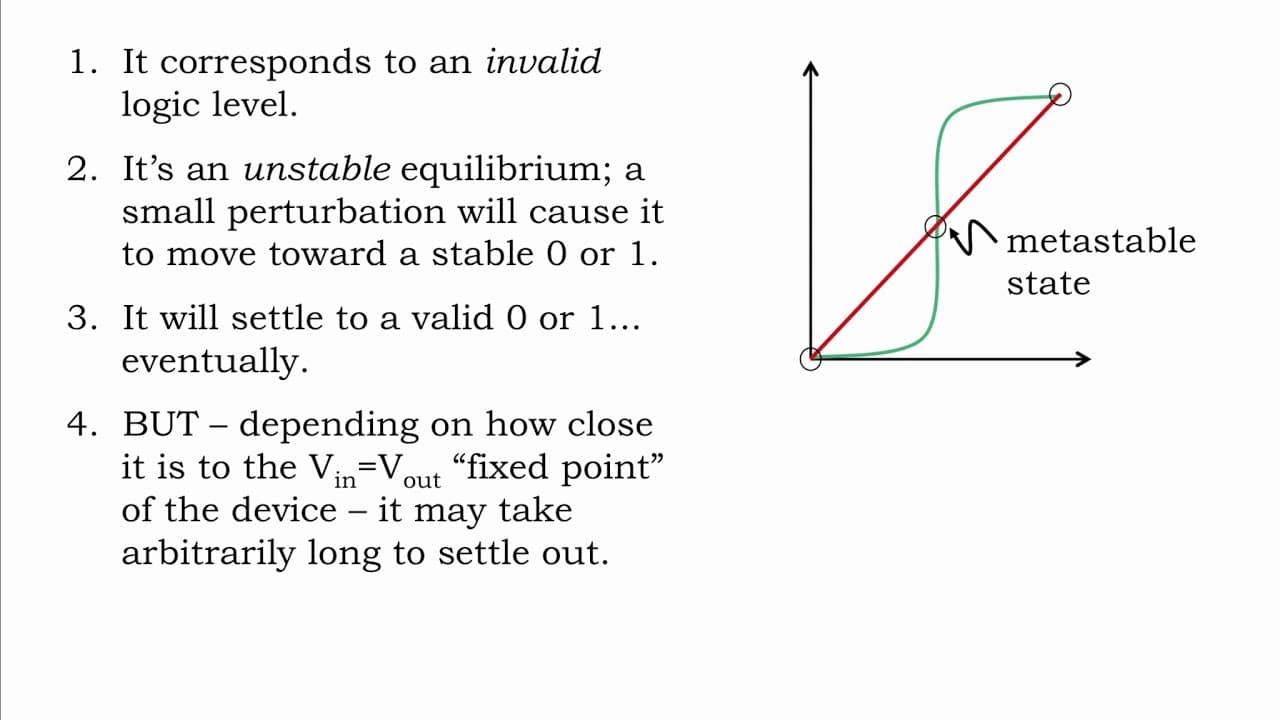
- 🥺 The metastable state is an unstable equilibrium that can lead to invalid logic levels and electrical havoc.
- 😒 Quarantine registers can be used to mitigate the impact of the metastable state by delaying the use of potentially metastable signals.
- ⏳ The longer the quarantine time, the lower the probability of failure, but it can never be reduced to zero.
- 👻 The failure probability decreases exponentially with the quarantine time, allowing for practical mitigation of metastability.
- ⌛ Multiple quarantine registers can be used in series to increase the quarantine time.
Install to Summarize YouTube Videos and Get Transcripts
Explore YouTube Video Summarizer or Get YouTube Transcript Extractor
Questions & Answers
Q: What are asynchronous inputs in sequential logic circuits?
Asynchronous inputs refer to inputs whose timing is independent of the timing of the sequential logic clock, making them unpredictable and potentially causing timing violations.
Q: How does a synchronizer circuit work?
A synchronizer circuit takes an unsynchronized input signal and produces a synchronized signal that only changes shortly after the rising edge of the clock. It helps solve timing problems by aligning the input transitions with the clock.
Q: Why is a synchronizer circuit not a perfect solution?
A synchronizer circuit can still lead to the metastable state, where the output is in an unstable equilibrium. This can result in unreliable output and violate the dynamic discipline of the system.
Q: How can the metastable state be mitigated?
The use of quarantine registers, which add additional registers in series, can help mitigate the metastable state. By delaying the use of the potentially metastable signal by the internal logic, the probability of failure can be significantly reduced.
Summary & Key Takeaways
-
Asynchronous inputs to sequential logic circuits can violate timing constraints, causing issues with reliable operation.
-
Synchronizer circuits can be used to produce synchronized signals that only change shortly after the rising edge of the clock.
-
However, the use of synchronizer circuits does not fully solve the timing problem as it can lead to the metastable state, which is an unstable equilibrium.
Read in Other Languages (beta)
Share This Summary 📚
Summarize YouTube Videos and Get Video Transcripts with 1-Click
Try YouTube Summary with ChatGPT & Claude or YouTube Transcript Generator
Explore More Summaries from MIT OpenCourseWare 📚



Summarize YouTube Videos and Get Video Transcripts with 1-Click
Try YouTube Summary with ChatGPT & Claude or YouTube Transcript Generator