Capacitive Reactance, Impedance, Power Factor, AC Circuits, Physics
TL;DR
This video explains how to calculate the capacitive reactance, impedance, current, voltage, and power in an AC circuit with a capacitor and resistor.
Transcript
in this video I'm gonna focus on capacitive reactance so we have a 50 micro farad capacitor and it's in series with a 40 ohm resistor and a 12 volt AC signal that has a frequency of 60 Hertz so let's start with a picture and so here's the resistor and here is the capacitor so we have a 40 ohm resistor and the capacitance is 50 micro farad's and we ... Read More
Key Insights
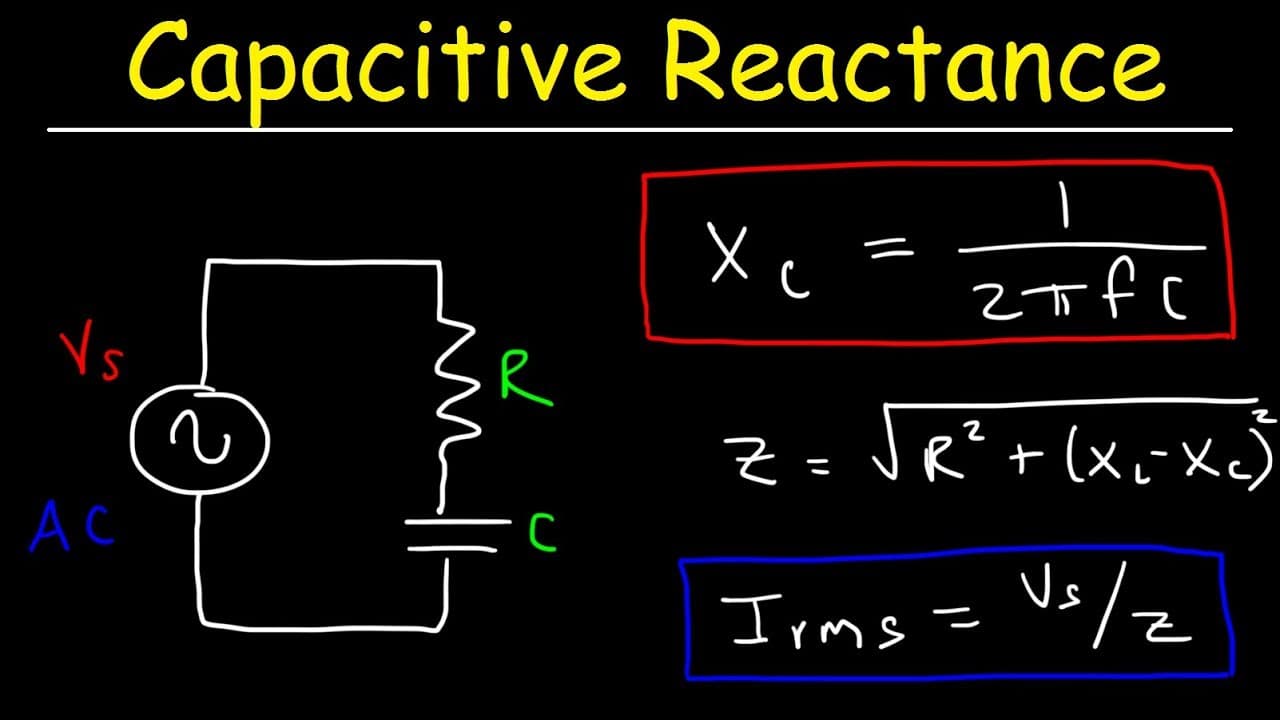
- 🔙 The formula XC = 1/(2πfC) is used to calculate capacitive reactance in an AC circuit, where XC represents capacitive reactance, f is the frequency, and C is the capacitance.
- 💤 The impedance of a circuit is determined by using the formula Z = √(R^2 + Xl - XC^2), where Z is impedance, R is resistance, Xl is inductive reactance (which is zero in this circuit), and XC is capacitive reactance.
- ⚡ The RMS current in the circuit can be obtained by dividing the source voltage by the impedance.
- 👮 Voltage across the resistor and capacitor can be calculated using Ohm's law and the formulas VR = I * R and VC = I * XC, respectively.
- ⚡ The equation V^2 = VR^2 + VC^2 relates the voltage of the source, voltage across the resistor and capacitor, and the power factor.
- ✊ The power absorbed by the circuit is the power consumed by the resistor, which can be calculated using the formula P = I^2 * R.
- 📡 Capacitors can block direct current (DC) signals but allow alternating current (AC) signals to pass through due to their ability to constantly charge and discharge.
Install to Summarize YouTube Videos and Get Transcripts
Explore YouTube Video Summarizer or Get YouTube Transcript Extractor
Questions & Answers
Q: How do you calculate the capacitive reactance in an AC circuit?
The formula to calculate capacitive reactance is XC = 1/(2πfC), where XC is the capacitive reactance, f is the frequency, and C is the capacitance. In this example, the frequency is 60 Hz and the capacitance is 50 µF, resulting in a capacitive reactance of 53.05 ohms.
Q: How is the impedance of the circuit determined?
The impedance (Z) of the circuit is calculated using the formula Z = √(R^2 + Xl - XC^2), where Z is the impedance, R is the resistance, Xl is the inductive reactance (which is zero in this circuit), and XC is the capacitive reactance. In this case, the impedance is 66.44 ohms.
Q: How do you calculate the RMS current in the circuit?
The RMS current can be obtained by dividing the source voltage by the impedance. In this example, with a source voltage of 12 volts and an impedance of 66.44 ohms, the RMS current is 0.1806 amps.
Q: Is there a relationship between frequency and capacitive reactance?
Yes, there is a relationship. As the frequency of the AC signal increases, the capacitive reactance decreases. This is because the formula for capacitive reactance includes frequency (f) in the denominator. Therefore, an increase in frequency results in a decrease in capacitive reactance, leading to an increase in current flow.
Summary & Key Takeaways
-
The video discusses how to calculate the capacitive reactance of a circuit using the formula XC = 1/(2πfC), where XC is the capacitive reactance, f is the frequency, and C is the capacitance.
-
It explains how to determine the impedance of the circuit using the formula Z = √(R^2 + Xl - XC^2), where Z is the impedance, R is the resistance, Xl is the inductive reactance (which is zero in this circuit), and XC is the capacitive reactance.
-
The video demonstrates how to calculate the RMS current in the circuit by dividing the source voltage by the impedance.
-
It shows how to calculate the voltage across the resistor and capacitor using Ohm's law and the formula VR = I * R and VC = I * XC, respectively.
-
The video explains the relationship between the voltage of the source, voltage across the resistor and capacitor, and the power factor using the equation V^2 = VR^2 + VC^2.
-
It highlights that the power absorbed by the circuit is the power consumed by the resistor and explains how to calculate it using the formula P = I^2 * R.
Read in Other Languages (beta)
Share This Summary 📚
Summarize YouTube Videos and Get Video Transcripts with 1-Click
Try YouTube Summary with ChatGPT & Claude or YouTube Transcript Generator
Explore More Summaries from The Organic Chemistry Tutor 📚




Summarize YouTube Videos and Get Video Transcripts with 1-Click
Try YouTube Summary with ChatGPT & Claude or YouTube Transcript Generator