37.1 Kinetic Energy of Translation and Rotation
TL;DR
The kinetic energy of a rolling wheel consists of both translational and rotational components, represented by the sum of the center of mass velocity squared and the product of the moment of inertia and the angular speed squared.
Transcript
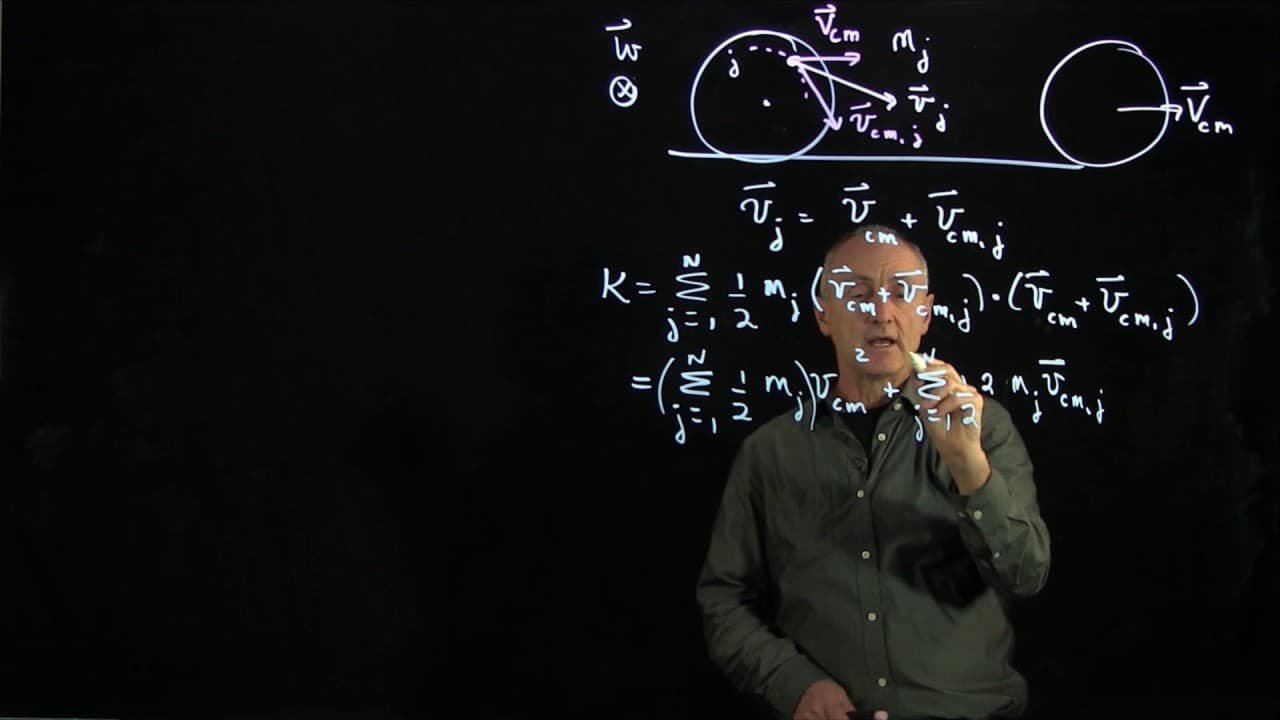
Let's consider the motion of a wheel that's rolling along the ground with some center of mass velocity vcm. And because the wheel is rotating it has an angular velocity. And you can see that that vector is directed into the plane of the board. Now, what we'd like to do is consider the kinetic energy of this continuous body. A little bit later on, t... Read More
Key Insights
- 🤣 The kinetic energy of a rolling wheel is determined by both its linear motion and rotational motion.
- 😥 The velocity of each point on the wheel is the sum of the center of mass velocity and the tangential rotational velocity.
- 🤣 The kinetic energy of a rolling wheel can be separated into translational and rotational components.
- 💆 The translational component is determined by the mass and velocity of the center of mass.
- 🐎 The rotational component is determined by the moment of inertia and the square of the angular speed.
- 💆 The center of mass reference frame is useful in simplifying calculations and separating contributions to the kinetic energy.
- 💆 The translational kinetic energy represents the motion of the center of mass, while the rotational kinetic energy represents the rotation of the wheel.
Install to Summarize YouTube Videos and Get Transcripts
Explore YouTube Video Summarizer or Get YouTube Transcript Extractor
Questions & Answers
Q: How is the kinetic energy of a rolling wheel calculated?
The kinetic energy of a rolling wheel is calculated by summing the kinetic energies of each particle in the wheel. This includes contributions from both the center of mass velocity and the tangential rotational velocity.
Q: What are the components of the kinetic energy of a rolling wheel?
The kinetic energy of a rolling wheel consists of two components. The first component is the translational kinetic energy, which represents the motion of the wheel's center of mass. The second component is the rotational kinetic energy, which represents the rotation of the wheel.
Q: How does the angular speed of the wheel affect its kinetic energy?
The angular speed of the wheel affects its kinetic energy through the rotational kinetic energy component. As the angular speed increases, the rotational kinetic energy increases proportionally to the square of the angular speed.
Q: What is the significance of the center of mass reference frame in calculating the kinetic energy?
The center of mass reference frame is important in calculating the kinetic energy because it allows for the separation of translational and rotational components. In the center of mass frame, the sum of the product of mass and tangential velocity for each particle is equal to zero.
Summary & Key Takeaways
-
The kinetic energy of a rolling wheel is determined by considering the velocities of each point on the wheel, which includes both the center of mass velocity and the tangential rotational velocity.
-
The kinetic energy can be calculated by summing the individual kinetic energies of the particles in the wheel, with contributions from the center of mass velocity and the tangential rotational velocity.
-
The kinetic energy can be separated into two components: the translational kinetic energy, which represents the motion of the center of mass, and the rotational kinetic energy, which represents the rotation of the wheel.
Read in Other Languages (beta)
Share This Summary 📚
Summarize YouTube Videos and Get Video Transcripts with 1-Click
Try YouTube Summary with ChatGPT & Claude or YouTube Transcript Generator
Explore More Summaries from MIT OpenCourseWare 📚



Summarize YouTube Videos and Get Video Transcripts with 1-Click
Try YouTube Summary with ChatGPT & Claude or YouTube Transcript Generator