Ring Counters | State diagram & Sequence table | Digital Systems Design | Lec-94
TL;DR
A ring counter is a synchronous counter using flip-flops to shift bits circularly.
Transcript
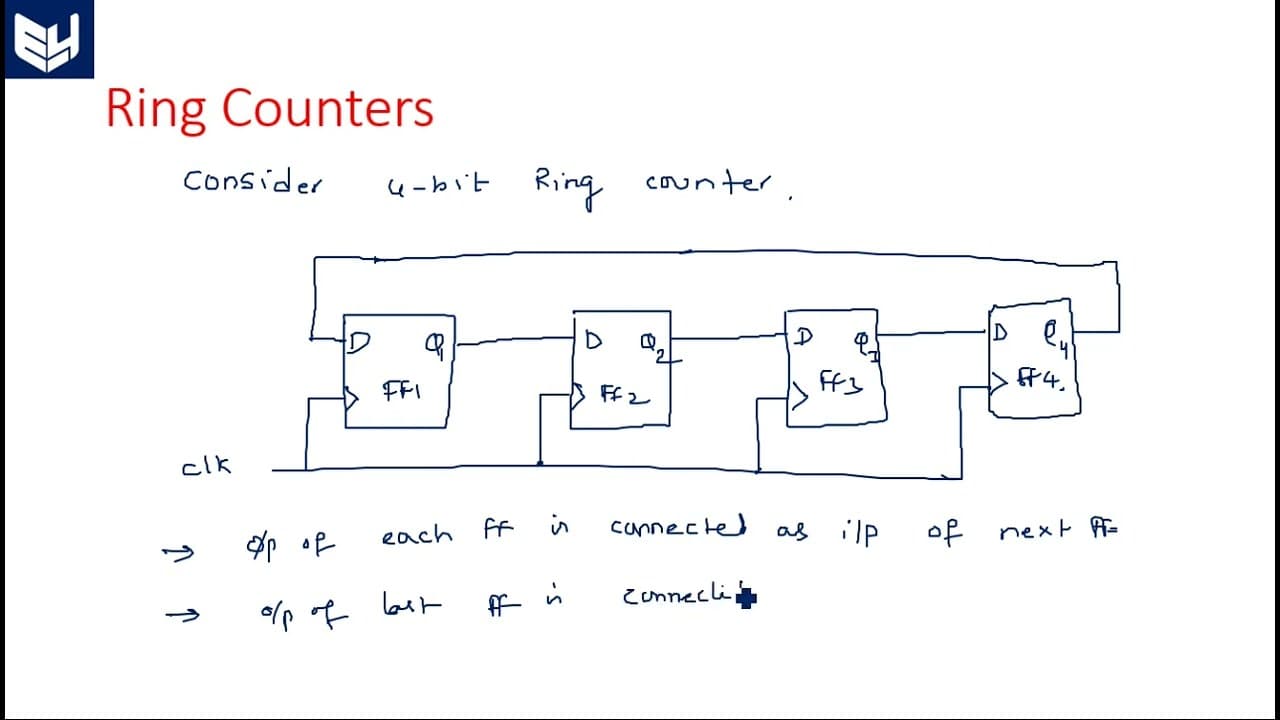
hi everyone in this video I'm going to explain about one of the counter types that is ring counter there are two such counters are there ring counter and Johnson counter Okay small difference is there between them I will explain what is that so ring counter it is like a ring that means the output of the last flip flop is again connected to the inpu... Read More
Key Insights
- 😋 Ring counters utilize D flip-flops to maintain stable data as they shift outputs.
- 🤱 The circular architecture means that the last output feeds back to the first, ensuring continuous data flow.
- 🔄 Counting in a ring counter is directly proportional to the number of flip-flops; thus, an n-bit ring counter counts n states.
- 💗 Synchronous operation means every flip-flop reacts simultaneously to the clock pulse, maintaining synchronized shifting.
- 🏍️ The initial state often starts from a specific binary configuration before repeating the cycle.
- 🔄 Each clock pulse advances the counter by one position, demonstrating predictable shifts in output.
- 💉 Understanding ring counters is essential in digital design, especially in applications where simple state cycling is needed.
Install to Summarize YouTube Videos and Get Transcripts
Explore YouTube Video Summarizer or Get YouTube Transcript Extractor
Questions & Answers
Q: What is the fundamental structure of a ring counter?
A ring counter consists of a series of flip-flops connected in a circular arrangement, where the last flip-flop's output feeds back into the first flip-flop's input. This structure allows for a seamless circular data shift with each clock pulse, maintaining data integrity through D-type flip-flops.
Q: How does a ring counter differ from a Johnson counter?
While both ring counters and Johnson counters are synchronous counters, a Johnson counter modifies the output by inverting it before feeding it back to the input of the first flip-flop, thus allowing for different state sequences. A ring counter merely circulates its binary state without alteration.
Q: How many states can a 4-bit ring counter represent?
A 4-bit ring counter can represent four unique states, cycling through outputs corresponding to each flip-flop configuration. The sequence includes 1000, 0100, 0010, and 0001, and then it repeats, illustrating its ability to count four distinct clock pulses.
Q: What role do clock pulses play in the operation of a ring counter?
Clock pulses synchronize the data shifting within a ring counter. Each pulse triggers a shift in output across the flip-flops, allowing the counter to progress through its defined state sequence. The clock input is common for all flip-flops, making it a synchronous counter.
Summary & Key Takeaways
-
A ring counter is constructed using D flip-flops where the output of the last one connects back to the first, creating a circular structure.
-
It counts clock pulses equal to the number of flip-flops in the design, shifting binary states with each pulse.
-
Each state in a 4-bit ring counter is represented uniquely, cycling through outputs like 1000, 0100, 0010, and 0001, before repeating.
Read in Other Languages (beta)
Share This Summary 📚
Summarize YouTube Videos and Get Video Transcripts with 1-Click
Try YouTube Summary with ChatGPT & Claude or YouTube Transcript Generator