designing of synchronous sequential circuits | using state diagram | STLD | Lec-142
TL;DR
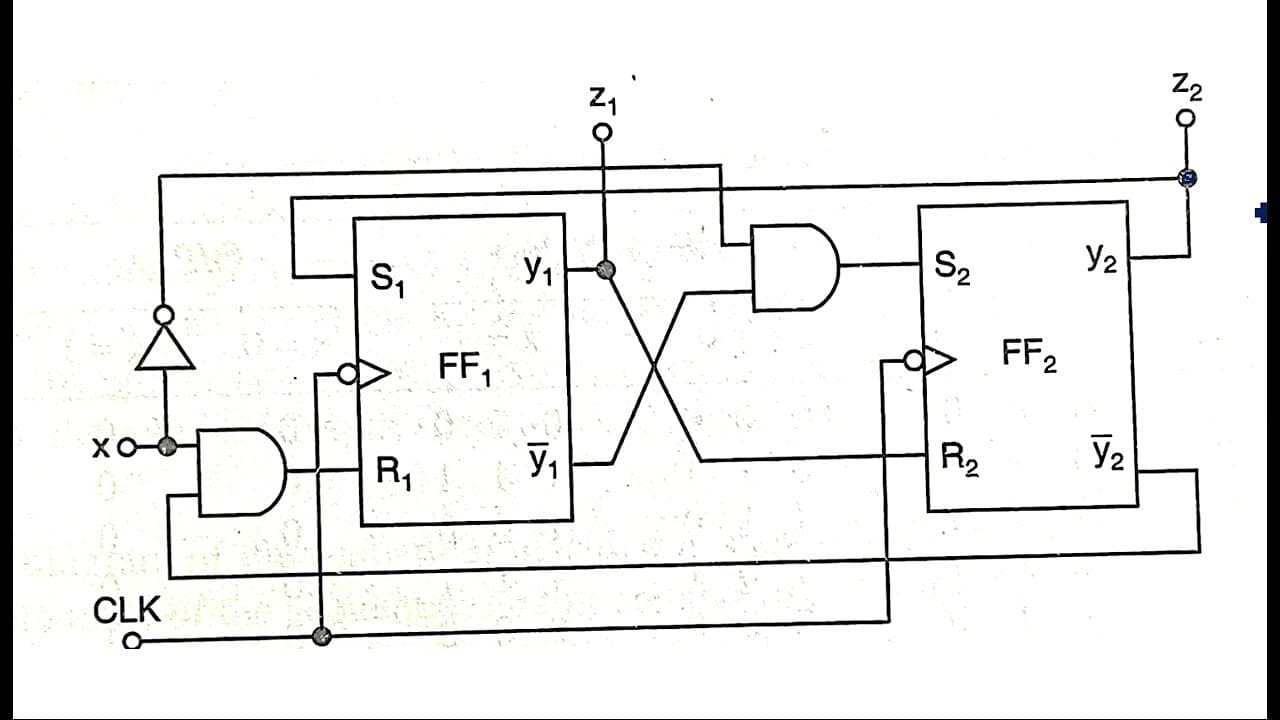
This video explains the reduction of state tables and diagrams for synchronous circuits using SR flip-flops.
Transcript
hi everyone in this video I'm going to explain about the reduction of State table and state diagram so here we need to design a circuit that will function as prescribed by the state diagram shown use Sr fops for the implementation so here this state diagram is given to you and we need to draw the state table and then we need to identify what are th... Read More
Key Insights
- 🎁 A clear understanding of state diagrams enables the design of corresponding state tables, which outline present states, next states, and outputs.
- 🔠 For any given state with multiple outputs, careful analysis is required to identify the relationship between inputs and outputs for the correct functioning of the circuits.
- 🐬 The calculation of excitation inputs for flip-flops is crucial in the design process for synchronous sequential circuits.
- #️⃣ It is important to note the number of flip-flops needed directly correlates to the number of states in the state diagram prepared.
- 😉 Implementing K-map simplifications can help derive efficient Boolean expressions from the defined excitation tables.
- 😒 The use of a common clock signal is essential when synchronizing multiple flip-flops within a sequential circuit.
- 🎨 Understanding how inputs affect state transitions and outputs is vital for circuitry design in both digital and electronic engineering.
Install to Summarize YouTube Videos and Get Transcripts
Explore YouTube Video Summarizer or Get YouTube Transcript Extractor
Questions & Answers
Q: What is the primary goal of the video?
The video aims to explain how to design a circuit based on a provided state diagram using SR flip-flops. It involves drawing a state table, identifying the necessary inputs for the flip-flops, and understanding the relationships between the states and their outputs.
Q: How many states are given in the state diagram discussed?
The state diagram discussed in the video has four distinct states: A, B, C, and D, which require two flip-flops to represent their transitions and outputs effectively. The states are represented in binary form as 00, 01, 10, and 11.
Q: What distinguishes Mealy from Moore circuits?
Mealy circuits produce outputs based on both present states and inputs, while Moore circuits depend solely on present states. In this context, the discussed circuit is identified as a Mealy circuit because it considers both inputs and states during its operation.
Q: How are the excitation inputs for the SR flip-flops determined?
The excitation inputs for the SR flip-flops are derived from the transitions of the present states to next states captured in the state table. Based on the defined outputs and states, the Boolean expressions for the SR flip-flop inputs are calculated.
Summary & Key Takeaways
-
The video focuses on designing circuits based on given state diagrams using SR flip-flops, explaining how to create state tables and identify inputs for the flip-flops.
-
It emphasizes the number of required flip-flops based on the number of states, unveiling the relationship between states and the corresponding outputs during transitions.
-
The content discusses the distinctions between Mealy and Moore circuits, highlighting their dependency on inputs and outputs for state transitions and output generation.
Read in Other Languages (beta)
Share This Summary 📚
Summarize YouTube Videos and Get Video Transcripts with 1-Click
Try YouTube Summary with ChatGPT & Claude or YouTube Transcript Generator