Microwaves | Advantages and Applications | Microwave Engineering | Lec-02
TL;DR
This video discusses the benefits and uses of microwaves, particularly in communication and heating.
Transcript
hi everyone in this video I am going to discuss about the advantages and applications of microwaves in the previous video I have started the microwave engineering and explained about how the microwaves having different types of frequencies ranging from 300 megahertz just to 300 gigahertz and wavelength varies from 1 meter to one millimeter okay if ... Read More
Key Insights
- 👻 Microwaves provide large bandwidth, allowing for efficient data transmission across telecommunication networks.
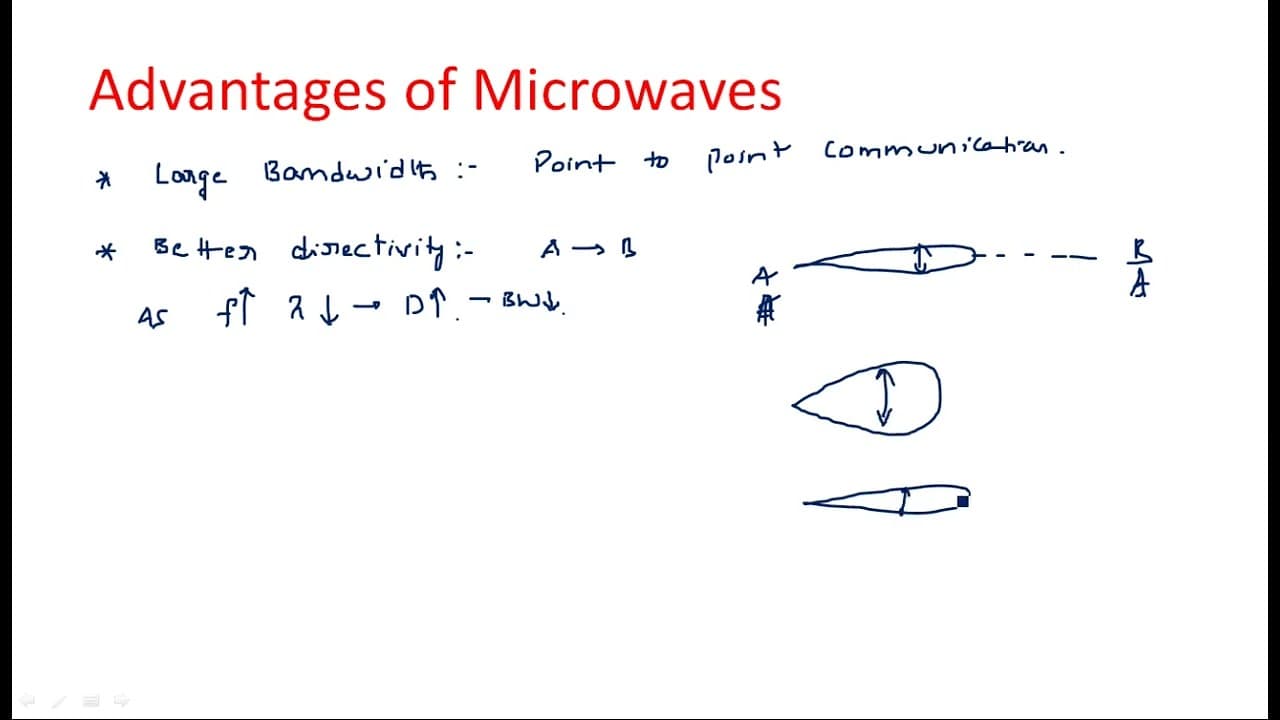
- ✋ High frequencies contribute to better directivity, which enhances the performance of antennas for targeted communication.
- 🥺 The size of antennas significantly decreases with microwave frequency, which leads to more compact and lightweight designs suitable for modern technologies.
- 😘 Low power consumption associated with microwave technology promotes sustainable practices and reduces operational costs in communication systems.
- 🫥 Line of sight is crucial for microwave signal propagation, ensuring reliable connections in various applications.
- 🈸 Applications in remote sensing utilize microwaves for efficient data collection in areas inaccessible to humans.
- 😷 Medical applications of microwaves facilitate advanced diagnostic techniques and therapeutic treatments, showcasing their significance in health care.
Install to Summarize YouTube Videos and Get Transcripts
Explore YouTube Video Summarizer or Get YouTube Transcript Extractor
Questions & Answers
Q: What frequency range do microwaves operate within?
Microwaves operate between 300 megahertz (MHz) to 300 gigahertz (GHz). This range allows them to transmit signals over long distances due to their ability to carry large amounts of information simultaneously, making them ideal for various communication technologies like satellites and radars.
Q: How does microwave technology enhance directivity in communication?
Microwave technology enhances directivity by allowing antennas to focus signals in specific directions. Higher microwave frequencies mean shorter wavelengths, which improve directivity, ensuring that signals are transmitted more effectively towards targeted receivers, thus increasing communication efficiency over long distances.
Q: What are some common applications of microwaves in everyday life?
Microwaves have numerous applications, including communications through satellite and radar systems, medical diagnosis and therapies, food heating in microwave ovens, and industrial processes like moisture control and pre-cooking. These applications showcase microwaves' versatility and importance across various fields.
Q: What is the relationship between frequency and antenna size in microwave technology?
The size of antennas in microwave technology is inversely proportional to the frequency of the waves. As the frequency increases, the wavelength decreases, allowing for smaller antennas to be used. This is beneficial for various technologies where space and design are critical considerations.
Q: Why do microwaves use less power compared to lower frequency signals?
Microwaves require lower power consumption because higher frequencies are more efficient in transmitting data over long distances. With greater energy efficiency, microwave systems can operate effectively while consuming less power, thus reducing operational costs and enhancing overall system performance.
Q: How is the 'line of sight' important in microwave communication?
The 'line of sight' in microwave communication refers to the need for the transmitting and receiving antennas to be directly visible to each other. This condition minimizes signal fading and ensures reliable transmission. Obstacles blocking this line can significantly impact communication quality and effectiveness.
Summary & Key Takeaways
-
Microwaves operate at frequencies between 300 MHz to 300 GHz, enabling long-distance communication through large bandwidth, which allows more information transmission.
-
The high frequency of microwaves leads to smaller size antennas due to the inverse relationship between antenna size and frequency, making them suitable for modern applications.
-
Applications of microwaves include communication technologies, remote sensing, medical uses, and household items like microwave ovens, illustrating their versatility.
Read in Other Languages (beta)
Share This Summary 📚
Summarize YouTube Videos and Get Video Transcripts with 1-Click
Try YouTube Summary with ChatGPT & Claude or YouTube Transcript Generator