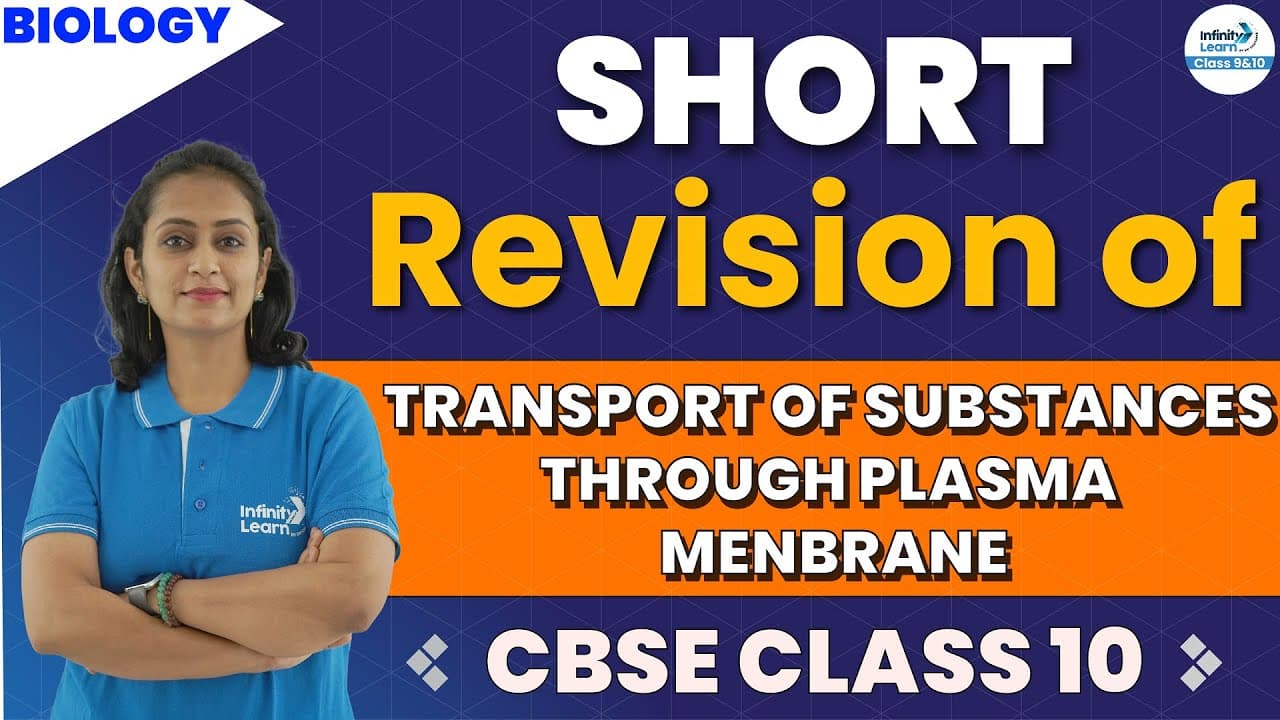
Transport of Substances through Plasma menbrane || Class 9 Science || Infinity Learn Class 9&10
TL;DR
This content discusses the transportation of substances through the plasma membrane, including passive transport (diffusion and osmosis) and active transport (requiring energy), as well as bulk transport through exocytosis and endocytosis.
Transcript
so in this particular Class A very very very important topic that we are going to talk is about transportation of substances through plasma membrane in site and outside of the cell it is always movement of molecules from the higher concentration to lower concentration rate the concentration of perfume is more where it is more in the bottle and as s... Read More
Key Insights
- ☢️ Passive transport includes diffusion and osmosis, while active transport requires energy.
- 🫢 Diffusion allows for the uniform distribution and exchange of gases and nutrients in the cell.
- 💦 Osmosis specifically involves the movement of water across a semi-permeable membrane.
- ❓ Bulk transport occurs through exocytosis (release) and endocytosis (uptake) of substances.
- 🌥️ Phagocytosis is the engulfment of larger particles, while pinocytosis is the uptake of fluid materials.
- 😑 Active transport is important for the transportation of ions, such as sodium ions, against the concentration gradient.
Install to Summarize YouTube Videos and Get Transcripts
Explore YouTube Video Summarizer or Get YouTube Transcript Extractor
Questions & Answers
Q: What is the difference between passive and active transport?
Passive transport does not require energy and includes diffusion and osmosis, while active transport requires energy and moves molecules against the concentration gradient.
Q: How does diffusion occur in the cell?
Diffusion is the movement of molecules from an area of higher concentration to lower concentration. It occurs naturally without the need for energy and is important for the uniform distribution of gases and exchange of nutrients in the cell.
Q: What is osmosis and how does it differ from diffusion?
Osmosis is the movement of water molecules across a semi-permeable membrane from higher to lower concentration. It is a type of passive transport that specifically involves water, whereas diffusion can occur with any molecule.
Q: How does bulk transport occur in cells?
Bulk transport involves the formation of vesicles from the plasma membrane. Exocytosis releases substances outside the cell, while endocytosis brings substances into the cell. Phagocytosis is the engulfment of larger particles, while pinocytosis is the uptake of fluid materials.
Summary & Key Takeaways
-
Passive transport occurs without the need for energy and includes diffusion (movement of molecules from higher to lower concentration) and osmosis (movement of water molecules across a semi-permeable membrane).
-
Active transport requires energy and moves molecules from lower to higher concentration.
-
Bulk transport involves the formation of vesicles for the release or uptake of substances through exocytosis and endocytosis.
Read in Other Languages (beta)
Share This Summary 📚
Summarize YouTube Videos and Get Video Transcripts with 1-Click
Try YouTube Summary with ChatGPT & Claude or YouTube Transcript Generator
Explore More Summaries from Infinity Learn NEET 📚

Summarize YouTube Videos and Get Video Transcripts with 1-Click
Try YouTube Summary with ChatGPT & Claude or YouTube Transcript Generator