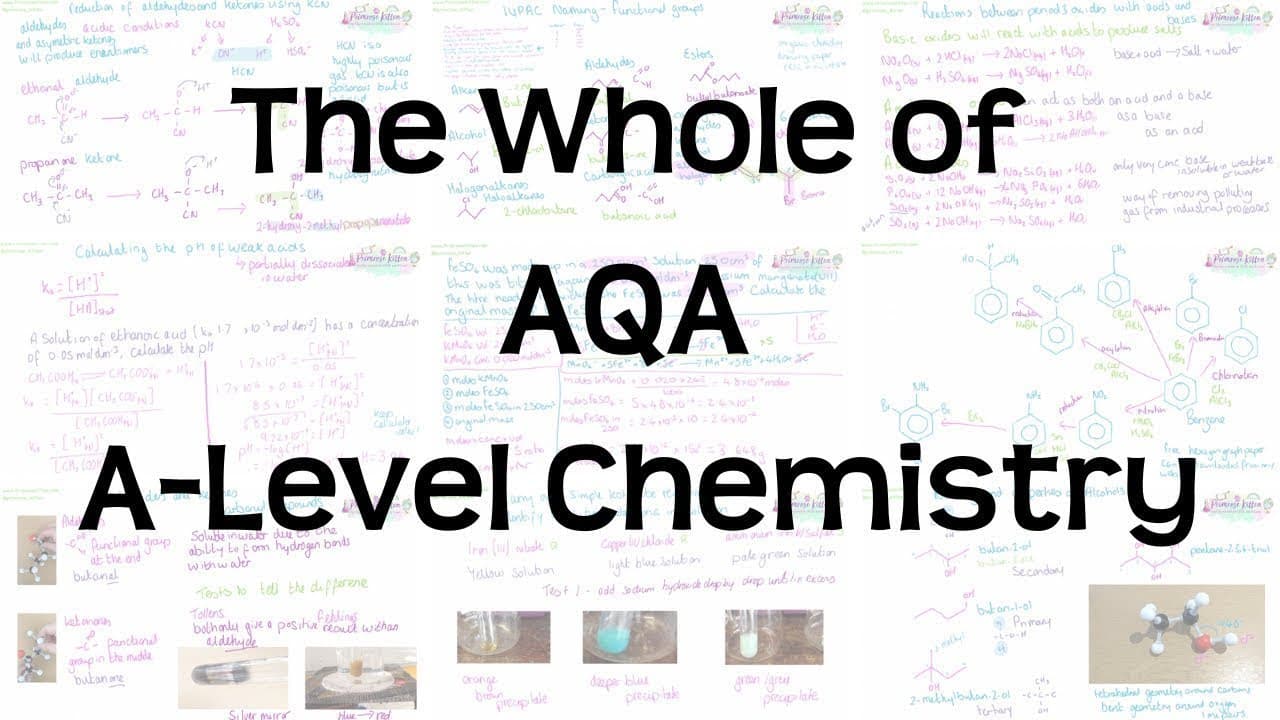
The Whole of AQA A-Level Chemistry | Revision for AS and A-Level Exams
TL;DR
This video provides a complete overview of AQA Alien Chemistry, including topics such as atomic structure, isotopes, mass spectrometry, electron configuration, and more.
Transcript
hello lovelies and welcome to the whole of AQA alien chemistry in one short-ish video I'm going to signpost the timestamps in the description down below which will help you jump between the bits that you need so if you're Rising for a topic test or whether you're advising for paper one or whether you're revising paper three you can get all the info... Read More
Key Insights
- 🫀 The structure of an atom includes protons, neutrons, and electrons, which have specific charges and masses.
- #️⃣ Isotopes are different versions of an element with the same number of protons but different numbers of neutrons.
- 🫀 Mass spectrometry can be used to determine the relative masses of isotopes and calculate the relative atomic mass of an element.
- ❓ Electron configuration is determined by the arrangement of electrons in subshells and orbitals, which can be represented using shorthand notation.
- 💁 Ions are formed when atoms gain or lose electrons, resulting in the formation of charged particles.
- 🫀 Ionization energy is the energy required to remove an electron from an atom, and it can provide evidence for electron structure.
- 📈 Trends in ionization energy can be used to determine electron structure and make predictions about reactivity.
Install to Summarize YouTube Videos and Get Transcripts
Explore YouTube Video Summarizer or Get YouTube Transcript Extractor
Questions & Answers
Q: What are the three subatomic particles that make up an atom?
An atom is made up of protons, neutrons, and electrons. Protons and neutrons are found in the nucleus and have a positive and neutral charge, respectively. Electrons are found in the outer shells and have a negative charge.
Q: How has the understanding of atom structures changed over time?
The understanding of atom structures has changed over time with new evidence. Initially, atoms were believed to be solid spheres before the current structure on the periodic table was established. The current understanding includes the concept of subshells, shells, and orbitals.
Q: What is the difference between atomic number and mass number?
Atomic number refers to the number of protons in an atom, while the mass number is the total number of protons and neutrons. Atomic number is typically represented by the symbol Z, while the mass number is represented by the symbol A.
Q: How does a mass spectrometer work?
A mass spectrometer works by ionizing a sample and then accelerating the ions using an electric field. The speed of the ions is determined by their mass-to-charge ratio. The ions create a small charge when detected, which can be used to calculate their relative mass.
Key Insights:
- The structure of an atom includes protons, neutrons, and electrons, which have specific charges and masses.
- Isotopes are different versions of an element with the same number of protons but different numbers of neutrons.
- Mass spectrometry can be used to determine the relative masses of isotopes and calculate the relative atomic mass of an element.
- Electron configuration is determined by the arrangement of electrons in subshells and orbitals, which can be represented using shorthand notation.
- Ions are formed when atoms gain or lose electrons, resulting in the formation of charged particles.
- Ionization energy is the energy required to remove an electron from an atom, and it can provide evidence for electron structure.
- Trends in ionization energy can be used to determine electron structure and make predictions about reactivity.
- Significant figures and unit conversions are important in chemistry calculations to ensure accuracy and precision.
Summary & Key Takeaways
-
The video covers a wide range of topics in AQA Alien Chemistry, including atomic structure, isotopes, mass spectrometry, electron configuration, and more.
-
The content is organized with timestamps provided in the description, allowing viewers to easily navigate to specific topics of interest.
-
Additional resources, such as a free revision guide and predictive papers, are provided to help students further their understanding of the subject matter.
Read in Other Languages (beta)
Share This Summary 📚
Summarize YouTube Videos and Get Video Transcripts with 1-Click
Try YouTube Summary with ChatGPT & Claude or YouTube Transcript Generator
Explore More Summaries from Primrose Kitten Academy | GCSE & A-Level Revision 📚
Summarize YouTube Videos and Get Video Transcripts with 1-Click
Try YouTube Summary with ChatGPT & Claude or YouTube Transcript Generator