Short Circuit Characteristics | Open Circuit | SCC & OCC | Synchronous Machines | Lec-19
TL;DR
This session covers the short circuit and open circuit characteristics of synchronous machines.
Transcript
hello everyone in this session we will discuss about the next topic is SCC and OCC SCC means here short circuit characteristics SCC means short circuit characteristics these SEC and OCC are useful to study the whenever is whenever the alternator is shorted so what are the characteristics and OCC also whenever the alternator is open circuited what a... Read More
Key Insights
- 🍰 Short circuit characteristics reveal important relationships between field current and armature current, crucial for understanding machine behavior under failure conditions.
- ☠️ The armature current in short circuit conditions can significantly exceed rated values, emphasizing the importance of designing machines to handle such scenarios safely.
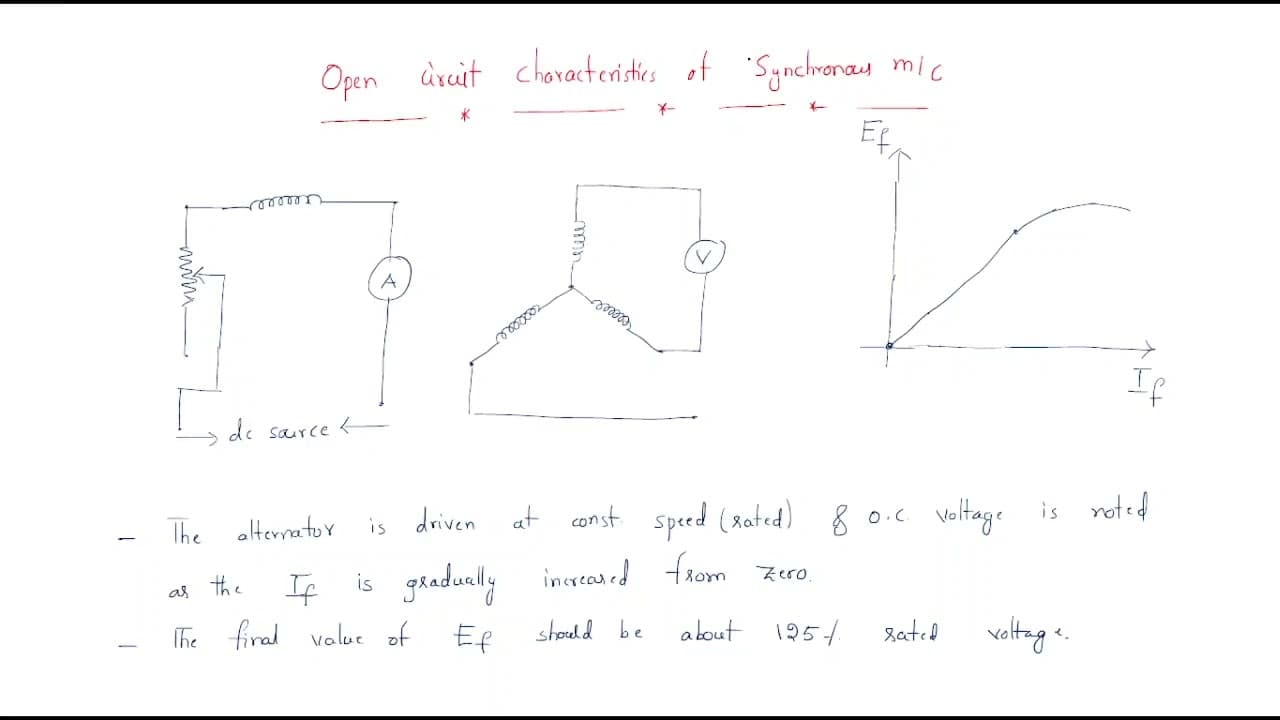
- 🤗 Open circuit characteristics are vital for assessing induced EMF while maintaining a constant synchronous speed, ensuring accurate data for machine performance.
- ⚡ Accurate measurement of voltage regulation in synchronous machines is essential for maintaining efficiency and stability in electrical systems.
- 🤗 The field current's gradual increase during tests provides a controlled environment to analyze both short and open circuit conditions' effects on performance.
- 👻 Different methods for calculating voltage regulation cater to various scenarios, allowing engineers to select the most appropriate method based on their requirements and machine specifications.
- 🎰 Understanding the differences among these calculation methods helps in optimizing machine performance and reliability in practical applications.
Install to Summarize YouTube Videos and Get Transcripts
Explore YouTube Video Summarizer or Get YouTube Transcript Extractor
Questions & Answers
Q: What is measured during short circuit conditions in synchronous machines?
During short circuit conditions, the relationship between the field current and the short circuit current is measured. As the field current increases, the armature current can reach up to 125% to 150% of the rated current. This relationship illustrates how the machine behaves under short circuit conditions, giving insight into its performance and stability.
Q: Why is the synchronous speed important when discussing open circuit characteristics?
Synchronous speed is critical in open circuit characteristics because the alternator must operate at this constant speed to accurately measure the induced EMF. If the speed fluctuates, it can affect the voltage readings leading to imprecise calculations of the relationship between field current and induced EMF, thus hindering performance analysis.
Q: How does the short circuit current behave as field current increases?
As the field current increases, the short circuit current also increases until it reaches its maximum value, which typically ranges from 125% to 150% of the rated current. This increase allows for an analysis of how the synchronous machine responds under short circuit conditions, indicating the limits of current before saturation effects occur.
Q: What are the different methods to calculate voltage regulation in synchronous machines?
The voltage regulation of synchronous machines can be calculated using several methods, including the synchronous impedance method (or EMF method), ampere turns method (MMF), zero power factor method (also known as the portier method), and the American Standard Association method, each providing unique ways to assess voltage performance.
Summary & Key Takeaways
-
The session details short circuit characteristics, emphasizing the relationship between field current and short circuit current in synchronous machines, with a focus on maximum armature current during conditions of short circuit.
-
Open circuit characteristics are defined, highlighting the importance of measuring induced EMF as field current increases, ensuring synchronous speed remains constant for accurate results.
-
Various methods for calculating voltage regulation in synchronous machines, including synchronous impedance and ampere-turns methods, are discussed, offering insights into industry-standard practices.
Read in Other Languages (beta)
Share This Summary 📚
Summarize YouTube Videos and Get Video Transcripts with 1-Click
Try YouTube Summary with ChatGPT & Claude or YouTube Transcript Generator