On Global Brain and AGI co evolution - Anton Kolonin
TL;DR
Explores the emergence of a global brain through interconnected AI systems.
Transcript
let me make a step back from the nature of AGI and I'm going to talk about the current state of the world where AGI is going to appear at some point and I'm going to talk about the perspective of the global brain which has been uh announced about 100 Years Ago by gerbert Wells on one hand and Vladimir woski as a term of nor spere on... Read More
Key Insights
- The concept of a global brain, introduced 100 years ago, is becoming a reality through interconnected AI and human interactions.
- The global brain is not a singular entity but rather an emergent property of interactions among humans and computing systems.
- Technological advancements have exponentially increased computing power, surpassing human brain capacity in some aspects.
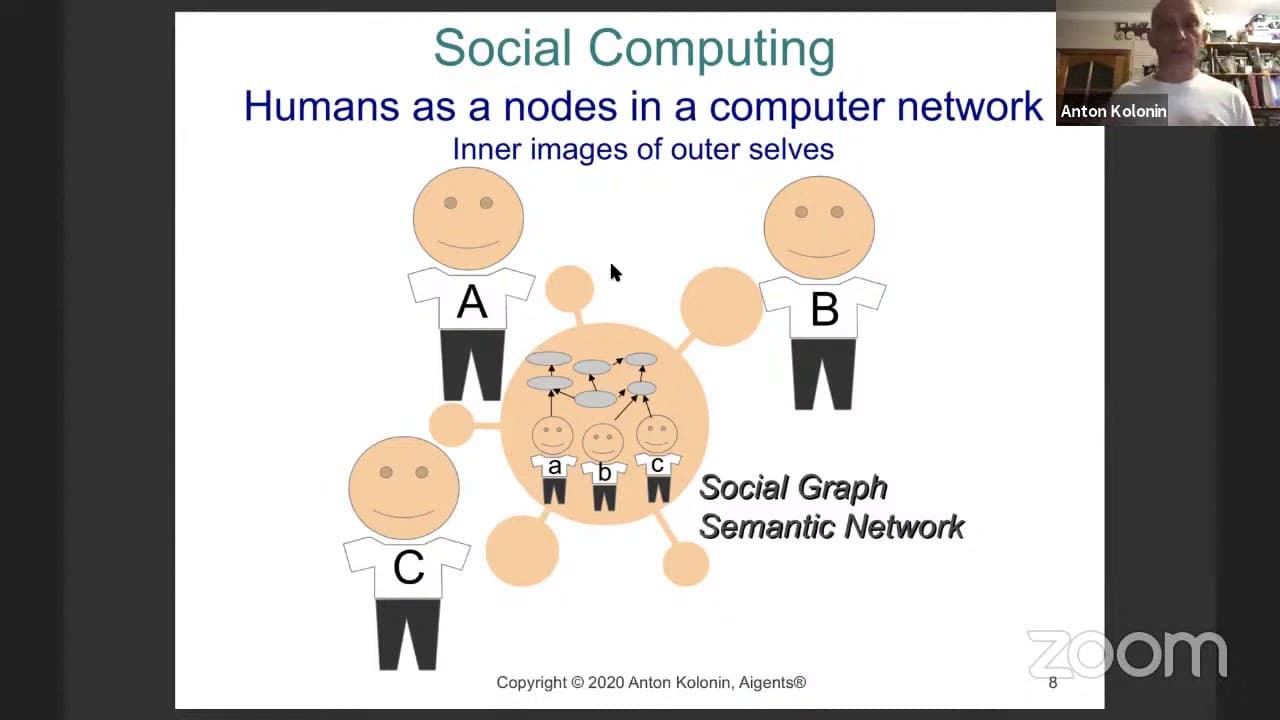
- Social networks and AI systems are forming complex, computable social structures, enabling unprecedented connectivity and data analysis.
- Reputation systems are crucial for managing trust and reliability within distributed networks, preventing manipulation and exploitation.
- Distributed AI ecosystems, like SingularityNET, aim to democratize AI access and prevent centralized control of global intelligence.
- The emergence of AGI raises questions about its potential origins, whether in personal devices or large-scale computing systems.
- The global brain's evolution requires understanding emergent cognitive behaviors to predict and manage future societal impacts.
Install to Summarize YouTube Videos and Get Transcripts
Explore YouTube Video Summarizer or Get YouTube Transcript Extractor
Questions & Answers
Q: What is the global brain concept discussed by Anton Kolonin?
The global brain concept, discussed by Anton Kolonin, refers to an emergent collective intelligence formed through the interactions of humans and computing systems. It is not a singular entity but a distributed network of interconnected nodes, representing the collective intelligence of humanity. This concept, introduced over a century ago, is becoming a reality with advancements in AI and connectivity.
Q: How does the global brain relate to advancements in computing power?
Advancements in computing power are crucial to the global brain's development, as they enable complex social cybernetics and interconnectedness. The exponential growth in computing speed and storage capacity has surpassed human brain capabilities, allowing for more comprehensive data analysis, inference, and decision-making. This technological evolution supports the emergence of a global brain through enhanced connectivity and processing power.
Q: What role do social networks play in the global brain concept?
Social networks play a vital role in the global brain concept by forming complex, computable social structures. They enable unprecedented connectivity among individuals, facilitating data exchange and interaction on a massive scale. These networks contribute to the emergent collective intelligence, allowing for advanced machine learning, predictive analytics, and social dynamics management within the global brain framework.
Q: Why are reputation systems important in distributed networks?
Reputation systems are crucial in distributed networks to manage trust and reliability among participants. They prevent manipulation and exploitation by ensuring that interactions are transparent and accountable. By assessing the trustworthiness of nodes based on their behavior and interactions, reputation systems maintain the integrity of the network, fostering a democratic and open environment for AI and human collaboration.
Q: How does SingularityNET contribute to the global brain's evolution?
SingularityNET contributes to the global brain's evolution by providing a decentralized marketplace for AI, democratizing access to AI technology. It aims to prevent centralized control of global intelligence by creating an open, distributed ecosystem where AI algorithms, services, and agents can be accessed by anyone. This approach supports the development of a distributed global brain, promoting innovation and collaboration.
Q: What are the potential origins of AGI according to the discussion?
According to the discussion, AGI could emerge from various origins, including personal devices, powerful servers, or supercomputers owned by global corporations. The emergence of AGI raises questions about its potential location and control, whether it will be centralized within a singular entity or distributed across a network, influencing the future trajectory of the global brain and its societal impact.
Q: What challenges does the global brain's evolution pose to society?
The global brain's evolution poses several challenges to society, including the risk of manipulation and exploitation by those controlling the networks. Understanding emergent cognitive behaviors within these systems is crucial to predict and manage future societal impacts. Additionally, ensuring equitable access to AI technology and maintaining democratic principles within distributed networks are essential to prevent centralized control and ensure positive outcomes.
Q: How can emergent cognitive behaviors within the global brain be understood?
Understanding emergent cognitive behaviors within the global brain requires analyzing complex social dynamics and interactions within the network. By studying patterns of connectivity, data exchange, and decision-making processes, researchers can predict the system's trajectory and potential impacts. This understanding is vital for managing societal challenges and ensuring that the global brain evolves in a way that benefits humanity as a whole.
Summary & Key Takeaways
-
Anton Kolonin discusses the emergence of a global brain, a concept rooted in early 20th-century theories, now materializing through interconnected AI systems and human interactions. This global brain is an emergent property, not confined to a single device but spread across vast networks, creating collective intelligence.
-
Advancements in computing power and connectivity have surpassed human brain capacities, enabling complex social cybernetics. This interconnectedness forms a computable social network, raising questions about manipulation and exploitation by those controlling these systems, emphasizing the need for robust reputation management.
-
Kolonin highlights the importance of distributed AI ecosystems, like SingularityNET, in democratizing AI access and preventing centralized control. Understanding emergent cognitive behaviors within these systems is crucial for predicting societal impacts, as the global brain continues to evolve alongside AGI development.
Read in Other Languages (beta)
Share This Summary 📚
Summarize YouTube Videos and Get Video Transcripts with 1-Click
Try YouTube Summary with ChatGPT & Claude or YouTube Transcript Generator