Synchronous motor | v & inverted v curves | Synchronous Machines | Lec-43
TL;DR
This session explains V curves, inverted V curves, and their relation to power factor and excitation in synchronous motors.
Transcript
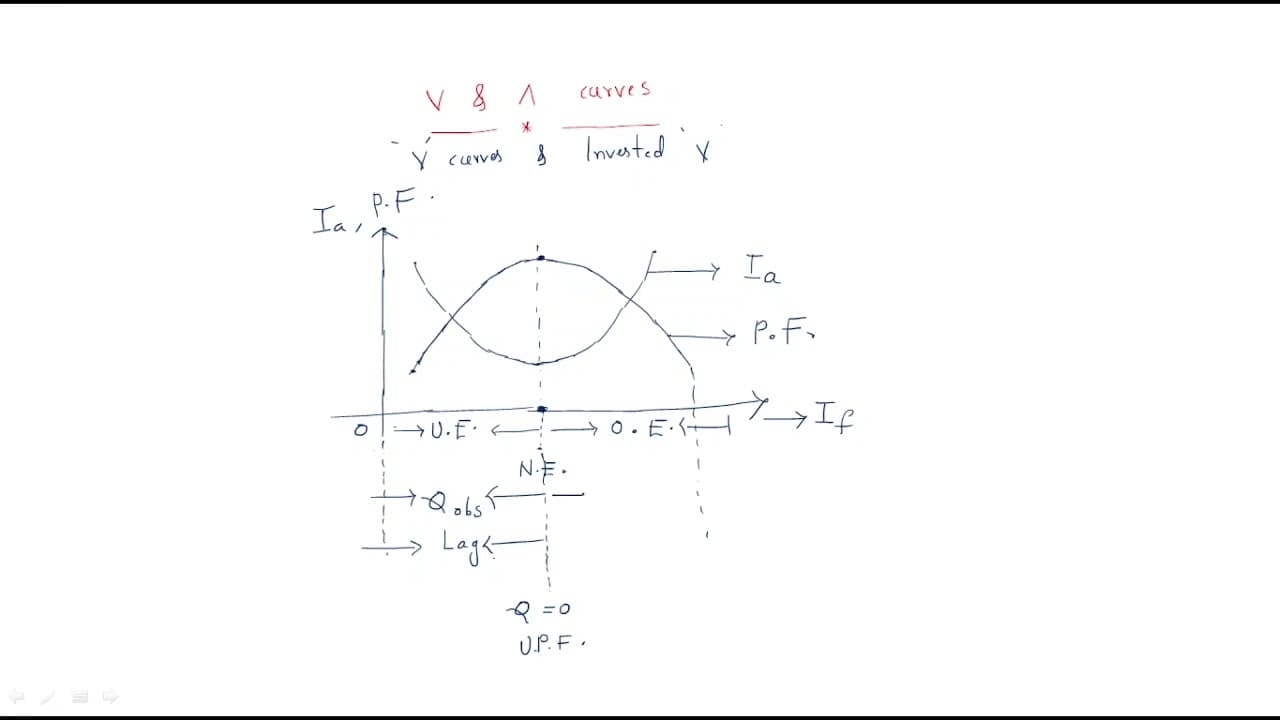
hello everyone in this session we will discuss about the next topic vakers and inverted videos that we means V curves and inverted V curves right so here V curves means it is the relation between field current and the Armature field current and the r major current so this is the relation between 0 and this is the it this is the field current and x ... Read More
Key Insights
- 🥰 V curves represent the relationship between field current and armature current, essential for analyzing synchronous motor behavior.
- 🥰 Inverted V curves depict the relation between power factor and current, crucial for adjustments in motor performance.
- ✊ The excitation level affects how reactive power is absorbed or delivered in synchronous motors depending on whether the power factor is leading or lagging.
- 🙊 The power factor peaks at normal excitation, decreasing during both under and over excitation.
- ✊ An increase in mechanical load directly influences power factor dynamics, with distinct behaviors observed in leading and lagging power factor scenarios.
- ✊ Maintaining a constant excitation while varying mechanical load can significantly affect the system's power characteristics.
- 🧑🦼 The relationship between load and armature current highlights the complexity of motor dynamics under operational changes.
Install to Summarize YouTube Videos and Get Transcripts
Explore YouTube Video Summarizer or Get YouTube Transcript Extractor
Questions & Answers
Q: What are V curves and inverted V curves in synchronous motors?
V curves display the relationship between armature current and field current in synchronous motors, resembling a V shape, whereas inverted V curves illustrate how power factor changes with excitation, taking the shape of an inverted V. These curves are crucial for understanding motor efficiency and performance under various excitation conditions.
Q: How does the power factor behave under normal, under, and over excitation?
Under normal excitation, the power factor is optimal, while in under excitation, the power factor is low due to insufficient reactive power to maintain voltage levels. In over excitation, the power factor can improve, often reaching unity and exhibiting a leading power factor, demonstrating an excess of reactive power.
Q: What happens to reactive power in synchronous motors during load changes?
As mechanical load increases in a synchronous motor, the behavior regarding reactive power alters. In leading power factor conditions, the machine delivers reactive power, while in lagging conditions, it absorbs reactive power. The exact relationship is influenced by the load's demand for reactive power.
Q: How does the power factor change with respect to mechanical load?
In leading power factor conditions, as mechanical load increases, the power factor also improves, indicating better motor performance. Conversely, under lagging power factor conditions, the power factor decreases as mechanical load increases because the motor must absorb more reactive power to maintain operation.
Summary & Key Takeaways
-
The session covers V curves and inverted V curves, illustrating the relationship between armature current, field current, and power factor in synchronous motors and generators.
-
It explains that under excitation conditions, the reactive power behavior varies: absorbing at lagging power factor and delivering at leading power factor depending on load changes.
-
The impact of mechanical load changes is discussed, detailing how they influence power factor and reactive power absorption or delivery in synchronous motors.
Read in Other Languages (beta)
Share This Summary 📚
Summarize YouTube Videos and Get Video Transcripts with 1-Click
Try YouTube Summary with ChatGPT & Claude or YouTube Transcript Generator