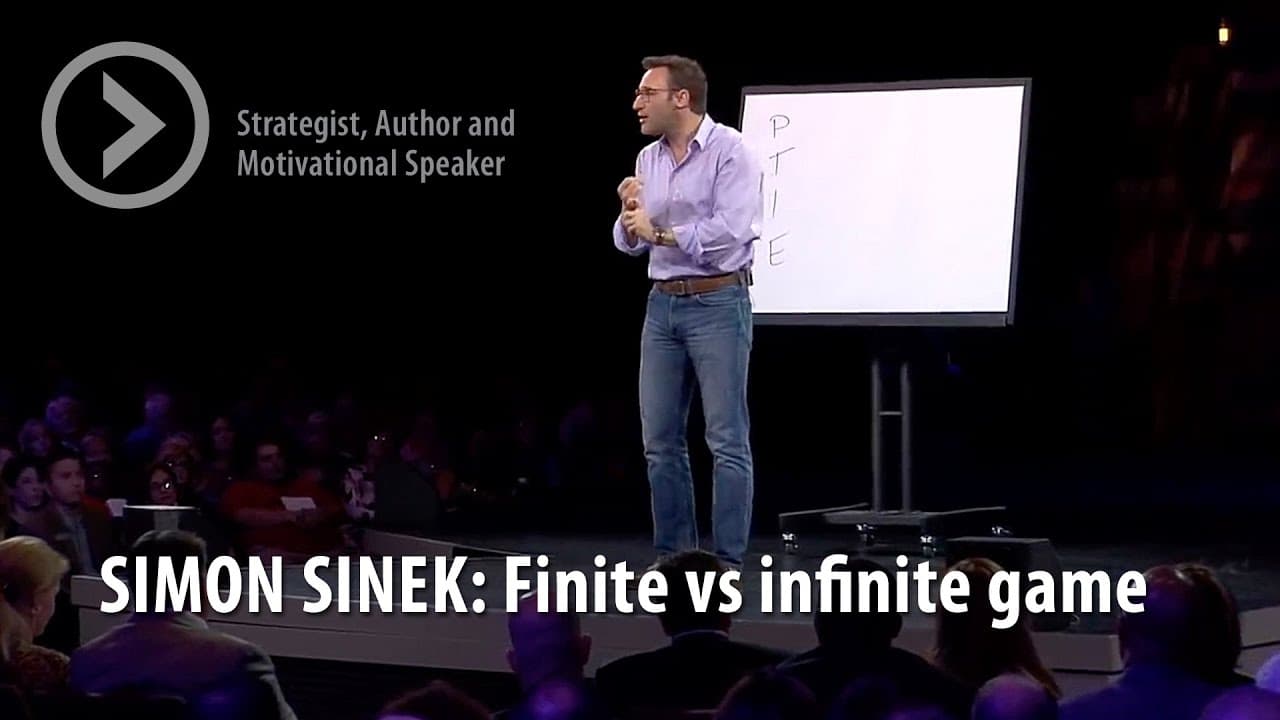
SIMON SINEK: Finite vs infinite game
TL;DR
In game theory, there are two types of games: finite games (with known rules and winners) and infinite games (with changeable rules and no winners or losers).
Transcript
in game theory there are two kinds of games there are finite games and there are infinite games and this is how you're going to change your perspective right a finite game is defined as known players fixed rules and agreed upon objective baseball for example we know the rules we all agree to the rules and whoever has more runs at the end of nine in... Read More
Key Insights
- 👾 Finite games have known players, fixed rules, and agreed-upon objectives, while infinite games have changeable rules, known and unknown players, and the objective of perpetuating the game.
- 👾 The game of business is an infinite game that predates and will outlast individual companies since there is no agreed-upon definition of winning.
- 👾 Many companies do not understand the game they are in and wrongly focus on beating their competition, using arbitrary metrics to declare themselves winners.
Install to Summarize YouTube Videos and Get Transcripts
Explore YouTube Video Summarizer or Get YouTube Transcript Extractor
Questions & Answers
Q: What is the difference between finite games and infinite games?
Finite games have known players, fixed rules, and agreed-upon objectives, while infinite games have known and unknown players, changeable rules, and the objective of perpetuating the game.
Q: Why are finite games stable when played between finite players?
Finite games are stable when played between finite players because they all abide by the same set of rules and objectives, leading to a definitive winner and the end of the game.
Q: Why are infinite contests stable when played between infinite players?
Infinite contests are stable when played between infinite players because there are no winners or losers. The objective is to keep the game going, and players drop out when they run out of will or resources.
Q: What happens when finite players compete against infinite players?
When finite players compete against infinite players, problems arise because the finite players are focused on winning, while infinite players are focused on perpetuating the game. This can lead to quagmires and frustrations for the finite players.
Key Insights:
- Finite games have known players, fixed rules, and agreed-upon objectives, while infinite games have changeable rules, known and unknown players, and the objective of perpetuating the game.
- The game of business is an infinite game that predates and will outlast individual companies since there is no agreed-upon definition of winning.
- Many companies do not understand the game they are in and wrongly focus on beating their competition, using arbitrary metrics to declare themselves winners.
- Companies that embrace the infinite contest and organize their resources and decision-making accordingly, like Southwest Airlines, Apple Computers, and Harley-Davidson, frustrate their competition and become exceptions in the business world.
Summary & Key Takeaways
-
There are two types of games: finite games (with known players, fixed rules, and agreed-upon objectives) and infinite games (with known and unknown players, changeable rules, and the objective of perpetuating the game).
-
In finite games, the system is stable when finite players compete against each other, while infinite contests are stable when infinite players compete against each other.
-
Problems arise when finite players compete against infinite players, as finite players play to win while infinite players play to keep the game going.
Read in Other Languages (beta)
Share This Summary 📚
Summarize YouTube Videos and Get Video Transcripts with 1-Click
Try YouTube Summary with ChatGPT & Claude or YouTube Transcript Generator
Explore More Summaries from Generate Insights 📚

Summarize YouTube Videos and Get Video Transcripts with 1-Click
Try YouTube Summary with ChatGPT & Claude or YouTube Transcript Generator