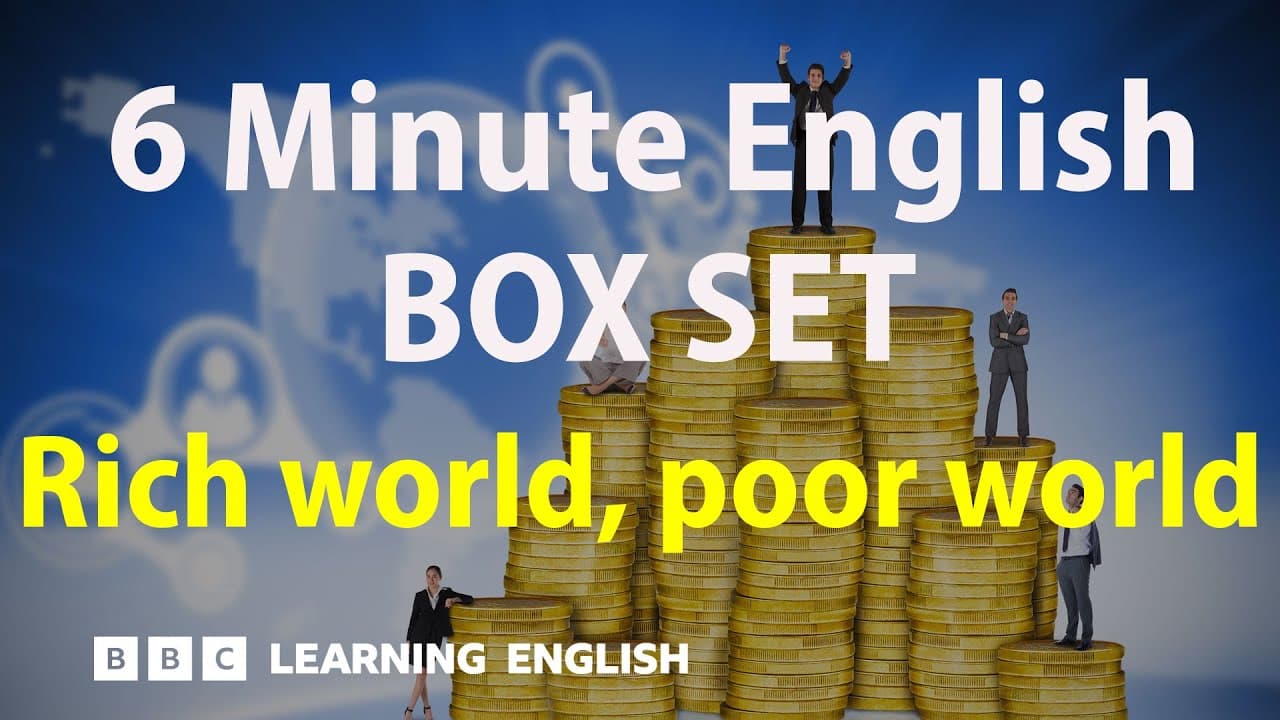
BOX SET: 6 Minute English - 'Rich world, poor world' English mega-class! 30 minutes of new vocab!
TL;DR
Discussion on economic disparities and sharing economy innovations.
Transcript
6 Minute English. From BBC Learning English. Hello and welcome to 6 Minute English. I'm Rob. And I'm Neil. Hello. Hello, Neil! You look very pleased today, Neil. I am pleased. I just moved into my new flat! OK, fantastic! Congratulations! So where is this new flat? It's in the city. It's a one-bed flat so it's 'bijou' — meaning 'small but attractiv... Read More
Key Insights
- The concept of 'poor doors' highlights economic segregation within housing, where different entrances are designated for residents based on their economic status.
- Social housing is defined as housing available for purchase or rent at a lower price, aiming to provide affordable living options.
- The superrich are identified as individuals with assets over $30 million, with yachts serving as a significant status symbol despite being financial liabilities.
- There's a stark global economic inequality, with the richest 1% owning a significant portion of the world's wealth, prompting discussions on fair wealth distribution.
- Philanthropy among the wealthy, as exemplified by Bill Gates, is encouraged as a means to address global poverty and economic disparities.
- The cost of vaccines has escalated, creating challenges for poorer countries in accessing necessary immunizations, leading to calls for pricing transparency.
- The sharing economy, exemplified by platforms like Airbnb and JustPark, offers innovative ways for individuals to monetize unused resources like spare rooms and parking spaces.
- Regulatory challenges exist in the sharing economy as traditional businesses face competition, and laws struggle to keep pace with new business models.
Install to Summarize YouTube Videos and Get Transcripts
Explore YouTube Video Summarizer or Get YouTube Transcript Extractor
Questions & Answers
Q: What is the concept of 'poor doors' discussed in the video?
The concept of 'poor doors' refers to separate entrances in buildings for residents based on their economic status. Typically, wealthier residents have access to more luxurious entrances, while less affluent residents use a different, less appealing entrance, highlighting economic segregation within the same building.
Q: How is social housing defined in the video?
Social housing is defined as housing that is available for purchase or rent at a lower price, intended to provide affordable living options for people who may not be able to afford market-rate housing. It aims to offer more equitable living opportunities for lower-income individuals.
Q: What role do yachts play in the lives of the superrich?
Yachts are considered a significant status symbol for the superrich, representing luxury and wealth. However, they are also described as financial liabilities, often referred to as 'black holes' of wealth, as they tend to depreciate in value and require substantial maintenance costs, unlike other investable assets.
Q: What is the economic disparity discussed in relation to global wealth?
The economic disparity discussed highlights that the richest 1% of the global population owns a disproportionately large share of the world's wealth. This statistic underscores the significant inequality in wealth distribution, prompting discussions on how to address such disparities through policies and philanthropy.
Q: How does Bill Gates view the role of the wealthy in addressing poverty?
Bill Gates advocates for the wealthy to be philanthropic, suggesting they should use their wealth to help the poor both in their own countries and globally. He believes in the obligation of the rich to pay taxes and contribute to societal welfare, finding philanthropy fulfilling and impactful in reducing poverty.
Q: What challenges do poorer countries face regarding vaccine costs?
Poorer countries face challenges with the rising costs of vaccines, making it difficult to immunize their populations effectively. The video discusses calls for greater transparency in vaccine pricing, as some poorer countries end up paying more than wealthier ones, which is seen as disproportionate and unfair.
Q: What is the sharing economy, and how does it function?
The sharing economy refers to a system where individuals can rent out or share their resources, such as spare rooms or parking spaces, through platforms like Airbnb and JustPark. It provides a way to monetize underutilized assets, offering financial benefits to individuals while also presenting regulatory and competitive challenges.
Q: What are the regulatory challenges faced by the sharing economy?
The sharing economy faces regulatory challenges as traditional businesses like hotels and taxi services compete with new models that often operate outside existing legal frameworks. The lack of clear regulations creates uncertainty, and there is a need for laws to evolve to address the unique aspects of these new business models.
Summary & Key Takeaways
-
The programme explores the concept of 'poor doors' in housing, highlighting economic segregation where wealthier residents access different entrances than less affluent ones.
-
Discussion includes insights into the superrich, their spending habits, and the economic gap, emphasizing the role of philanthropy in addressing global inequalities.
-
The sharing economy is presented as a growing trend, with platforms like Airbnb enabling people to monetize spare resources amidst regulatory and competitive challenges.
Read in Other Languages (beta)
Share This Summary 📚
Summarize YouTube Videos and Get Video Transcripts with 1-Click
Try YouTube Summary with ChatGPT & Claude or YouTube Transcript Generator
Explore More Summaries from BBC Learning English 📚
Summarize YouTube Videos and Get Video Transcripts with 1-Click
Try YouTube Summary with ChatGPT & Claude or YouTube Transcript Generator