Average Treatment Effects: Introduction

TL;DR
This content focuses on applying machine learning methods for estimating average treatment effects in causal inference, highlighting the importance of understanding counterfactuals and interventions. It introduces the concept of potential outcomes and discusses the use of randomized trials and confounders in estimating average treatment effects.
Transcript
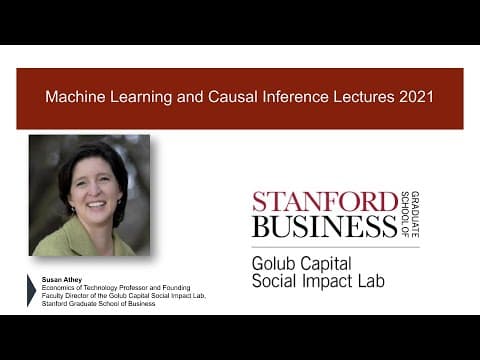
hi everyone welcome to week two of machine learning and causal inference just to get everyone up to speed last week right you had a crash course on machine learning just a reminder of what are some of the widely used methods in machine learning what people are doing out there i imagine that for most of you that is a review or mostly now is when we ... Read More
Key Insights
- 🎰 Machine learning methods are designed for prediction, while causal inference focuses on understanding interventions and counterfactuals.
- 🔬 Estimating average treatment effects is crucial for assessing the effectiveness of interventions in economic and social science applications.
- 🎁 Randomized trials are a straightforward method for estimating average treatment effects, but their applicability is limited when confounders are present.
- 🎰 Machine learning methods can be adapted for causal inference tasks, such as estimating average treatment effects, through methodologies like double robust estimation.
- 🎮 Understanding potential outcomes and the difference between treated and control potential outcomes is essential for estimating average treatment effects accurately.
- 🥺 Treatment assignment based on confounders can lead to biased estimates, highlighting the need for careful consideration of confounding variables in causal inference.
Install to Summarize YouTube Videos and Get Transcripts
Explore YouTube Video Summarizer or Get YouTube Transcript Extractor
Questions & Answers
Q: What is the difference between prediction and understanding causal relationships in the context of machine learning?
Prediction in machine learning refers to the task of determining what is likely to happen in a given situation based on historical data. Understanding causal relationships, on the other hand, involves determining the effect of interventions and counterfactuals, and how changing variables would impact the outcome.
Q: Why is estimating average treatment effects important in causal inference?
Estimating average treatment effects allows us to understand the effectiveness of certain interventions and assess the impact of treatments on outcomes. It provides valuable insights for improving economic and social science applications.
Q: How can machine learning methods be applied to estimating average treatment effects?
Machine learning methods can be adapted for causal tasks by using specialized methodologies, such as double robust estimation. These methods take generic machine learning estimates as inputs and provide confidence intervals with reliable guarantees.
Q: What are the limitations of using randomized trials for estimating average treatment effects?
Randomized trials are a useful approach when treatment assignment is randomized and there are no confounders. However, in scenarios where confounders exist, randomized trials can lead to biased estimates if there is an association between the potential outcomes and the treatment assignment.
Summary & Key Takeaways
-
The content introduces the core concepts of machine learning and causal inference, emphasizing the difference between prediction and understanding causal relationships.
-
It discusses the importance of estimating average treatment effects and how machine learning methods can be applied to this task.
-
The content explores the use of randomized trials as a simple approach to estimating average treatment effects and highlights the limitations of this method when confounders are present.
Read in Other Languages (beta)
Share This Summary 📚
Summarize YouTube Videos and Get Video Transcripts with 1-Click
Try YouTube Summary with ChatGPT & Claude or YouTube Transcript Generator
Explore More Summaries from Stanford Graduate School of Business 📚


Summarize YouTube Videos and Get Video Transcripts with 1-Click
Try YouTube Summary with ChatGPT & Claude or YouTube Transcript Generator