1. Algorithms and Computation

TL;DR
This lecture provides an introduction to algorithms and computational problem solving, emphasizing the importance of proving correctness and efficiency. The class will cover different strategies for solving algorithm problems and design paradigms.
Transcript
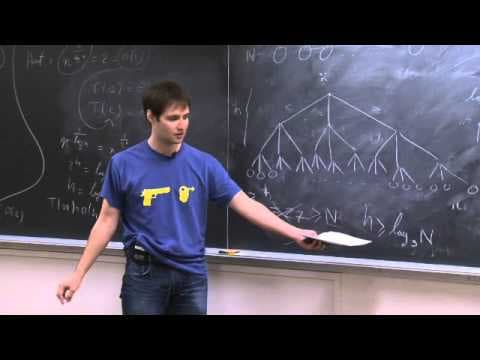
[SQUEAKING] [RUSTLING] [CLICKING] JASON KU: Good morning, everybody. STUDENT: Morning-- JASON KU: My name's Jason Ku. I'm going to be teaching this class in Introduction to Algorithms with two other instructors here-- faculty in the department-- Eric Demaine and Justin Solomon. They're excellent people, and so they will be working on teaching this ... Read More
Key Insights
- 🏛️ The Introduction to Algorithms class focuses on solving computational problems and communicating solutions effectively.
- 🎨 Correctness and efficiency are essential aspects of algorithm design.
- 🔠 Problems are defined as binary relations between inputs and outputs.
- 👍 Algorithms are functions that map inputs to outputs, and their correctness can be proven.
- 🔄 Efficiency is measured by counting fundamental operations and comparing them to the size of the input.
- 🏛️ The class will cover different strategies for solving algorithm problems and design paradigms.
Install to Summarize YouTube Videos and Get Transcripts
Explore YouTube Video Summarizer or Get YouTube Transcript Extractor
Questions & Answers
Q: What is the purpose of the Introduction to Algorithms class?
The class aims to teach students how to solve computational problems and effectively communicate their solutions to others. It focuses on proving correctness and efficiency.
Q: How is a problem defined in computational terms?
A problem is defined as a binary relation between inputs and outputs. For each input, the problem specifies which outputs are correct.
Q: What is an algorithm?
An algorithm is a function that takes inputs and maps them to a single output. The output must be correct according to the problem's definition.
Q: How is efficiency measured in algorithms?
Efficiency is measured by counting fundamental operations and comparing them to the size of the input. The class uses asymptotic analysis and the word RAM model to measure efficiency.
Summary & Key Takeaways
-
The lecture introduces the concept of algorithms and computational problem solving, emphasizing the importance of solving problems and communicating solutions effectively.
-
The speaker discusses the formal definition of a problem and an algorithm, highlighting the relationship between inputs, outputs, and correctness.
-
The class will focus on general algorithms that can handle arbitrarily sized inputs and will require a lot of writing to prove correctness and efficiency.
Read in Other Languages (beta)
Share This Summary 📚
Summarize YouTube Videos and Get Video Transcripts with 1-Click
Try YouTube Summary with ChatGPT & Claude or YouTube Transcript Generator
Explore More Summaries from MIT OpenCourseWare 📚
Summarize YouTube Videos and Get Video Transcripts with 1-Click
Try YouTube Summary with ChatGPT & Claude or YouTube Transcript Generator