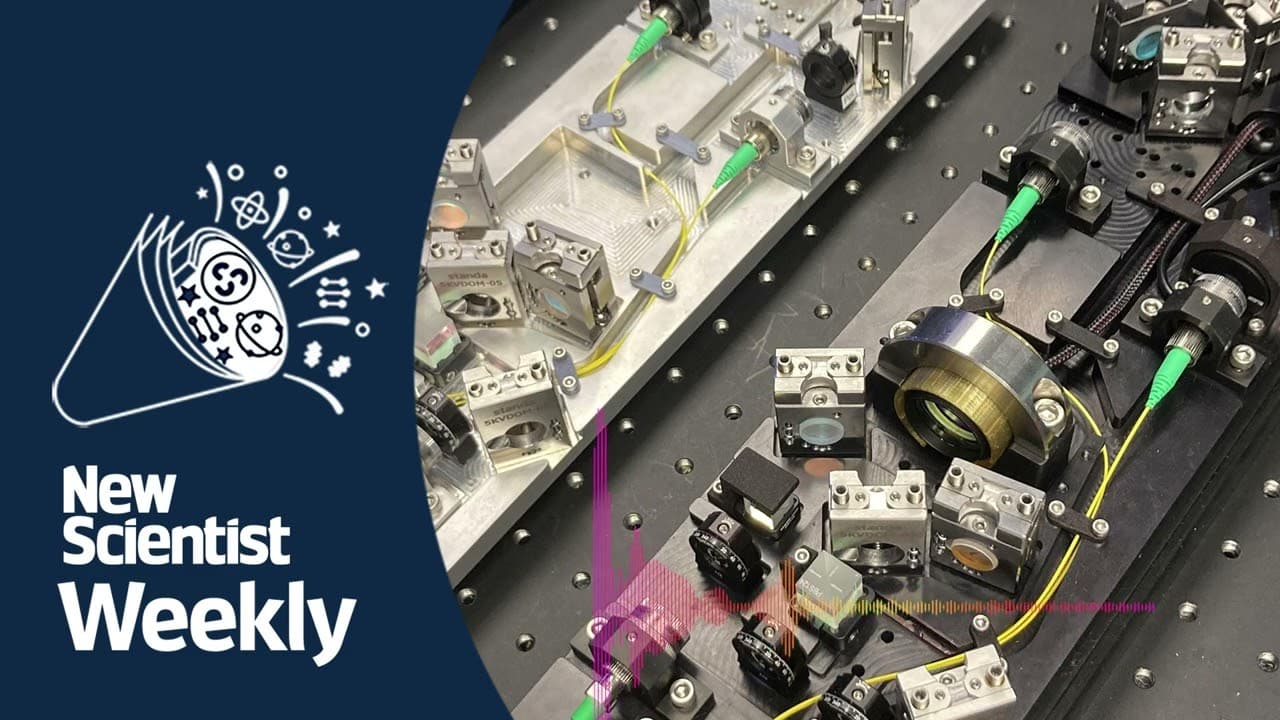
New York goes quantum | New Scientist Weekly podcast 181
TL;DR
Study finds we could feed nearly 20 billion people on current agricultural land if meat and dairy consumption decreases, but risks of nitrogen overuse exist.
Transcript
hello welcome back to New Scientist weekly the essential selection of the week's science stories I'm Penny Sashay and I'm Rowan Hooper welcome to the show coming up on the show this week we have an amazing story about what a 40 000 year old horse bone or maybe bison bone is telling us about a vital time in human cultural Evolution very intriguing u... Read More
Key Insights
- 🤱 Shift towards plant-based diet can maximize feeding capacity.
- 🍻 Environmental risks linked to industrial nitrogen fertilizer overuse.
- 🤱 Organic farming as a sustainable feeding alternative.
- 🍖 Importance of reducing meat and dairy consumption for sustainability.
- 😒 Need for efficient nitrogen use to prevent ecological harm in farming.
- ⚖️ Balancing agriculture productivity with environmental conservation.
- 😋 Organic farming's role in sustainable food production.
Install to Summarize YouTube Videos and Get Transcripts
Explore YouTube Video Summarizer or Get YouTube Transcript Extractor
Questions & Answers
Q: How many people could theoretically be fed on the world's current agricultural land?
The study suggests that nearly 20 billion people could potentially be fed on existing farmland if there is a substantial shift towards a diet focused on more plants and less meat and dairy consumption.
Q: What are the ecological risks associated with feeding 20 billion people using industrial nitrogen fertilizer?
The study warns about the dangers of using vast amounts of industrial nitrogen fertilizer to achieve the feeding capacity, as it could surpass the safe planetary boundary for nitrogen use, leading to biodiversity impacts, dead zones in rivers and oceans, and accelerated climate change.
Q: How could organic farming help in feeding the world's growing population without ecological risks?
Organic farming, if managed efficiently, could potentially feed between 3 to 14 billion people using current agricultural land, emphasizing the need to use organic farming techniques to maximize yield and prevent nitrogen leaching, thus reducing ecological harm.
Q: Why is reducing meat and dairy consumption crucial in ensuring sustainable feeding of the growing population?
The study highlights the importance of reducing meat and dairy consumption as a central aspect of sustainable feeding, indicating that even with organic farming or increased fertilizer use, a diet based on the Western model rich in animal protein would pose challenges in feeding nine billion people due to its environmental impact.
Summary & Key Takeaways
-
Study reveals we could potentially feed 20 billion with altered diet.
-
Concerns arise due to ecological risks of industrial nitrogen fertilizer.
-
Organic farming switch could feed 3-14 billion safely, emphasizing meat reduction.
Read in Other Languages (beta)
Share This Summary 📚
Summarize YouTube Videos and Get Video Transcripts with 1-Click
Try YouTube Summary with ChatGPT & Claude or YouTube Transcript Generator
Explore More Summaries from New Scientist weekly podcast 📚

Summarize YouTube Videos and Get Video Transcripts with 1-Click
Try YouTube Summary with ChatGPT & Claude or YouTube Transcript Generator