6.2.7 Worked Examples: FSM Implementation
TL;DR
The analysis focuses on filling in missing entries in a truth table and identifying equivalent states in a 4-state Moore machine.
Transcript
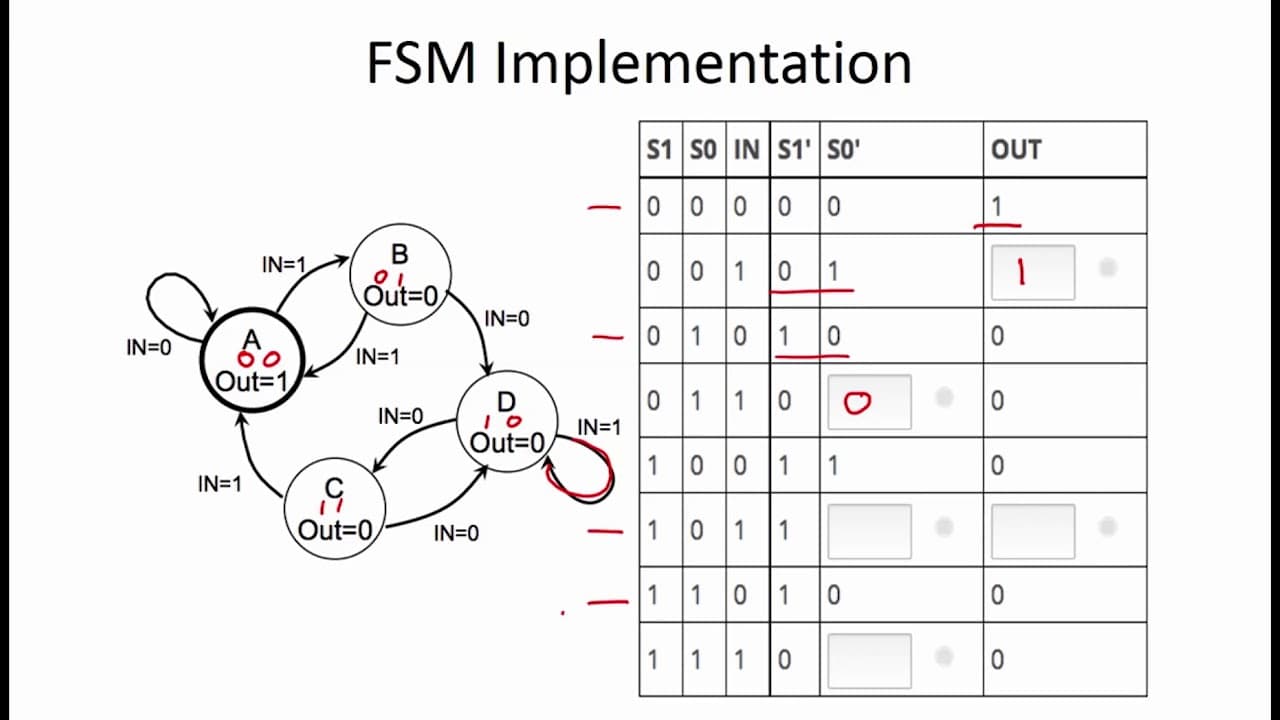
In this problem, we are given a 4 state transition diagram. We know that it represents a Moore machine because the output is a function of only the current state. We are also given a partially filled out truth table and our first job is to fill in the missing entries in the truth table. In order to do this, we need to find the correlation between s... Read More
Key Insights
- 🎟️ The content discusses filling in missing entries in a truth table for a 4-state Moore machine.
- ❓ The correlation between the states and their S1S0 encoding is determined by analyzing the transitions and output values.
- 😃 Equivalent states (B and C) are identified based on their matching transitions and output values.
Install to Summarize YouTube Videos and Get Transcripts
Explore YouTube Video Summarizer or Get YouTube Transcript Extractor
Questions & Answers
Q: How is the encoding for each state determined in a Moore machine?
The encoding for each state in a Moore machine is determined based on the correlation between the state and its S1S0 encoding, as well as the output value associated with that state. By analyzing the transitions and output values, the encoding can be deduced.
Q: What is the significance of the missing entries in the truth table?
The missing entries in the truth table need to be filled in to have a complete understanding of the FSM's behavior. These entries determine the next states (S0' values) and the outputs associated with each state, enabling proper functioning and analysis of the machine.
Q: How are equivalent states identified in a Moore machine?
In a Moore machine, equivalent states have the same output and the same input transitions. By comparing the transitions and output values of different states, it is possible to identify equivalent states. These equivalent states can then be merged to simplify the FSM.
Q: How does merging equivalent states affect the FSM?
Merging equivalent states reduces the number of states in the FSM, leading to a simpler and more efficient machine. In the provided analysis, states B and C are identified as equivalent and can be combined into a single state, resulting in a 3-state FSM.
Summary & Key Takeaways
-
The content provides a 4-state transition diagram representing a Moore machine and a partially filled truth table.
-
By analyzing the diagram and output values, the missing entries in the truth table are filled in.
-
The encoding for each state (A, B, C, and D) is determined based on the transitions and correlation with the output values.
-
Equivalent states are identified, specifically states B and C, which can be merged to create a 3-state FSM (Finite State Machine).
Read in Other Languages (beta)
Share This Summary 📚
Summarize YouTube Videos and Get Video Transcripts with 1-Click
Try YouTube Summary with ChatGPT & Claude or YouTube Transcript Generator
Explore More Summaries from MIT OpenCourseWare 📚



Summarize YouTube Videos and Get Video Transcripts with 1-Click
Try YouTube Summary with ChatGPT & Claude or YouTube Transcript Generator