Why Are Your Headphones Always in a Knot? Science Explains
TL;DR
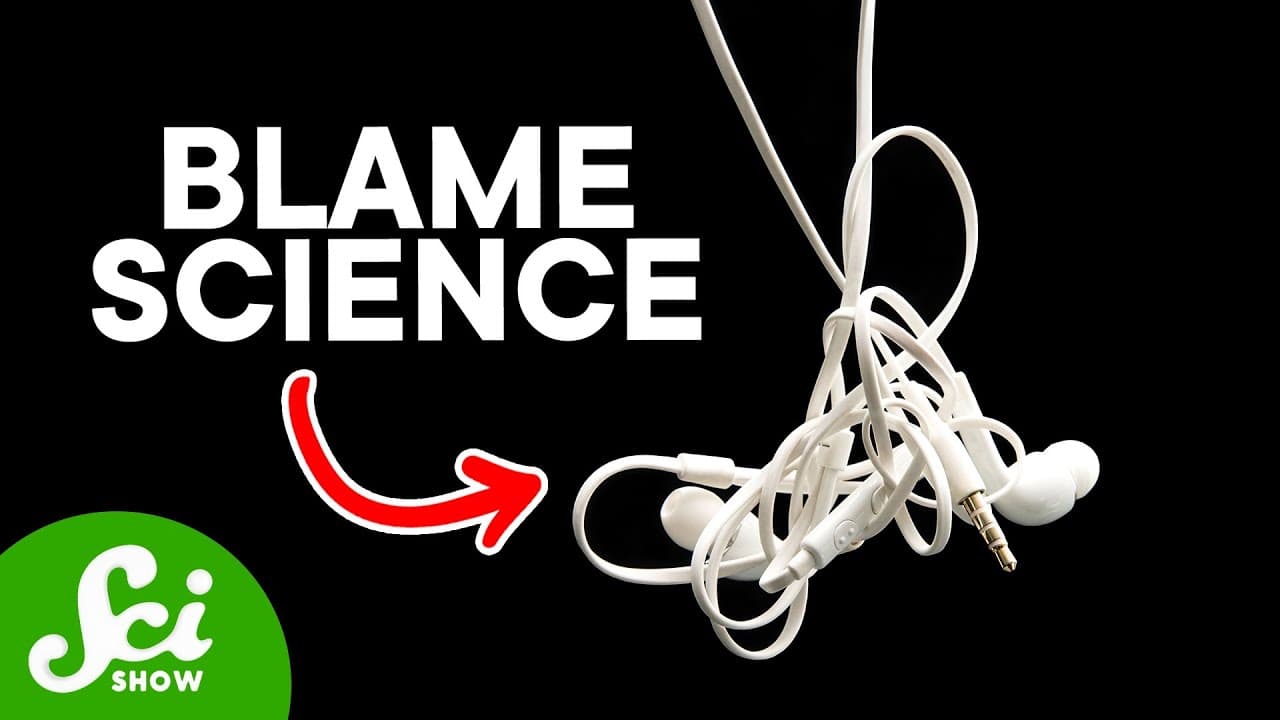
Scientists have discovered that headphone cords naturally form knots due to the way they move, but there are ways to prevent this from happening.
Transcript
Thanks to Skillshare for supporting this episode of SciShow. [♩INTRO] Sometimes, headphones are just the worst. It seems like every time I want to whip out my earbuds and go for a run, I’m stuck untangling a huge knotted mess. I swear I try to keep them organized, but nothing seems to work. Believe it or not, scientists have studied this phenomenon... Read More
Key Insights
- 🥺 Agitation causes strings to naturally form knots, leading to tangled headphone cords.
- 🪢 Knot theory, a branch of mathematics, is used to study and understand how and why things get tangled.
- 🪘 Longer strings, longer spinning time, and stiffer strings increase the probability of knot formation.
Install to Summarize YouTube Videos and Get Transcripts
Explore YouTube Video Summarizer or Get YouTube Transcript Extractor
Questions & Answers
Q: Why do headphone cords get tangled so easily?
Headphone cords get tangled easily because the movement of the cords creates agitation, causing the string to form knots naturally. This phenomenon has been studied by scientists.
Q: What did the researchers find in their experiments?
The researchers found that it doesn't take much for a knot to form in a string. In just 10 seconds of spinning with 10 rotations, about half of the strings formed knots. They also discovered that longer strings, longer spinning time, and stiffer strings increase the probability of a knot forming.
Q: What types of knots did the researchers observe in their experiments?
The researchers observed that the knots formed in the experiments were mostly big, single knots called prime knots. They did not find many composite knots with two knots at either end.
Q: Can headphone tangles be prevented?
Yes, there are ways to prevent headphone tangles. Keeping the cords in a small, confined space where they cannot move or jiggle is recommended. Wrapping the cords around something can also help prevent tangles.
Summary & Key Takeaways
-
Scientists have studied the phenomenon of headphone cords becoming tangled and have found that strings naturally form knots when agitated.
-
Researchers conducted experiments with strings of different lengths and stiffness, spinning them in a plastic box to observe knot formation.
-
They discovered that longer strings, longer spinning time, and stiffer strings increase the likelihood of a knot forming.
Read in Other Languages (beta)
Share This Summary 📚
Summarize YouTube Videos and Get Video Transcripts with 1-Click
Try YouTube Summary with ChatGPT & Claude or YouTube Transcript Generator
Explore More Summaries from SciShow 📚


Summarize YouTube Videos and Get Video Transcripts with 1-Click
Try YouTube Summary with ChatGPT & Claude or YouTube Transcript Generator