Real GDP Per Capita and the Standard of Living
TL;DR
Real GDP per capita correlates with living standards but isn't perfect.
Transcript
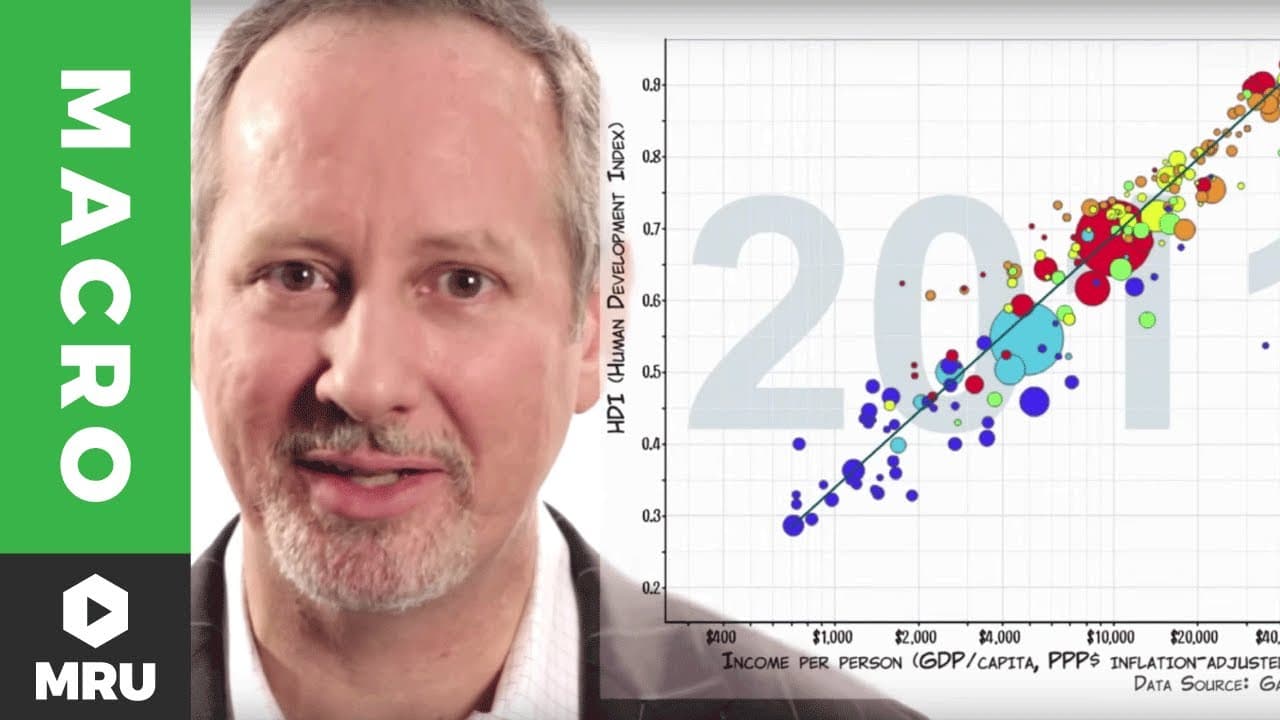
♪ [music] ♪ - [Alex] Is Real GDP per capita a good measure of the standard of living? People tell me all the time, "You economists, you're too materialistic." Doesn't Real GDP per capita just measure the things we buy? What about our health, our happiness, education? Well, Real GDP per capita -- it's not a perfect measure. But I want to show you wh... Read More
Key Insights
- Real GDP per capita is often criticized for being materialistic, but it correlates with life expectancy, happiness, and education.
- Higher Real GDP per capita is positively correlated with longer life expectancy and greater happiness across countries.
- The Human Development Index, which includes GDP per capita, life expectancy, and education, shows improvement with higher GDP per capita.
- GDP per capita misses income distribution, evident in countries like Nigeria, Pakistan, and Honduras with similar GDP but different poverty levels.
- Despite its limitations, Real GDP per capita is useful for comparing living standards across countries and over time.
- Growth in Real GDP per capita usually indicates rising incomes, including for the poorest segments of society.
- Income inequality can skew perceptions of living standards despite similar GDP per capita figures.
- Understanding GDP per capita helps in assessing a country's standard of living, but it's not the sole measure of progress.
Install to Summarize YouTube Videos and Get Transcripts
Explore YouTube Video Summarizer or Get YouTube Transcript Extractor
Questions & Answers
Q: What is the relationship between Real GDP per capita and life expectancy?
There is a positive correlation between Real GDP per capita and life expectancy. As Real GDP per capita increases, countries generally experience longer life expectancies. This relationship suggests that higher economic output per person often corresponds with better access to healthcare, nutrition, and other factors contributing to longevity.
Q: How does Real GDP per capita relate to happiness?
Real GDP per capita is positively correlated with happiness. Countries with higher GDP per capita tend to have happier populations. This correlation may be attributed to improved living conditions, better access to resources, and enhanced social services that accompany increased economic prosperity.
Q: What does the Human Development Index (HDI) reveal about GDP per capita?
The Human Development Index (HDI) combines life expectancy, education, and standard of living, often showing improvement with higher GDP per capita. It indicates that as GDP per capita rises, countries tend to see advancements in human development, reflecting better health, education, and overall living conditions.
Q: Why is GDP per capita not a perfect measure of living standards?
GDP per capita is not perfect because it does not account for income distribution. While it provides an average economic output per person, it can mask disparities within a population. For example, countries with similar GDP per capita can have vastly different poverty levels due to unequal income distribution.
Q: What role does income distribution play in GDP per capita assessments?
Income distribution plays a crucial role in assessing GDP per capita. Even with similar GDP per capita figures, countries can have different standards of living if income is unevenly distributed. This can lead to significant portions of the population living in poverty, as seen in Nigeria compared to Pakistan and Honduras.
Q: How does Real GDP per capita impact the poorest segments of society?
Growth in Real GDP per capita usually indicates rising incomes, including for the poorest segments of society. As average per capita income increases, the incomes of the very poor also tend to rise, suggesting that economic growth can benefit all levels of society, albeit not always equally.
Q: Can GDP per capita be misleading when comparing countries?
Yes, GDP per capita can be misleading when comparing countries if income distribution is not considered. Similar GDP per capita figures can hide significant differences in poverty and living standards, as wealth concentration in a small segment of the population can skew the average.
Q: Why is understanding GDP per capita important for measuring living standards?
Understanding GDP per capita is important because it provides a snapshot of a country's economic output per person, which correlates with various aspects of living standards, such as health, education, and happiness. While not comprehensive, it is a valuable tool for assessing economic health and development.
Summary & Key Takeaways
-
Real GDP per capita is a key measure of living standards, correlating with life expectancy, happiness, and education. However, it has limitations, particularly in accounting for income distribution, as seen in countries like Nigeria, Pakistan, and Honduras.
-
While Real GDP per capita is a useful measure for comparing living standards, it is not perfect. It fails to account for income inequality, which can lead to misleading conclusions about a country's overall well-being.
-
Despite criticisms, Real GDP per capita remains a valuable tool for understanding economic growth and its impact on living standards. It highlights the interconnectedness of material wealth with health, happiness, and education.
Read in Other Languages (beta)
Share This Summary 📚
Summarize YouTube Videos and Get Video Transcripts with 1-Click
Try YouTube Summary with ChatGPT & Claude or YouTube Transcript Generator
Explore More Summaries from Marginal Revolution University 📚

Summarize YouTube Videos and Get Video Transcripts with 1-Click
Try YouTube Summary with ChatGPT & Claude or YouTube Transcript Generator