The Monopoly Markup
TL;DR
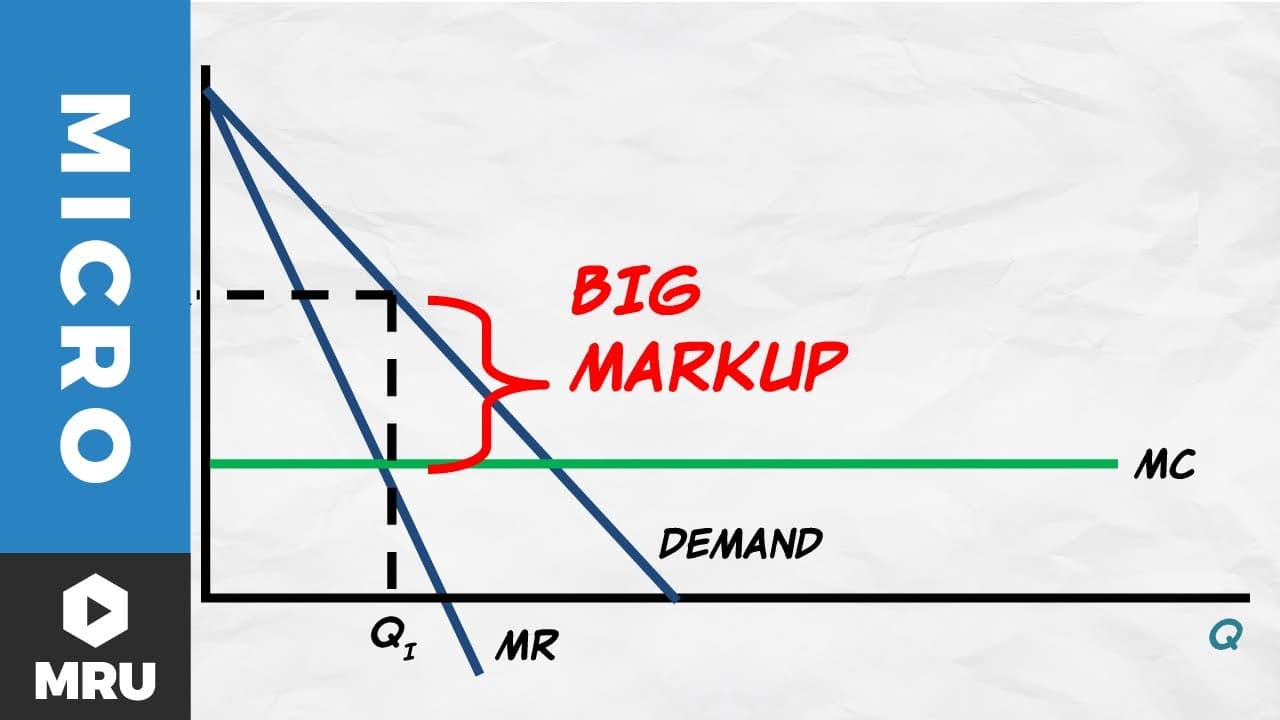
Monopoly markup depends on demand elasticity.
Transcript
♪ [music] ♪ - [Alex] In a competitive market, we know that price is equal to marginal cost and equilibrium. In a market with a monopoly, we now know the price will be greater than marginal cost. But how much greater? What determines the markup? What we're going to show in this talk is that the monopoly markup depends upon the elasticity of demand. ... Read More
Key Insights
- In competitive markets, price equals marginal cost, but monopolies set prices higher than marginal costs, creating a markup.
- The monopoly markup is influenced by the elasticity of demand; less elastic demand results in a higher markup.
- The 'you can't take it with you' effect explains why people with serious illnesses are less sensitive to price changes for life-saving medicines.
- The 'other people's money' effect occurs when third parties, like insurance companies, pay for goods, reducing consumer price sensitivity.
- Inelastic demand allows monopolists to raise prices without significantly reducing quantity demanded, increasing profits.
- Elastic demand curves lead to lower markups, as price increases significantly reduce quantity demanded.
- Airline pricing illustrates these principles, with fewer substitutes leading to inelastic demand and higher prices for certain routes.
- Monopolists adjust pricing strategies based on demand elasticity, aiming to maximize profits while considering consumer price sensitivity.
Install to Summarize YouTube Videos and Get Transcripts
Explore YouTube Video Summarizer or Get YouTube Transcript Extractor
Questions & Answers
Q: What determines the size of a monopoly's markup?
The size of a monopoly's markup is determined by the elasticity of demand. When demand is inelastic, consumers are less sensitive to price changes, allowing monopolists to set higher prices without significantly reducing the quantity demanded. This results in a higher markup over marginal cost, maximizing the monopolist's profits.
Q: How does the 'you can't take it with you' effect influence monopoly pricing?
The 'you can't take it with you' effect influences monopoly pricing by making consumers less sensitive to price changes for essential goods, like life-saving medicines. People with serious illnesses prioritize their health over costs, allowing monopolists to increase prices without significantly affecting demand. This leads to higher markups and profits for the monopolist.
Q: What role does the 'other people's money' effect play in monopoly markets?
The 'other people's money' effect plays a significant role in monopoly markets by reducing consumer sensitivity to price changes when third parties, such as insurance companies, pay for goods. This effect allows monopolists to raise prices without affecting demand, as consumers are not directly bearing the cost, leading to higher markups and increased profits.
Q: Why do airlines charge more for certain routes despite longer distances?
Airlines charge more for certain routes despite longer distances due to demand elasticity and the availability of substitutes. Routes with fewer alternatives, often to hub cities, face inelastic demand, allowing airlines to charge higher prices. In contrast, routes with more options have elastic demand, leading to lower prices and markups closer to competitive market levels.
Q: How does demand elasticity affect a monopolist's pricing strategy?
Demand elasticity affects a monopolist's pricing strategy by dictating how much they can charge above marginal cost. Inelastic demand allows monopolists to raise prices significantly without reducing sales, maximizing profits. Conversely, elastic demand requires competitive pricing, as consumers are more sensitive to price changes, limiting the monopolist's ability to set high markups.
Q: What is the relationship between demand elasticity and markup size?
The relationship between demand elasticity and markup size is inversely proportional. As demand becomes more inelastic, consumers are less responsive to price changes, allowing monopolists to increase markups and set prices significantly above marginal cost. Conversely, more elastic demand results in smaller markups, as price increases lead to substantial decreases in quantity demanded.
Q: How do monopolists use demand curves to determine pricing?
Monopolists use demand curves to determine pricing by assessing the elasticity of demand. They analyze how quantity demanded responds to price changes and adjust prices accordingly. Inelastic demand allows for higher markups, while elastic demand necessitates lower prices to maintain sales volume. This strategic pricing maximizes profits while considering consumer sensitivity to price.
Q: What lessons can be learned from the airline pricing example regarding monopolistic markets?
The airline pricing example teaches that monopolistic markets exploit demand elasticity to set prices. Routes with fewer substitutes face inelastic demand, leading to higher prices and markups. In contrast, routes with more options have elastic demand, resulting in competitive pricing. This illustrates how monopolists adjust strategies based on consumer sensitivity to price changes, maximizing profits.
Summary & Key Takeaways
-
Monopolies set prices above marginal costs, creating a markup determined by demand elasticity. Inelastic demand results in higher markups, as consumers are less sensitive to price changes. This is evident in markets like pharmaceuticals, where life-saving drugs face inelastic demand due to critical needs and third-party payers.
-
Airline pricing strategies demonstrate how monopolies exploit inelastic demand. Routes with fewer substitutes, like hub cities, face higher prices due to limited competition. Conversely, routes with more options have more elastic demand, leading to lower markups and prices closer to competitive market levels.
-
Monopolists maximize profits by adjusting prices based on demand elasticity. Inelastic demand allows price hikes without significantly reducing sales, while elastic demand requires competitive pricing. Understanding these dynamics helps explain pricing puzzles, such as varying airline ticket costs for similar routes.
Read in Other Languages (beta)
Share This Summary 📚
Summarize YouTube Videos and Get Video Transcripts with 1-Click
Try YouTube Summary with ChatGPT & Claude or YouTube Transcript Generator
Explore More Summaries from Marginal Revolution University 📚


Summarize YouTube Videos and Get Video Transcripts with 1-Click
Try YouTube Summary with ChatGPT & Claude or YouTube Transcript Generator