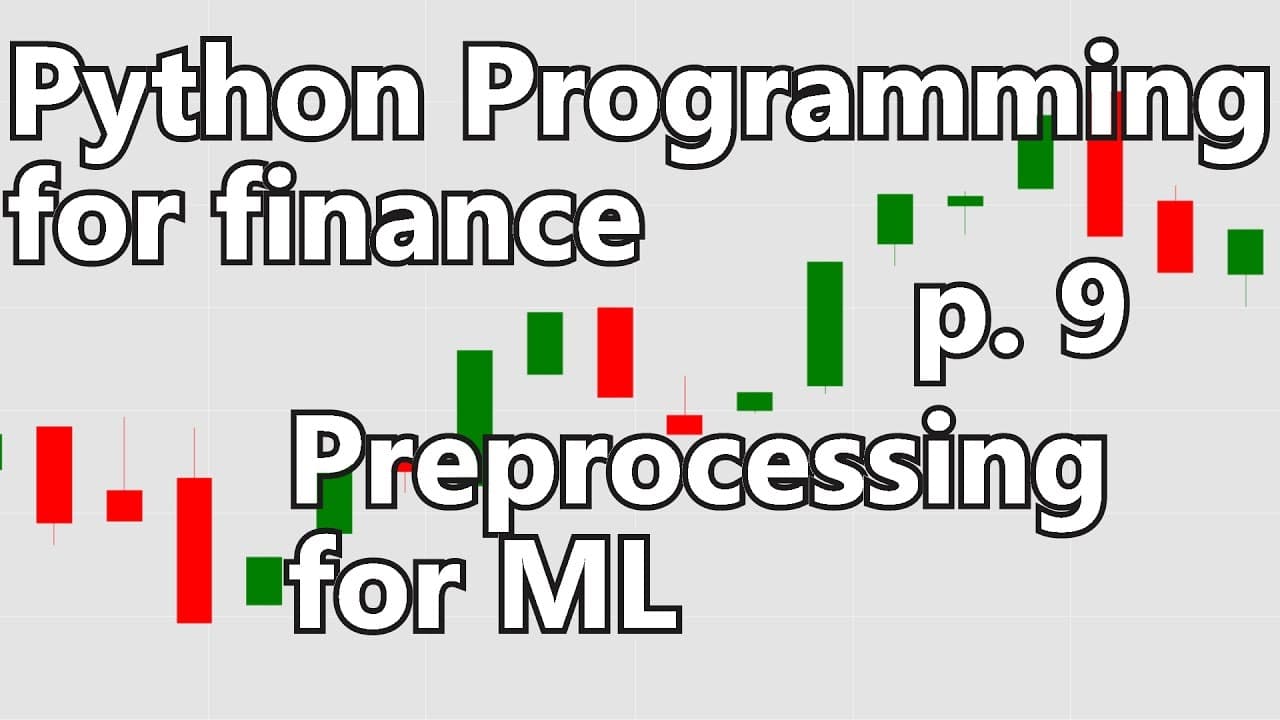
Preprocessing data for Machine Learning - Python Programming for Finance p. 9
TL;DR
In this tutorial, we learn how to create a correlation table for stock data using Python and explore the idea of predicting stock movements based on the correlations between companies.
Transcript
what's going on everybody welcome to part 9 of our Python for financing toriel series in the tutorials leading up to here we've learned how to get some data we've learned how to manipulate some of that data a we learn how to visualize a bunch of data now in this tutorial really doing is since in the visualization of a bunch of data basically creati... Read More
Key Insights
- 👻 Normalizing stock pricing data to percentage changes allows for better analysis and comparison.
- 🥹 Labeling stocks as buy, sell, or hold based on price movements within a specific timeframe can assist in creating a predictive model.
- ❓ Considering the correlation between multiple companies' stock data may provide a more accurate prediction of individual stocks.
- 🧑🤝🧑 The tutorial emphasizes the need for more historical data and potentially shorter timeframes to capture up-to-date correlations.
- 🦔 Taking into account the movement of all other companies can potentially provide an edge in predicting stock movements.
- ❓ Accurately predicting stock movements requires advanced data processing and feature engineering.
- 🧑🦽 Machine learning algorithms can help in finding patterns and relationships in stock data that may be missed by manual analysis.
Install to Summarize YouTube Videos and Get Transcripts
Explore YouTube Video Summarizer or Get YouTube Transcript Extractor
Questions & Answers
Q: How is the stock pricing data processed in this tutorial?
The stock pricing data is normalized by converting it to percentage change, creating features for machine learning algorithms to analyze.
Q: How are the labels (buy, sell, hold) determined for each stock?
The labels are determined based on whether the stock price goes up or down by more than 2% within the next seven trading days. If it goes up, it's labeled as a buy; if it falls, it's labeled as a sell; otherwise, it's labeled as a hold.
Q: Can the correlation between companies accurately predict stock movements?
The tutorial explores the idea that groups of companies may move together but not necessarily at the same time. Taking into account the movement of all other companies in addition to the current company could potentially provide an edge in predicting stock movements.
Q: What are some limitations of using correlation for stock prediction?
The tutorial mentions that long-term correlations between companies may change over time. It also suggests that more than daily data is needed for accurate predictions.
Summary & Key Takeaways
-
The tutorial teaches how to process stock pricing data and convert it into percentage change to create features for machine learning.
-
The goal is to label the data as buy, sell, or hold based on whether the price goes up or down within the next seven trading days.
-
The tutorial explains how to generate future values for each company's stock data and provides insight on the limitations of using correlation for stock prediction.
Read in Other Languages (beta)
Share This Summary 📚
Summarize YouTube Videos and Get Video Transcripts with 1-Click
Try YouTube Summary with ChatGPT & Claude or YouTube Transcript Generator
Explore More Summaries from sentdex 📚

Summarize YouTube Videos and Get Video Transcripts with 1-Click
Try YouTube Summary with ChatGPT & Claude or YouTube Transcript Generator