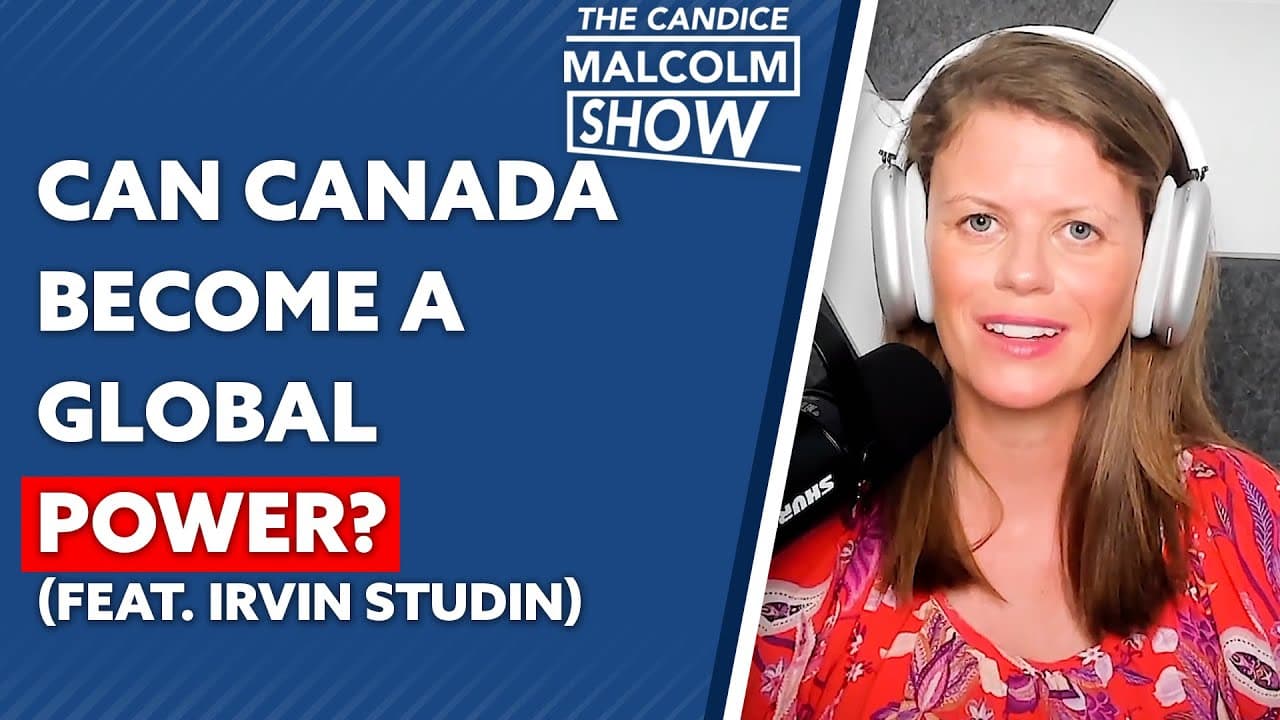
Can Canada become a global power? (ft. Irvin Studin)
TL;DR
Canada can only succeed as a global superpower by prioritizing self-thinking and strategic development.
Transcript
can canada become a global superpower only if we learn to think for ourselves i'm kenneth malcolm and this is the kenneth malcolm show hi everyone thank you so much for tuning in to the podcast prime minister justin trudeau and his deputy christian freeland have a rather small view of canada when it comes to a role in the world and on the world sta... Read More
Key Insights
- 🌍 The Canadian government’s internationalism undermines its national interest and hampers its potential on the world stage.
- ⚠️ Dr. Irvin Studin warns of the existential threats to Canada, including unity challenges and aggressive posturing from surrounding superpowers.
- 🇨🇦 The Arctic's potential as an economic center is a significantly overlooked opportunity critical to Canada's growth and survival.
- 🇨🇫 Shifting public perception of the North as an unattractive frozen wasteland to a thriving economic frontier is essential.
- 🌐 A strategic population increase is required for Canada to maintain sovereignty and a meaningful role in global affairs.
- 👨💼 Collaboration between federal leaders, businesses, and civil society is essential to attract families and professionals to the North.
- 📽️ Understanding history is important, but projecting forward and fostering confidence in Canada’s future is crucial.
Install to Summarize YouTube Videos and Get Transcripts
Explore YouTube Video Summarizer or Get YouTube Transcript Extractor
Questions & Answers
Q: What are the main points of contention regarding Canada's current government’s view on its global role?
The government's belief in Canada as a "middle power" limits its ambition on the world stage. Prime Minister Justin Trudeau and Deputy Prime Minister Chrystia Freeland emphasize stakeholder capitalism, prioritizing social justice and climate action over strategic national interests. This ideology leads to decisions that may sacrifice Canada's economic growth and innovation for global virtue signaling.
Q: How does Dr. Studin characterize the threats facing Canada?
Dr. Studin identifies multiple existential threats, including domestic unity challenges like Quebec separation, indigenous governance issues, and external pressures from major powers like Russia and China. He warns that these threats, if unaddressed, could lead to Canada's instability or collapse, highlighting a critical need for a coherent national strategy.
Q: What opportunities does Dr. Studin see in the development of Canada's northern territories?
The northern territories represent vast untapped resources and economic potential. Dr. Studin envisions transforming the Arctic into a hub that connects Canada to larger markets, thereby fostering population growth and economic prosperity. He suggests that as the Arctic opens, Canada can create a major trade route and become influential in the global market.
Q: How can Canada attract more people to the North, according to Dr. Studin?
Dr. Studin suggests targeted recruitment initiatives that could include incentives like land grants or financial benefits for families willing to relocate north. By improving infrastructure and creating job opportunities, Canada can reshape perceptions of the North as a viable and desirable place for living and working.
Q: What is the significance of changing Canada's demographic strategy?
Dr. Studin posits that increasing Canada's population to around 100 million is vital for its survival and influence. A larger population would enhance economic vibrancy, lead to better resource management in the North, and create a stronger political landscape that could resist external pressures from more populous neighbor states.
Q: How does the current ideology affect the perception of immigration in Canada?
The prevailing ideology often discourages a healthy discourse on immigration by viewing it through a lens of guilt and historical colonialism. This can undermine the self-esteem of Canadians and affect integration efforts for newcomers. Dr. Studin argues for a positive reimagining of Canada to welcome diverse cultures while maintaining national unity.
Q: In what way does Dr. Studin believe Canada can achieve major power status?
Dr. Studin believes that through intensified strategic thought on national identity, resource development, and relationship building with other major powers, Canada can transition from a middle power to a major influence on the global stage. This can be achieved by leveraging its geographical advantages, especially in relation to the Arctic.
Summary & Key Takeaways
-
The current Canadian government holds a limited worldview, focusing on internationalism rather than national interests, which may hinder Canada's global role.
-
Dr. Irvin Studin argues that Canada faces significant existential threats that require a serious reevaluation of its strategy and capacity for growth, particularly in the Arctic region.
-
Future potential lies in developing Canada’s northern territories and fostering economic growth to position the nation as a major power amidst powerful neighboring countries.
Read in Other Languages (beta)
Share This Summary 📚
Summarize YouTube Videos and Get Video Transcripts with 1-Click
Try YouTube Summary with ChatGPT & Claude or YouTube Transcript Generator
Explore More Summaries from True North 📚


Summarize YouTube Videos and Get Video Transcripts with 1-Click
Try YouTube Summary with ChatGPT & Claude or YouTube Transcript Generator