Open primaries, closed primaries, and blanket primaries | US government and civics | Khan Academy
TL;DR
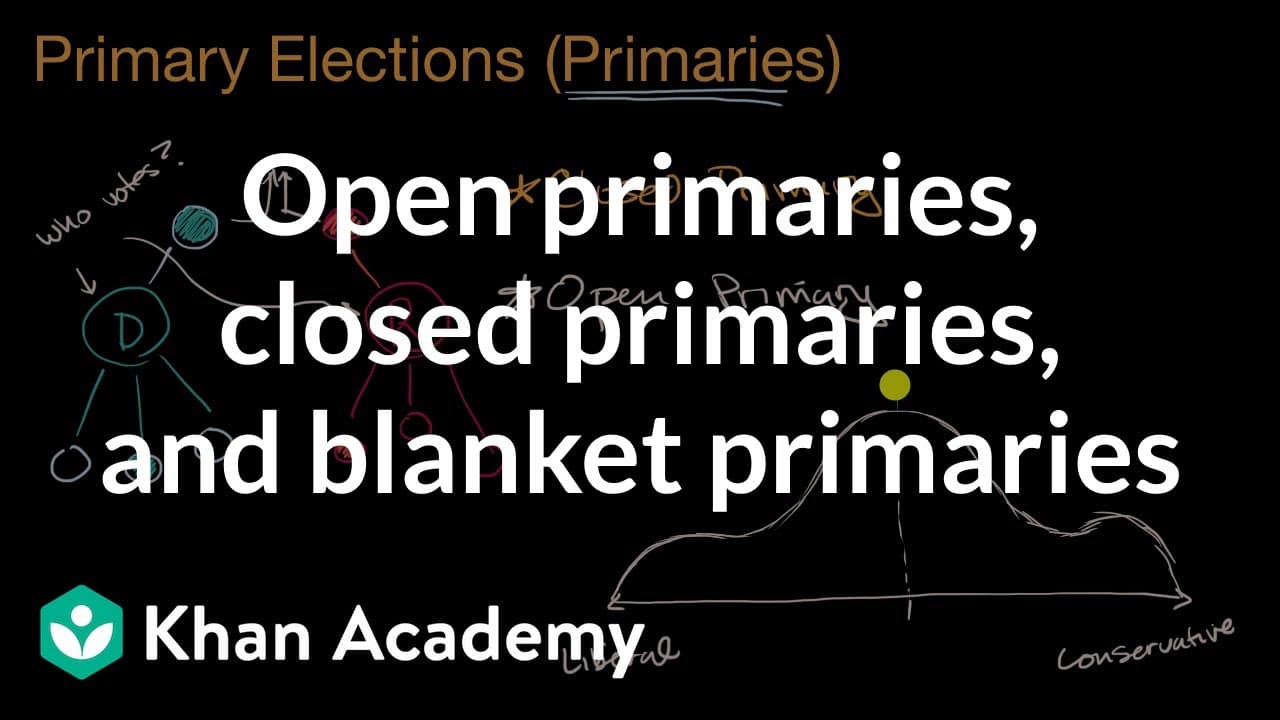
Primary elections are preliminary elections used to select a candidate to represent a political party in the general election. There are closed, open, and blanket primaries, each with their own advantages and disadvantages.
Transcript
- [Presenter] Let's talk about primary elections, which are often known as primaries. One way to think about them is that they're just preliminary elections used to get down to a fewer number of candidates. A very simple example would be let's say there's a congressional seat in your district, and there's three folks who are interested in that posi... Read More
Key Insights
- 🥳 Primary elections are essential for selecting candidates to represent political parties in general elections.
- 😚 Closed primaries limit participation to registered party members, ensuring a more partisan selection.
- 🤗 Open primaries allow for crossover voting and potentially moderate the candidate selection process.
- 🥳 Blanket primaries are nonpartisan and can result in two candidates from the same party advancing to the general election.
Install to Summarize YouTube Videos and Get Transcripts
Explore YouTube Video Summarizer or Get YouTube Transcript Extractor
Questions & Answers
Q: What is a primary election and why is it important in the political process?
A primary election is a preliminary election used to select a candidate to represent a political party in the general election. It is important because it helps narrow down the number of candidates and allows party members to choose their preferred representative.
Q: What is the difference between a closed and an open primary?
In a closed primary, only registered members of a specific party can vote. In an open primary, non-affiliated voters and even members of the opposing party can participate, potentially influencing the outcome.
Q: What are the advantages and disadvantages of a closed primary?
The advantage of a closed primary is that it ensures that only registered members of a party have a say in selecting their representative. However, critics argue that it can lead to candidates catering only to the party's base and leaning towards extreme views, which may not accurately represent the overall population.
Q: How does a blanket primary work?
In a blanket primary, all candidates, regardless of party affiliation, participate in a single preliminary election. The top two candidates with the most votes then move on to the general election. This system allows for potential scenarios where two candidates from the same party face off in the general election.
Summary & Key Takeaways
-
Primary elections are used to narrow down the number of candidates for a specific position, such as a congressional seat.
-
In closed primaries, only registered Democrats can vote in the Democratic primary, and only registered Republicans can vote in the Republican primary.
-
Open primaries allow non-affiliated voters and even members of the opposing party to vote in a primary, potentially influencing the outcome.
-
Blanket primaries are nonpartisan and involve all candidates running against each other, with the top two moving on to the general election.
Read in Other Languages (beta)
Share This Summary 📚
Summarize YouTube Videos and Get Video Transcripts with 1-Click
Try YouTube Summary with ChatGPT & Claude or YouTube Transcript Generator
Explore More Summaries from Khan Academy 📚




Summarize YouTube Videos and Get Video Transcripts with 1-Click
Try YouTube Summary with ChatGPT & Claude or YouTube Transcript Generator