What Is the Arctic Circle Theorem and Its Significance?
TL;DR
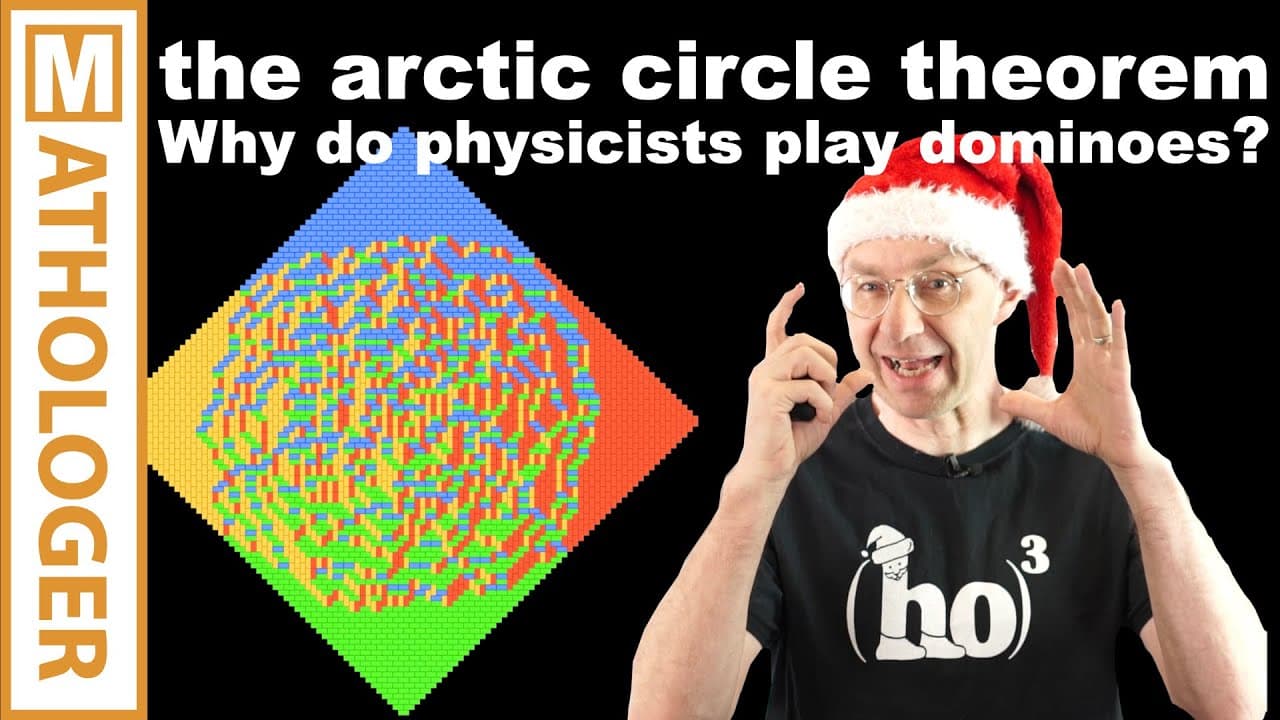
The Arctic Circle Theorem explains how domino tilings on Aztec diamonds lead to frozen regions at the corners and a circular chaotic area in the center, resembling structures in nature. It reveals that a mutilated chessboard cannot be tiled if it has unequal numbers of black and green squares. Mathematicians use determinant formulas to calculate tilings, showcasing a simple yet powerful mathematical model.
Transcript
Welcome to the 2020 Mathologer Christmas video. What a crazy crazy year. Right? Well let me finish off this crazy year with a really crazy video. An intro to why physicists and mathematicians love playing dominoes. And we'll finish the craziness with an explanation of the mysterious arctic circle theorem. Pretty sure you've never heard of... Read More
Key Insights
- 🟩 Removing two opposite corners from a chessboard creates a mutilated board that cannot be tiled due to an unequal number of black and green squares.
- 🛟 Domino tilings serve as models for natural phenomena in physics, providing insights into structures and patterns found in nature.
- 🖕 Aztec diamonds exhibit frozen regions in the corners and an arctic circle in the middle, with their tilings revealing connections to brickwork patterns and circularity.
Install to Summarize YouTube Videos and Get Transcripts
Explore YouTube Video Summarizer or Get YouTube Transcript Extractor
Questions & Answers
Q: What is the mutilated chessboard puzzle, and why is it impossible to tile the board after removing two opposite corners?
The mutilated chessboard puzzle involves removing two opposite corners from a chessboard and attempting to tile the remaining board with dominoes. However, it is impossible to do so because the mutilated board has an unequal number of black and green squares.
Q: How do mathematicians use domino tilings to model natural phenomena in physics?
Domino tilings serve as a simplified model for certain natural phenomena, where each square on the board represents an atom. By studying random tilings and looking for interesting structures, mathematicians can gain insights into the underlying patterns and connections to the natural world.
Q: What are Aztec diamonds, and what do their tilings reveal?
Aztec diamonds are diamond-shaped boards subdivided into triangles. The tilings of Aztec diamonds exhibit frozen regions in the corners, where regular brickwork patterns appear, and an arctic circle in the middle, representing a chaotic region. The arctic circle theorem states that as the diamond size increases, the arctic circle becomes more circular.
Q: How is the determinant formula used to calculate the number of tilings?
The determinant formula is used by constructing matrices that correspond to the board's tiling. Each term in the determinant formula represents a tiling, and the sign of the term depends on the permutation associated with it. By evaluating the determinant, mathematicians can determine the number of tilings.
Summary & Key Takeaways
-
Mathematicians investigate how domino tilings work on chessboards, starting with the mutilated chessboard puzzle and uncovering patterns related to the number of black and green squares. They prove that a mutilated board with differing numbers of black and green squares cannot be tiled.
-
Domino tilings are not only a puzzle but also a model for natural phenomena in physics. Tilings on square and hexagon boards reveal interesting structures that mirror patterns found in nature.
-
The video introduces the concept of Aztec diamonds, which are diamond-shaped boards subdivided into triangles. Tilings of Aztec diamonds exhibit frozen regions in the corners and an arctic circle in the center.
-
Mathematicians derive a determinant formula to calculate the number of tilings for various boards, showcasing the simplicity and elegance of these formulas.
-
The video concludes with a puzzle about equal numbers of colored tiles on regular hexagon boards, challenging viewers to think "inside the box".
Read in Other Languages (beta)
Share This Summary 📚
Summarize YouTube Videos and Get Video Transcripts with 1-Click
Try YouTube Summary with ChatGPT & Claude or YouTube Transcript Generator
Explore More Summaries from Mathologer 📚
Summarize YouTube Videos and Get Video Transcripts with 1-Click
Try YouTube Summary with ChatGPT & Claude or YouTube Transcript Generator