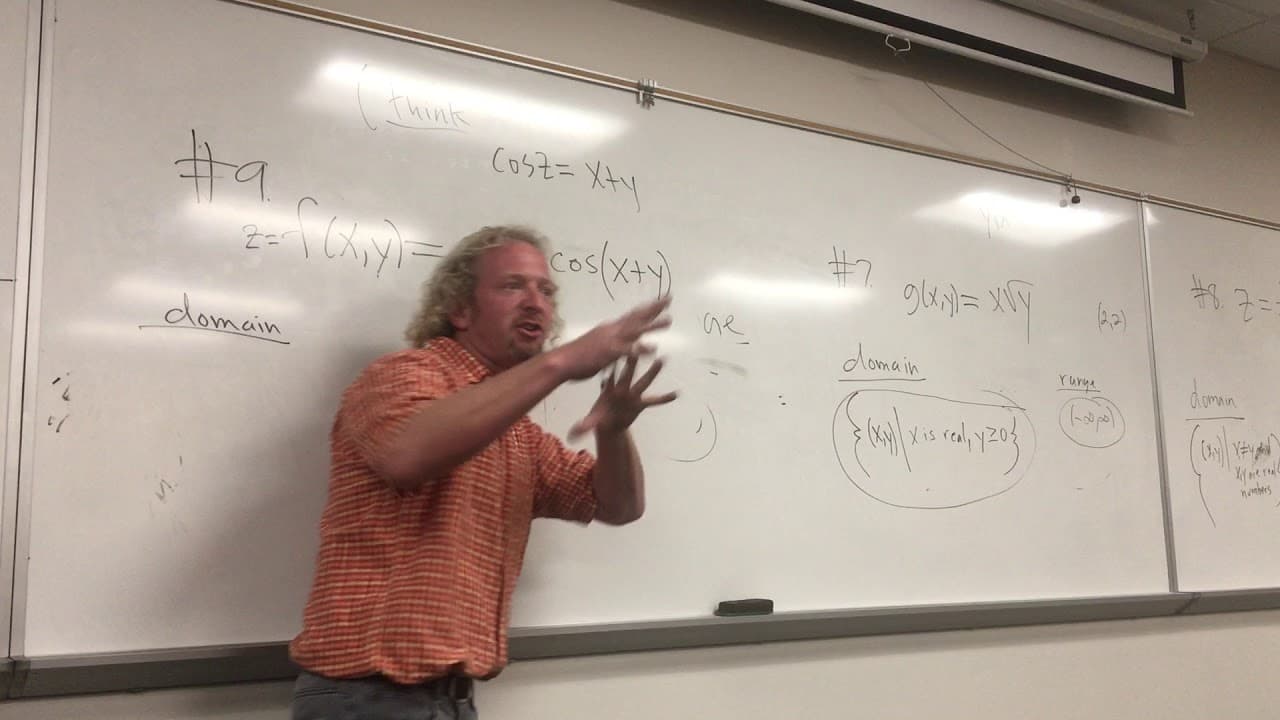
Domain and Range of f(x,y) = arccos(x + y) Multivariable Calculus
TL;DR
Explaining the relationship between cosine and its inverse, focusing on domain and range concepts.
Transcript
you don't think it's gonna be on there no cosine of X plus y restrict I mean let me think about it domain and range I give it me it to write it down then we'll work it out so domain a range so it's one of like baby steps here right it was just okay so so that's that's like your Z right that's in the range so Z is equal to the arc cosine of X plus y... Read More
Key Insights
- 🫠 Inverse functions, like arc cosine, play a crucial role in reversing the operations of their counterparts, such as cosine.
- 🧡 Domain and range concepts are essential in understanding the interactions between inverse functions.
- ❓ Bounded functions, like cosine, impact the restrictions and limitations of inverse functions.
- 📈 Memorizing the graph of functions helps in identifying where they are one-to-one and have inverses.
- 🧡 The domain of a function becomes the range of its inverse, highlighting the fundamental swap between domain and range in inverse functions.
- 🫥 Restricting functions is necessary to ensure their inverses pass the horizontal line test, allowing for the existence of inverse functions.
- ❓ Mathematical problem-solving involves a deep understanding of the relationships between functions and their inverses.
Install to Summarize YouTube Videos and Get Transcripts
Explore YouTube Video Summarizer or Get YouTube Transcript Extractor
Questions & Answers
Q: How do inverse functions like arc cosine and cosine interact with each other?
Inverse functions, such as arc cosine and cosine, complement each other by undoing their operations. The arc cosine takes X plus y and sends it to Z, while the cosine function reverses the process, sending Z back to X plus y.
Q: Why is the domain of the inverse cosine function connected to the range of the cosine function?
The domain of the inverse cosine function is linked to the range of the cosine function because inverse functions swap domain and range. Understanding this relationship helps in solving mathematical problems effectively.
Q: How does the concept of bounded functions apply to the domain and range of inverse functions?
Bounded functions, like cosine being between -1 and 1, affect the domain and range of inverse functions. For instance, the bounded nature of cosine influences the domain and range restrictions of its inverse.
Q: How can one determine the range of the inverse cosine function based on its graph?
To identify the range of the inverse cosine function, one must consider where the function is one-to-one, passing the horizontal line test. This approach helps in understanding the relationship between the domain and range of inverse functions.
Summary & Key Takeaways
-
Inverse functions like arc cosine and cosine have a unique relationship where they undo each other.
-
The domain of the inverse cosine function is based on the range of the cosine function.
-
Understanding the concept of bounded functions and how they relate to inverse functions is key to solving mathematical problems.
Read in Other Languages (beta)
Share This Summary 📚
Summarize YouTube Videos and Get Video Transcripts with 1-Click
Try YouTube Summary with ChatGPT & Claude or YouTube Transcript Generator
Explore More Summaries from The Math Sorcerer 📚



Summarize YouTube Videos and Get Video Transcripts with 1-Click
Try YouTube Summary with ChatGPT & Claude or YouTube Transcript Generator