7. Classical Mechanical Harmonic Oscillator
TL;DR
Classical mechanics provides insights into the behavior of the harmonic oscillator, including the exchange of energy between potential and kinetic energy.
Transcript
The following content is provided under a Creative Commons license. Your support will help MIT OpenCourseWare continue to offer high quality, educational resources for free. To make a donation or view additional materials from hundreds of MIT courses, visit MIT OpenCourseWare at ocw.mit.edu. ROBERT FIELD: Last time, I talked a lot about the semicla... Read More
Key Insights
- 🏛️ The semiclassical method bridges classical and quantum mechanics by using classical insights to gain understanding in quantum systems.
- 😥 The harmonic oscillator exchanges energy between potential and kinetic energy as it moves between turning points.
- 🧘 The average values of position and momentum in the harmonic oscillator are zero, while the average values of position squared and momentum squared are related to the energy.
Install to Summarize YouTube Videos and Get Transcripts
Explore YouTube Video Summarizer or Get YouTube Transcript Extractor
Questions & Answers
Q: Why is it important to study the semiclassical method in classical mechanics?
The semiclassical method allows us to gain insight into quantum mechanics without directly solving differential equations. It provides a bridge between classical and quantum behavior.
Q: How does the harmonic oscillator exchange energy between potential and kinetic energy?
As the particle in the harmonic oscillator moves between turning points, it transfers energy from potential to kinetic energy and vice versa. This exchange is responsible for the oscillatory motion.
Q: How do turning points in the harmonic oscillator potential affect the behavior of the system?
At turning points, the particle momentarily comes to rest, and the potential energy is equal to the total energy. This influences the behavior of the wave function and affects the probability distribution.
Q: What insights can be gained from the classical treatment of the harmonic oscillator?
The classical treatment provides information about the energy levels, expectation values, and uncertainties in position and momentum. It also reveals the relationship between classical and quantum behaviors.
Summary & Key Takeaways
-
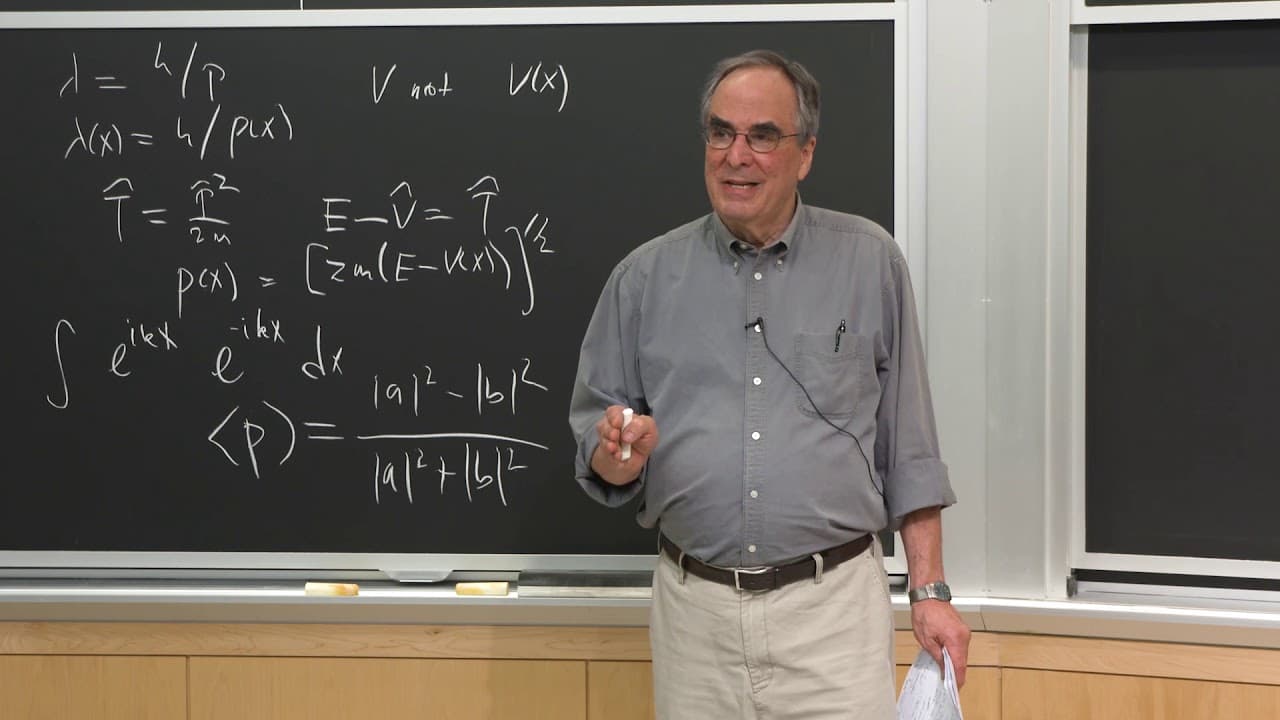
The harmonic oscillator can be described by a potential energy function and a momentum function, which relates to wavelength and probability.
-
The turning points in the harmonic oscillator potential correspond to the exchange of energy between potential and kinetic energy.
-
Knowledge of the harmonic oscillator can be applied to understand other potentials, such as the Morse potential.
-
The average values of position and momentum in the harmonic oscillator are zero, while the average values of position squared and momentum squared are related to the energy.
Read in Other Languages (beta)
Share This Summary 📚
Summarize YouTube Videos and Get Video Transcripts with 1-Click
Try YouTube Summary with ChatGPT & Claude or YouTube Transcript Generator
Explore More Summaries from MIT OpenCourseWare 📚



Summarize YouTube Videos and Get Video Transcripts with 1-Click
Try YouTube Summary with ChatGPT & Claude or YouTube Transcript Generator