VHDL code for Decoder | 2x4 | Dataflow & Behavioural | Digital Systems Design | Lec-52
TL;DR
This video explains how to write VHDL code for a 2x4 decoder using both data flow and behavioral models.
Transcript
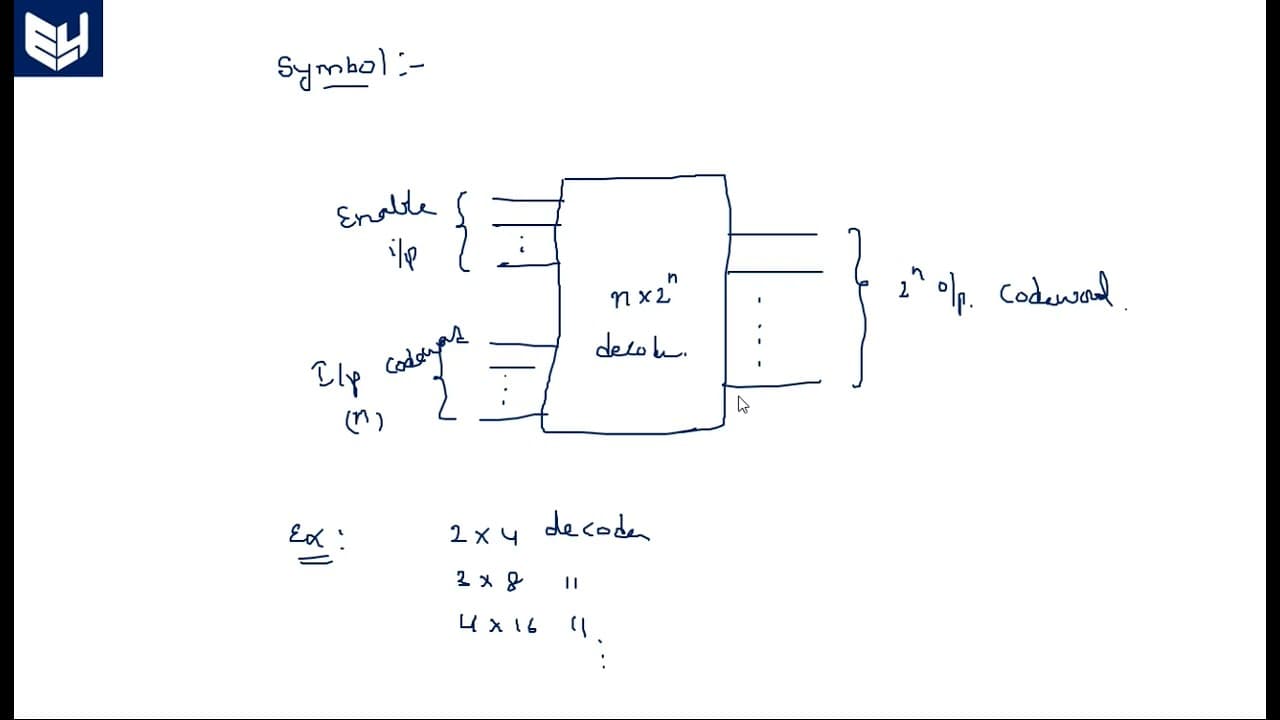
hi everyone in this video I'm going to tell how to write a vhdl code for the decoder 2x4 in data flow and as well as behavior model OKAY in the last video I have discussed about the decoder and the size of the decoder as 2 N by 2^n and different I are there 74 LS 139 and 74 LS 138 so it may be 74 LS 139 means dual 224 decoder and 74138 maybe a 328 ... Read More
Key Insights
- 😅 The normal operation of a 2x4 decoder involves binary inputs that translate into a specific one-hot output configuration based on the truth table.
- 💐 Data flow modeling is crucial for implementing digital circuits in VHDL, as it simplifies the representation of Boolean operations.
- 👨💻 The importance of library and package usage in VHDL cannot be overstated, as it establishes the foundational elements of the code.
- 😑 Boolean expressions in the data flow model facilitate straightforward coding, linking directly to familiar logic gate functions.
- 🚫 A behavioral model provides flexibility by enabling conditional logic to manage circuit behavior through process blocks.
- 😒 Understanding both data flow and behavioral models is essential for comprehensive digital design in VHDL, catering to different use cases.
- 💁 Proper syntax format is vital when creating VHDL code, as it influences readability and functionality.
Install to Summarize YouTube Videos and Get Transcripts
Explore YouTube Video Summarizer or Get YouTube Transcript Extractor
Questions & Answers
Q: What is a 2x4 decoder and what are its key components?
A 2x4 decoder is a combinational circuit that converts a binary input of two bits into a one-hot output of four lines. It has two inputs, which represent the binary value, and four outputs that correspond to the decoded result. The decoder also includes an enable pin that activates the circuit, making it essential for proper operation.
Q: Why is understanding data flow modeling important in VHDL?
Data flow modeling in VHDL allows designers to represent the functionality of digital circuits using high-level descriptions. This approach focuses on the actual flow of data and the relationships among signals, making it easier to implement complex logic functions and simplifying debugging and verification processes.
Q: How does the behavioral model differ from the data flow model in VHDL?
The behavioral model emphasizes how a system behaves in response to inputs, using conditional statements and processes to express logic. In contrast, the data flow model depicts the relationships between inputs and outputs more directly through Boolean expressions. Both models serve different purposes and can be chosen based on design requirements.
Q: What syntax structure is required for initializing a VHDL code?
A VHDL code typically begins with library and package declarations, specifying the necessary libraries required for the code, such as "library IEEE;" and "use IEEE.std_logic_1164.all;". This sets up the environment for defining the entity and architecture of the design.
Q: Can you explain how to implement Boolean expressions in the data flow model?
In the data flow model, Boolean expressions can be directly translated into VHDL code. For instance, expressions like 'Y0 = enable and not I1 and not I0' are written directly in code. The emphasis is on mapping logic gates directly to their corresponding operations without further abstraction.
Q: What role does the enable signal play in a decoder?
The enable signal allows for controlling whether the decoder is active or not. When the enable signal is set to '1', the decoder processes the inputs and activates the corresponding output. If the enable signal is '0', all outputs remain inactive, ensuring the decoder does not interfere with system operations.
Summary & Key Takeaways
-
The video provides a detailed guide on writing VHDL code for a 2x4 decoder, emphasizing the importance of understanding different design models.
-
The presenter outlines the specifics of the data flow model, illustrating how to implement Boolean expressions directly in VHDL code for the decoder's behavior.
-
A behavioral model is introduced, highlighting the use of conditional statements and process blocks to define logic based on the decoder's truth table.
Read in Other Languages (beta)
Share This Summary 📚
Summarize YouTube Videos and Get Video Transcripts with 1-Click
Try YouTube Summary with ChatGPT & Claude or YouTube Transcript Generator