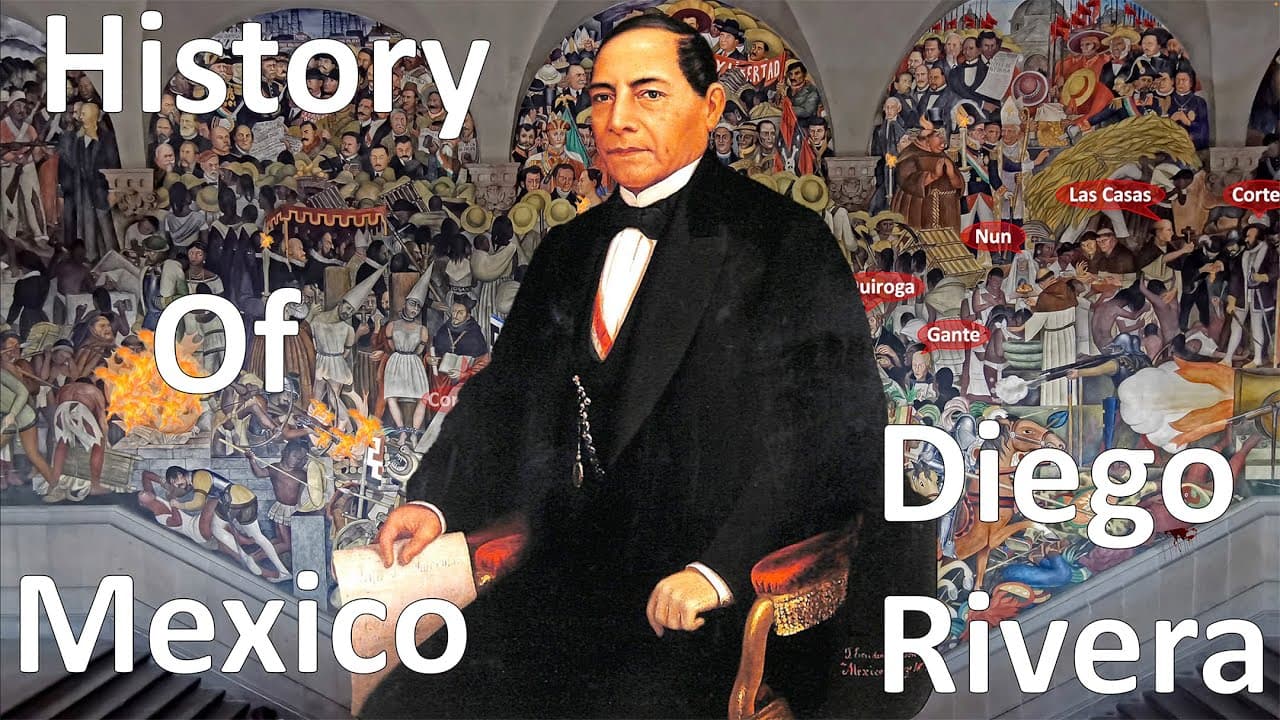
Diego Rivera, “The History of Mexico” Fresco Mural at the National Palace, CDMX, Fully Explained
TL;DR
Diego Rivera's mural captures 2,000 years of Mexican history in 554 meters.
Transcript
Diego Rivera's the history of Mexico an epic of the Mexican people is one of its masterpieces the Fresco Miro tells more than 2,000 years of Mexican history from mesro America to the present but there's an emphasis on the last 700 years of Mexican history commissioned by The Mexican government the mirror was painted from May 1929 an... Read More
Key Insights
- Diego Rivera's mural, 'The History of Mexico,' spans 2,000 years of Mexican history, focusing on the last 700 years, and is located in the National Palace in Mexico City.
- The mural is divided into three large sections, covering ancient Mexico, the Spanish conquest, and modern Mexican history, including the Mexican Revolution and future visions.
- Rivera's work features over 230 historical figures, showcasing the cultural richness of Mesoamerica, the brutality of the Spanish conquest, and the struggles for Mexican independence and reform.
- The mural illustrates significant events like the Aztec-Spanish war, the Mexican Reform movement, the 1910 Mexican Revolution, and French intervention, highlighting the resilience of the Mexican people.
- Rivera emphasizes the impact of European colonization, depicting figures like Hernán Cortés and the forced conversion of Native Mexicans to Christianity.
- The artwork also critiques modern societal issues, portraying the exploitation of workers and the influence of foreign powers and the church in Mexican society.
- Rivera's personal fascination with Mesoamerican history is evident, as he collected over 60,000 Mexican artifacts, which informed the detailed depictions in the mural.
- The mural concludes with a vision of a socialist future, inspired by Marxist ideals, reflecting Rivera's political beliefs and hope for a more equitable society.
Install to Summarize YouTube Videos and Get Transcripts
Explore YouTube Video Summarizer or Get YouTube Transcript Extractor
Questions & Answers
Q: What is the primary focus of Diego Rivera's mural?
Diego Rivera's mural, 'The History of Mexico,' primarily focuses on depicting over 2,000 years of Mexican history, with a particular emphasis on the last 700 years. It illustrates significant historical periods and events, including the ancient Mesoamerican cultures, the Spanish conquest, the Mexican Revolution, and visions of Mexico's future.
Q: Where is the mural 'The History of Mexico' located?
The mural 'The History of Mexico' is located in the National Palace in Mexico City, specifically within the north stairwell. This location allows the expansive artwork to cover 554 meters, providing a comprehensive visual narrative of Mexican history as conceived by Diego Rivera.
Q: How does Rivera's mural depict the Spanish conquest?
Rivera's mural vividly depicts the Spanish conquest by illustrating the brutality and impact of European colonization on Mesoamerican societies. Key figures such as Hernán Cortés are shown leading the conquest, and the forced conversion of Native Mexicans to Christianity is highlighted, reflecting the cultural and societal upheaval caused by the conquest.
Q: What historical figures are featured in the mural?
The mural features over 230 historical figures, including legendary Mesoamerican deities, Spanish conquerors like Hernán Cortés, and key figures from Mexican history such as Benito Juárez and Emiliano Zapata. These individuals represent various eras, from ancient civilizations to modern reformers and revolutionaries, showcasing Mexico's diverse historical narrative.
Q: How does the mural reflect Rivera's political beliefs?
Rivera's political beliefs, particularly his Marxist ideology, are reflected in the mural through its critique of societal issues such as the exploitation of workers and the influence of foreign powers and the church. The mural concludes with a vision of a socialist future, inspired by Marxist ideals, indicating Rivera's hope for a more equitable society.
Q: What artistic techniques did Rivera use in the mural?
Rivera employed fresco techniques to create the mural, allowing for vibrant and enduring imagery. His use of detailed and expressive figures, along with a dynamic composition that guides the viewer through different historical periods, showcases his mastery in capturing complex narratives and emotions within a single, cohesive artwork.
Q: What is the significance of the mural's location in the National Palace?
The location of the mural in the National Palace is significant as it situates the artwork within a central and symbolic site of Mexican governance and history. This placement underscores the importance of the mural as a national treasure, reflecting the rich cultural heritage and historical struggles of the Mexican people within a prominent public space.
Q: How does Rivera's personal collection influence the mural?
Rivera's personal collection of over 60,000 Mexican artifacts greatly influenced the mural, providing a rich source of historical and cultural references. This collection informed the detailed and accurate depictions of Mesoamerican cultures and historical events, enhancing the mural's authenticity and depth in portraying Mexico's diverse and complex history.
Summary & Key Takeaways
-
Diego Rivera's mural, 'The History of Mexico,' is a comprehensive depiction of over 2,000 years of Mexican history, focusing on the last 700 years. Located in the National Palace, it covers significant historical events and figures, reflecting Rivera's deep engagement with Mexican culture and politics.
-
The mural is divided into three sections, illustrating ancient Mesoamerican cultures, the Spanish conquest, and modern Mexican history, including the Mexican Revolution. Rivera's work highlights the resilience of the Mexican people and critiques societal issues like exploitation and foreign influence.
-
Rivera's personal collection of Mexican artifacts and his Marxist beliefs heavily influenced the mural's content, which includes over 230 historical figures. The mural ends with a vision of a socialist future, representing Rivera's hope for a more just and equitable society.
Read in Other Languages (beta)
Share This Summary 📚
Summarize YouTube Videos and Get Video Transcripts with 1-Click
Try YouTube Summary with ChatGPT & Claude or YouTube Transcript Generator