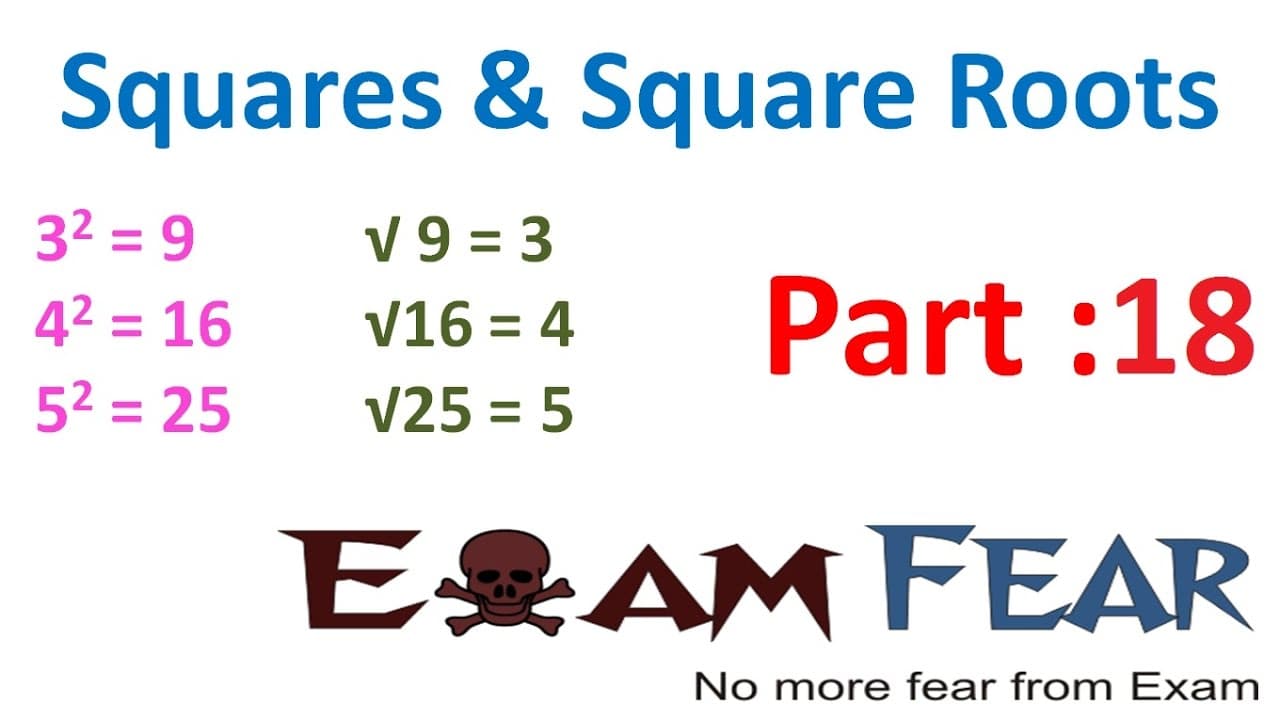
Maths Square and Square Roots part 18 (Prime Factorization Method) CBSE Class 8 Mathematics VIII
TL;DR
Learn how to find square roots using the prime factorization method, including determining if a number is a perfect square.
Transcript
hello friends this video on smashing schedules but 18 is brought to you by examples or car no no to your calm exam look at the second options that we have and that is the prime factorization method so I hope all of you remember what is prime factorization if you are given a number you can write that number in terms of product of its prime factors t... Read More
Key Insights
- 🧑🏭 The prime factorization method involves finding the prime factors of a number to determine its square root.
- ❎ If a number can be written as the square of a single number, it is a perfect square.
- 💯 Non-perfect square numbers can be converted into perfect squares by dividing or multiplying them by their extra factors.
- 🫚 The prime factorization method is a more efficient and convenient method for finding square roots compared to repeated subtraction.
Install to Summarize YouTube Videos and Get Transcripts
Explore YouTube Video Summarizer or Get YouTube Transcript Extractor
Questions & Answers
Q: What is the prime factorization method for finding square roots?
The prime factorization method involves finding the prime factors of a number to determine its square root. By dividing the number by the smallest prime number, you can factorize it.
Q: How do you determine if a number is a perfect square using prime factorization?
If a number can be written as the square of a single number, it is a perfect square. However, if it cannot be written in this way, it is not a perfect square.
Q: Can you give an example of finding the square root using the prime factorization method?
Sure! Let's take the number 100. By prime factorizing it as 2 x 2 x 5 x 5, we can see that it can be written as (2 x 5)^2, which is equal to 10^2. Therefore, the square root of 100 is 10.
Q: How can you determine the nearest perfect square to a non-perfect square number?
To determine the nearest perfect square, you can either divide the number by its extra factors or multiply it by those factors. This will convert the number into a perfect square.
Summary & Key Takeaways
-
The prime factorization method involves finding the prime factors of a number to determine its square root.
-
To find the square root of a number, first prime factorize it by dividing it by the smallest prime number.
-
If a number cannot be written as the square of a single number, it is not a perfect square.
Read in Other Languages (beta)
Share This Summary 📚
Summarize YouTube Videos and Get Video Transcripts with 1-Click
Try YouTube Summary with ChatGPT & Claude or YouTube Transcript Generator
Explore More Summaries from LearnoHub - Class 11, 12 📚





Summarize YouTube Videos and Get Video Transcripts with 1-Click
Try YouTube Summary with ChatGPT & Claude or YouTube Transcript Generator