Products
Features
YouTube Video Summarizer
Summarize YouTube videos
Web & PDF Highlighter
Highlight web pages & PDFs
Chat with PDF
Ask any PDF questions with AI
Ask AI Clone
Chat with your highlights & memories
Audio Transcriber
Transcribe audio files to text
Glasp Reader
Read and highlight articles
Kindle Highlight Export
Export your Kindle highlights
Idea Hatch
Hatch ideas from your highlights
Integrations
Obsidian Plugin
Notion Integration
Pocket Integration
Instapaper Integration
Medium Integration
Readwise Integration
Snipd Integration
Hypothesis Integration
Apps & Extensions
Chrome Extension
Safari Extension
Edge Add-ons
Firefox Add-ons
iOS App
Android App
Discover
Discover
Ideas
Discover new ideas and insights
Articles
Curated articles and insights
Books
Book recommendations by great minds
Posts
Essays and notes from readers
Quotes
Inspiring quotes collection
Videos
Curated videos and summaries
Explore Glasp
Glasp Newsletter
Weekly insights and updates
Glasp Talk
Interview series with great minds
Glasp Blog
Latest news and articles
Glasp Use Cases
Learn how others use Glasp
Build & Support
Glasp API
Access Glasp's API for developers
MCP Connector
Connect Glasp to Claude & ChatGPT
Community
Glasp Reddit Community
Students
Student discount and benefits
FAQs
Frequently Asked Questions
AboutPricing
DashboardLog inSign up

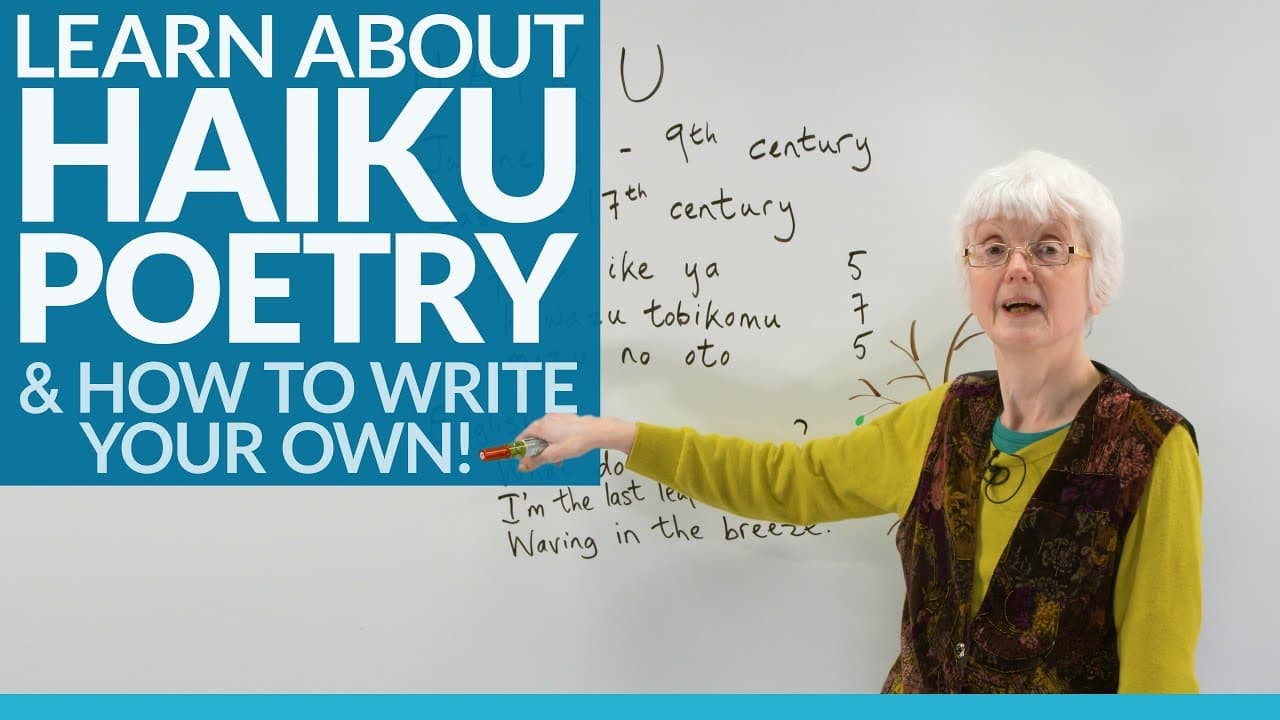
Learn to write poetry: THE HAIKU
103.8K views
•
June 15, 2018
by
Learn English with Gill · engVid
YouTube video player
Learn to write poetry: THE HAIKU

TL;DR

Learn about haiku poetry, its origins, structure, and how it can help with English learning.

Transcript

"Furu ike ya kawazu tobikomu mizu no oto." Okay, so don't adjust your set, this is an English lesson, but we're looking today at haiku, which is a Japanese form of poetry, but lots of English poems have been written in the haiku form. So, first of all, I'd like to thank my students, Kuni and Negu, for their help in training me to recite this haiku ... Read More

Key Insights

  • 💁 Haiku originated in Japan in the 9th century, with famous poets like Basho popularizing the form.
  • ❓ The syllable pattern for haiku is typically 5-7-5, emphasizing the importance of rhythm in poetry.
  • 👶 Haiku can help with learning new vocabulary and offer a philosophical aspect for contemplation.
  • 🏃 Writing haiku in English can be a fun and creative exercise for language learners.
  • 🎑 Haiku poetry can vary in themes from nature scenes to humorous or philosophical reflections.
  • 🫠 Haiku poems are short and quick to read, making them a convenient form of poetry for busy individuals.
  • 😒 The structure of haiku encourages brevity and precision in language use.

Install to Summarize YouTube Videos and Get Transcripts

Explore YouTube Video Summarizer or Get YouTube Transcript Extractor

Questions & Answers

Q: What is haiku poetry?

Haiku is a Japanese form of poetry, usually describing nature scenes, consisting of three lines with a syllable pattern of 5-7-5.

Q: How can haiku help with learning English?

Haiku can help with English learning by being a short and manageable text to read, allowing for the discovery of new words and offering a philosophical element for contemplation.

Q: Who is Basho and why is he important in haiku poetry?

Basho was a famous poet who lived in the 17th century and was known for his haiku writing, contributing significantly to the development and popularity of haiku poetry.

Q: Can anyone write a haiku, even if they are not a poet?

Yes, anyone can write a haiku as it follows a simple structure of three lines with a specific syllable count, making it accessible for beginners or non-poets to try their hand at composing haiku.

Summary & Key Takeaways

  • Haiku is a Japanese form of poetry often describing nature scenes.

  • It consists of three lines with a syllable pattern of 5-7-5.

  • Haiku can be a useful tool for learning new words and has a philosophical aspect.


Read in Other Languages (beta)

English

Share This Summary 📚

Summarize YouTube Videos and Get Video Transcripts with 1-Click

Download browser extensions on:

Try YouTube Summary with ChatGPT & Claude or YouTube Transcript Generator

Explore More Summaries from Learn English with Gill · engVid 📚
How to Use the Auxiliary Verb 'Could' in English thumbnail
How to Use the Auxiliary Verb 'Could' in English
Learn English with Gill · engVid
Where do the names of the days of the week come from? thumbnail
Where do the names of the days of the week come from?
Learn English with Gill · engVid
Help a Charity, Save a Life thumbnail
Help a Charity, Save a Life
Learn English with Gill · engVid
How the UK is Divided: Countries, Cities, Counties, Councils, Wards thumbnail
How the UK is Divided: Countries, Cities, Counties, Councils, Wards
Learn English with Gill · engVid
Improve Your Vocabulary: 23 words for talking about feeling good or bad thumbnail
Improve Your Vocabulary: 23 words for talking about feeling good or bad
Learn English with Gill · engVid
Easy English Lesson: Should you use “A” or “AN”? thumbnail
Easy English Lesson: Should you use “A” or “AN”?
Learn English with Gill · engVid

Summarize YouTube Videos and Get Video Transcripts with 1-Click

Download browser extensions on:

Try YouTube Summary with ChatGPT & Claude or YouTube Transcript Generator

Apps & Extensions

  • Chrome Extension
  • Safari Extension
  • Edge Add-ons
  • Firefox Add-ons
  • iOS App
  • Android App

Key Features

  • YouTube Video Summarizer
  • Web & PDF Summarizer
  • Web & PDF Highlighter
  • Chat with PDF
  • Ask AI Clone
  • Audio Transcriber
  • Glasp Reader
  • Kindle Highlight Export
  • Idea Hatch

Integrations

  • Obsidian Plugin
  • Notion Integration
  • Pocket Integration
  • Instapaper Integration
  • Medium Integration
  • Readwise Integration
  • Snipd Integration
  • Hypothesis Integration

More Features

  • APIs
  • MCP Connector
  • Blog & Post
  • Embed Links
  • Image Highlight
  • Personality Test
  • Quote Shots

Company

  • About us
  • Blog
  • Community
  • FAQs
  • Job Board
  • Newsletter
  • Pricing
Terms

•

Privacy

•

Guidelines

© 2026 Glasp Inc. All rights reserved.