Lecture 14: Lorentz Covariance of the Dirac Equation
TL;DR
The Dirac equation describes particles that have both positive and negative energy solutions, and the solutions can be separated into positive and negative energy states.
Transcript
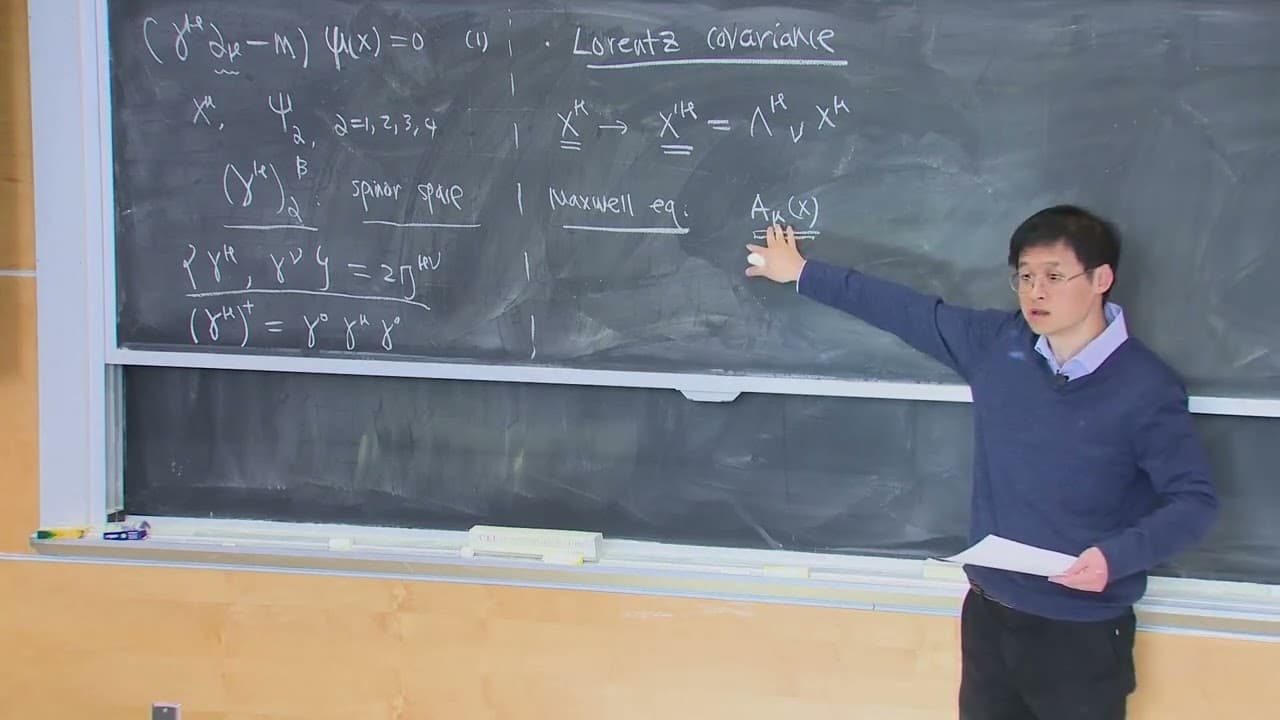
[SQUEAKING] [RUSTLING] [CLICKING] PROFESSOR: So last time, we talked about Dirac equation. So the Dirac equation has the following form: gamma mu partial mu minus m psi equal to 0. So here, we have two spaces. So one is your standard physical spacetime, so with x mu. And then we have a lot of internal space which is labeled by the index of the psi ... Read More
Key Insights
- 👾 The Dirac equation couples spacetime and an internal spinor space.
- 😶 Lorentz covariance of the Dirac equation is achieved through a matrix S that transforms the gamma mu matrices appropriately.
- ❓ The Dirac equation can be derived from the Dirac action, which is a Lorentz invariant scalar.
- ❎ The solutions of the Dirac equation can be separated into positive and negative energy solutions.
- 😣 The solutions can be found by considering the particle at rest and applying Lorentz boosts.
- 😍 The solutions u and v are determined by eigenvectors of the gamma 0 matrix, and they can be used to obtain solutions for general momentum.
Install to Summarize YouTube Videos and Get Transcripts
Explore YouTube Video Summarizer or Get YouTube Transcript Extractor
Questions & Answers
Q: How does the gamma mu matrix transform under Lorentz transformations?
The gamma mu matrix does not change under Lorentz transformations. It satisfies specific anticommutation and Hermiticity conditions. The gamma mu dagger matrix is equal to gamma 0 gamma mu gamma 0.
Q: What are the key insights from this analysis?
- The Dirac equation describes particles with both positive and negative energy solutions.
- The gamma mu matrices represent the coupling between spacetime and an internal spinor space.
- The Lorentz covariance of the Dirac equation requires finding a matrix S that transforms the gamma mu matrices appropriately.
- The Dirac action allows for the quantization of the Dirac equation and the identification of fermions.
- The solutions of the Dirac equation can be separated into positive and negative energy solutions represented by psi plus and psi minus, respectively.
- The solutions can also be obtained by considering the particle at rest and applying Lorentz boosts for general momentum.
- The solutions u and v are determined by eigenvectors of the gamma 0 matrix.
- The solutions can be found by solving the equations i m gamma 0 u = -u and i m gamma 0 v = -v.
Summary & Key Takeaways
-
The Dirac equation has the form gamma mu partial mu - m psi = 0, where gamma mu is a set of 4x4 matrices, psi is the Dirac spinor field, and m is the mass of the particle.
-
The equation represents a coupling between spacetime coordinates and an internal spinor space. The gamma matrices satisfy specific conditions and are not ordinary matrices.
-
Lorentz covariance of the Dirac equation requires finding a matrix S that transforms gamma mu appropriately. The solution for S is found using infinitesimal transformations and the properties of gamma mu.
-
The Dirac action, which gives rise to the Dirac equation, is S = -i∫ d^4x psi bar gamma mu partial mu psi, where psi bar is the Hermitian conjugate of psi.
Read in Other Languages (beta)
Share This Summary 📚
Summarize YouTube Videos and Get Video Transcripts with 1-Click
Try YouTube Summary with ChatGPT & Claude or YouTube Transcript Generator
Explore More Summaries from MIT OpenCourseWare 📚



Summarize YouTube Videos and Get Video Transcripts with 1-Click
Try YouTube Summary with ChatGPT & Claude or YouTube Transcript Generator