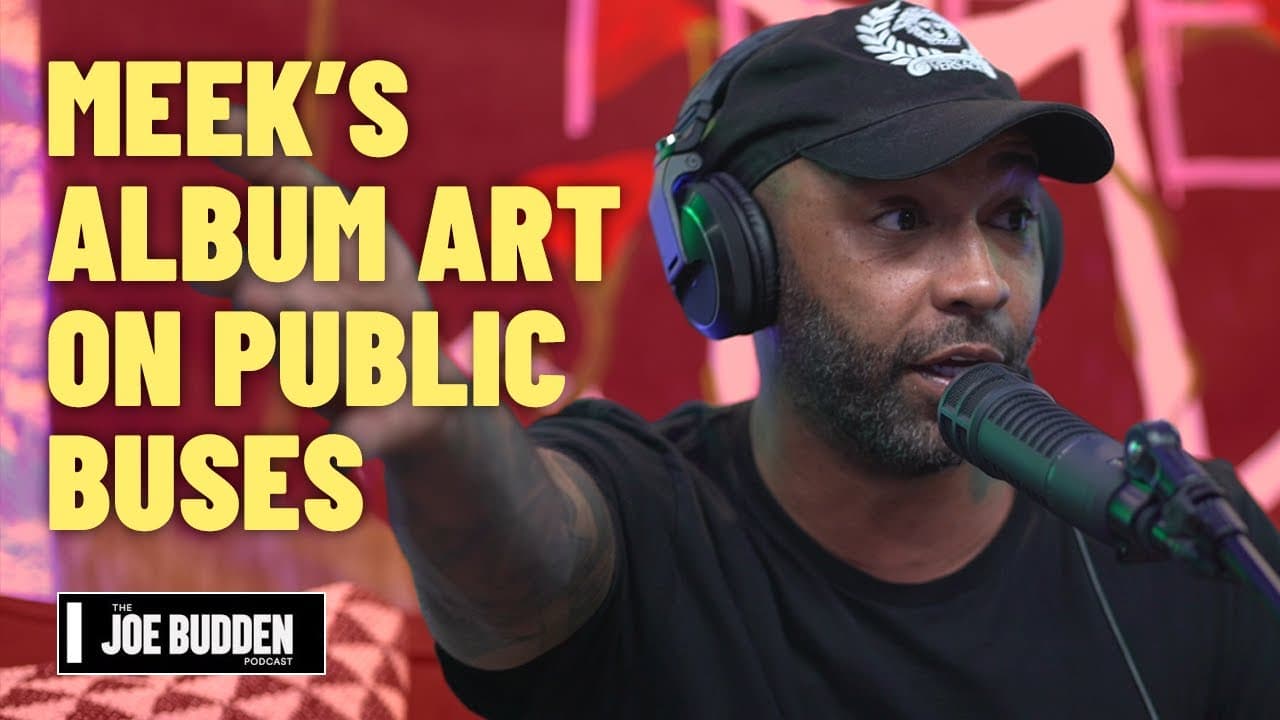
Meek Mill's Album Art On Public Buses | The Joe Budden Podcast
TL;DR
A white man's outrage over Meek Mill's album cover sparks discussion on public decency and representation.
Transcript
do you all see the conversation going on around surrounding uh did y'all see the video about the white guy uh addressing meek's album cover on the bus in philadelphia no no video village y'all saw that pull it up look at this bus that goes by in my neighborhood what the [ __ ] is this what the [ __ ] is this what is this this is on the side of the ... Read More
Key Insights
- 🐎 The imagery used in public marketing can reinforce negative stereotypes, particularly related to race and gender.
- 🥰 Distinctions between art and marketing become blurry when artwork is widely commercialized, prompting discussions about the implications for public messaging.
- 🙇♀️ The representations of black women in media often reflect larger societal issues concerning respect and equality.
- 🥰 The role of gatekeepers in music and art can hinder authentic cultural expression, leading to potential exploitation.
- 😑 The ongoing discourse regarding public decency highlights growing tensions between artistic expression and community standards.
- 🦔 Public outrage, while an important tool for change, can also serve as a double-edged sword, fueling unwanted attention to the very issues being criticized.
- 🔉 As media landscapes evolve, so too do the expectations surrounding content consumption and parental responsibility.
Install to Summarize YouTube Videos and Get Transcripts
Explore YouTube Video Summarizer or Get YouTube Transcript Extractor
Questions & Answers
Q: What details about Meek Mill's album cover sparked the initial outrage?
The white man expressed his disgust at the explicit imagery on Meek Mill's album cover, which features a naked woman bent over. He found it inappropriate for public display, especially considering that children could see it on the side of a bus. His passionate response highlighted concerns over how such representations impact societal views on black women and respect.
Q: How do the participants in the discussion view the role of marketing in art?
The participants generally agree that once art becomes a marketing tool, it fundamentally changes its nature. They argue that marketing prioritizes profit over artistic integrity, which can lead to harmful societal messaging, especially when explicit imagery is splashed across public spaces accessible to children.
Q: What concerns were raised about the portrayal of women in the context of this debate?
Concerns were raised regarding the exploitation of black women's images in the media and marketing. Participants emphasized that showcasing such explicit images in public spaces contradicts ongoing efforts toward advocating for black excellence and respect, presenting a mixed message about black women's representation in society.
Q: What implications does the conversation have concerning cultural ownership?
The dialogue underlines the ongoing struggle for cultural ownership within the music industry, stressing that black artists like Meek Mill may not have full control over how their art is marketed. This raises larger questions about who benefits from cultural representation and the impact of external narratives on the portrayal of marginalized communities.
Q: How did the audience's reactions vary based on the reviewer's perspectives?
Audience reactions spanned a spectrum, with some supporting the white man's criticism, viewing it as a necessary stand against vulgarity in public spaces. Others defended the artistic freedom of the album cover while cautioning against its public exposure, arguing that artistic expression should still consider the audience, especially young children.
Q: What was mentioned about the evolution of public decency standards in media?
The conversation pointed out that public decency standards have shifted significantly over time, with explicit content becoming more normalized on various platforms, including television and advertising. Participants highlighted the need for media outlets and public institutions to reassess what is deemed appropriate for diverse audiences, especially in family-friendly spaces.
Summary & Key Takeaways
-
A white man criticizes Meek Mill's album cover displayed on public buses, arguing it's inappropriate for children while reflecting poorly on black women.
-
The dialogue explores themes of public decency, cultural representation, and the contrast between artistic expression and commercial marketing.
-
Participants debate the impact of such imagery on societal values, touching on the ownership of culture and the consequences of mainstream media representation.
Read in Other Languages (beta)
Share This Summary 📚
Summarize YouTube Videos and Get Video Transcripts with 1-Click
Try YouTube Summary with ChatGPT & Claude or YouTube Transcript Generator
Explore More Summaries from Joe Budden TV 📚



Summarize YouTube Videos and Get Video Transcripts with 1-Click
Try YouTube Summary with ChatGPT & Claude or YouTube Transcript Generator