VHDL code for Demultiplexer | Structural and behavioural | Digital Systems Design | Lec-47
TL;DR
This video explains how to program a 2x1 D multiplexer using structural and behavioral models.
Transcript
hi everyone in this video I'm going to explain how to program the D multiplexor 2x1 in structural and as well as behavioral model in the previous video we have started this discussion of D multiplexer so D multiplexer is having 1 by 2 power n size one input and 2 power n output lines where n indicates the number of selection lines okay and these ar... Read More
Key Insights
- 👻 A 2x1 D multiplexer allows one input to select between multiple outputs, demonstrating essential digital logic principles.
- 🫥 The selection line determines which output line receives the input, crucial for understanding how multiplexers control data transmission.
- 💨 VHDL programming can be approached in structural and behavioral ways, each serving different purposes and design insights.
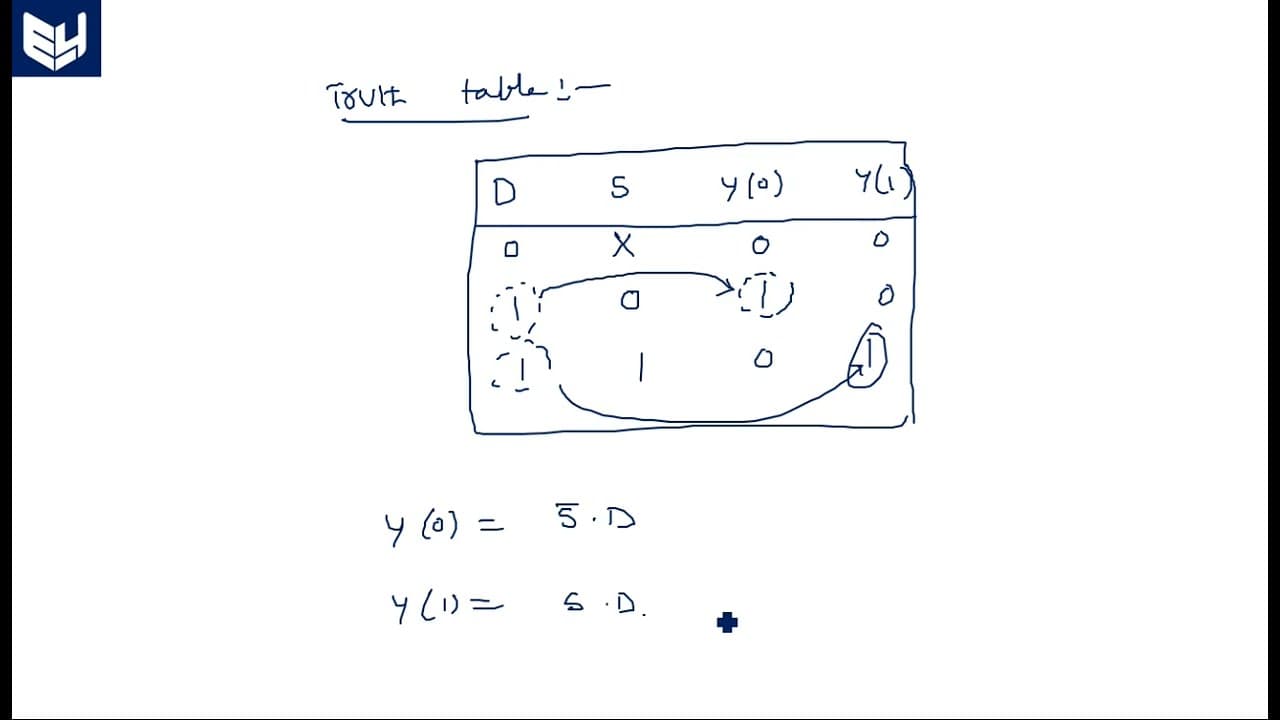
- 🚰 Understanding truth tables is vital for creating efficient digital circuits, such as multiplexers, showcasing how outputs are influenced by inputs.
- 💁 The entity declaration serves as a foundation in VHDL, forming a bridge between the hardware description and the logic implemented within the architecture.
- ⌛ Instantiating gates in the structural model promotes reusability and efficiency, as components can be used multiple times without redundancy.
- 🪛 Behavioral modeling emphasizes the processes driving output decisions, clarifying how conditional logic governs circuit behavior.
Install to Summarize YouTube Videos and Get Transcripts
Explore YouTube Video Summarizer or Get YouTube Transcript Extractor
Questions & Answers
Q: What is the function of a D multiplexer?
A D multiplexer takes one input and directs it to one of several outputs based on the selection lines. For example, in a 1x2 D multiplexer, one input can be routed to two outputs depending on the binary state of a selection line, effectively controlling data flow.
Q: How does the truth table for a 2x1 multiplexer look?
The truth table for a 2x1 multiplexer specifies output states based on selection inputs. When the selection line is 0, the output corresponds to the input data; when the selection line is 1, the input is routed to the other output, demonstrating logical operations through Boolean expressions.
Q: What distinguishes structural from behavioral modeling in VHDL?
Structural modeling in VHDL involves defining interconnections between components (like gates) with a focus on the hardware structure, while behavioral modeling describes the functionalities and processes, emphasizing what outputs are produced based on conditions, leading to more abstract descriptions.
Q: Can you explain the significance of the ‘entity’ in VHDL?
The ‘entity’ in VHDL defines the interface of a design block, detailing the inputs, outputs, and internal signals for both structural and behavioral programs. It provides a clear organizational framework for implementing logic while allowing the architecture part to focus on internal operations.
Q: What are the components involved in programming a D multiplexer?
The essential components involved in programming a D multiplexer include AND gates and NOT gates. In the structural model, these gates are instantiated to control the data flow based on selection signals, allowing the correct output to be activated according to input conditions.
Q: How does behavioral coding enhance understanding of D multiplexers?
Behavioral coding presents a higher-level abstraction by outlining processes and conditions to achieve desired outputs, making it easier for programmers to focus on logic without delving into the hardware specifics, thus enhancing comprehension of multiplexer operations.
Q: How important are Boolean expressions in D multiplexer logic?
Boolean expressions are crucial for defining output conditions based on inputs and selection lines within D multiplexers. They allow for the logical representation of data flow, facilitating the design of efficient and functional digital circuits.
Q: Why is it acceptable to reuse variable names in different components?
Reusing variable names in different components is permitted in VHDL because each instance operates within its own context. This flexibility allows programmers to maintain clarity and organization in their code without risking variable name conflicts.
Summary & Key Takeaways
-
The video provides a detailed explanation of programming a 2x1 D multiplexer utilizing both structural and behavioral models, covering the fundamentals of the logic behind the device.
-
It introduces the definitions and workings of the D multiplexer, highlighting the significance of selection lines and how different configurations operate through various truth tables and Boolean expressions.
-
Examples are provided, including structural code requiring gate instantiation and behavioral code that interprets processes and conditions, illustrating programming methods in VHDL.
Read in Other Languages (beta)
Share This Summary 📚
Summarize YouTube Videos and Get Video Transcripts with 1-Click
Try YouTube Summary with ChatGPT & Claude or YouTube Transcript Generator