L02.3 A Die Roll Example
TL;DR
A demonstration of conditional probability using a four-sided die, explaining how to calculate the probability of specific outcomes given certain conditions.
Transcript
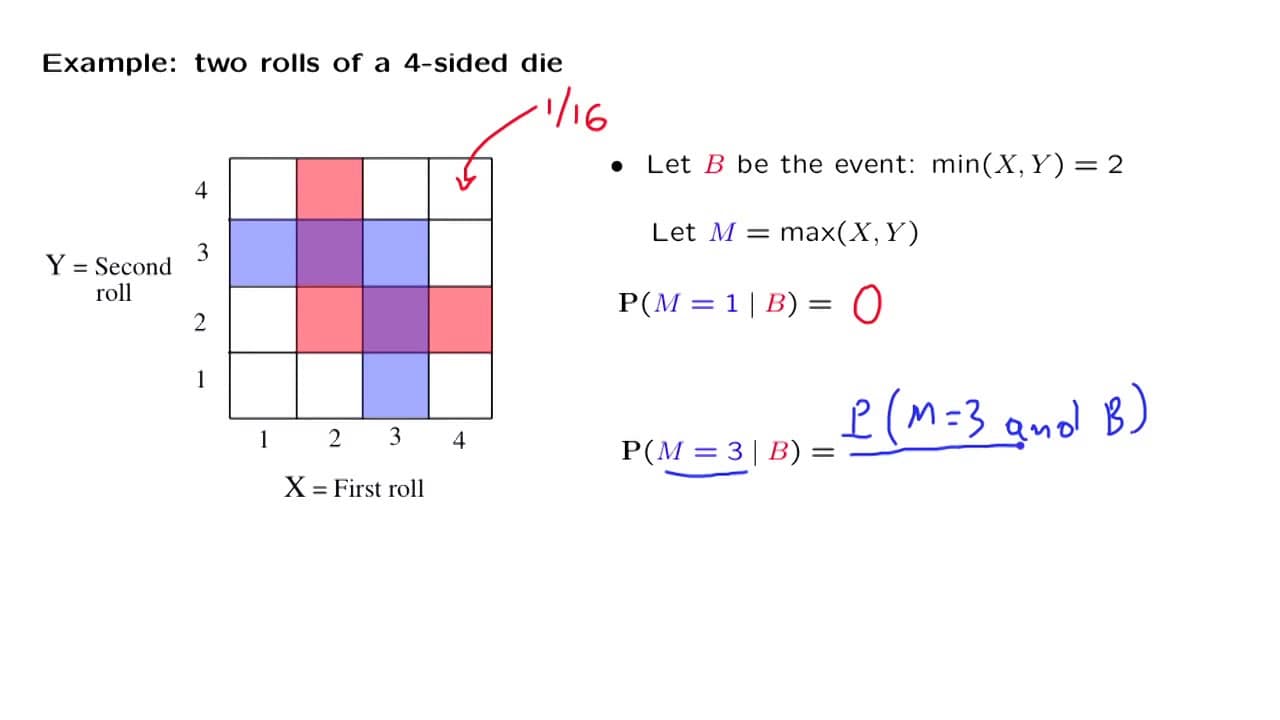
This is a simple example where we want to just apply the formula for conditional probabilities and see what we get. The example involves a four-sided die, if you can imagine such an object, which we roll twice, and we record the first roll, and the second roll. So there are 16 possible outcomes. We assume to keep things simple, that each one of tho... Read More
Key Insights
- 🤣 There are 16 possible outcomes when rolling a four-sided die twice, assuming equal probabilities for each outcome.
- 💱 Conditioning on an event changes the probabilities of different outcomes.
- ❓ The conditional probability of an outcome that cannot happen is 0.
- 🥳 The conditional probability of an outcome that intersects with the conditioning event can be calculated by finding the ratio of the intersection to the conditioning event's probability.
Install to Summarize YouTube Videos and Get Transcripts
Explore YouTube Video Summarizer or Get YouTube Transcript Extractor
Questions & Answers
Q: How many possible outcomes are there when rolling the four-sided die twice?
There are a total of 16 possible outcomes when rolling the four-sided die twice.
Q: What is the event B that is used for conditioning?
Event B is when the smaller of the two die rolls is equal to 2, and the other die is 2 or larger.
Q: What is the conditional probability of the maximum roll being 1 given that the minimum roll is 2?
The conditional probability of this outcome is 0 because it is impossible for the maximum roll to be 1 when the minimum roll is 2.
Q: How is the conditional probability of the maximum roll being 3 given event B calculated?
The conditional probability is calculated by finding the intersection of the event where the maximum roll is 3 and event B. The intersection occurs in two outcomes out of 16, resulting in a conditional probability of 2/5.
Summary & Key Takeaways
-
A four-sided die is rolled twice, and the smaller of the two rolls being equal to 2 is considered.
-
There are five possible outcomes where one die is 2 and the other is equal to or larger than 2.
-
The conditional probability of the maximum roll being 1 given that the minimum roll is 2 is 0.
-
The conditional probability of the maximum roll being 3 given that the minimum roll is 2 is 2/5.
Read in Other Languages (beta)
Share This Summary 📚
Summarize YouTube Videos and Get Video Transcripts with 1-Click
Try YouTube Summary with ChatGPT & Claude or YouTube Transcript Generator
Explore More Summaries from MIT OpenCourseWare 📚


Summarize YouTube Videos and Get Video Transcripts with 1-Click
Try YouTube Summary with ChatGPT & Claude or YouTube Transcript Generator