Galilean transformation of ordinary waves
TL;DR
Wave functions exhibit complex behavior and do not follow Galilean invariance, leading to differences in measurement between observers.
Transcript
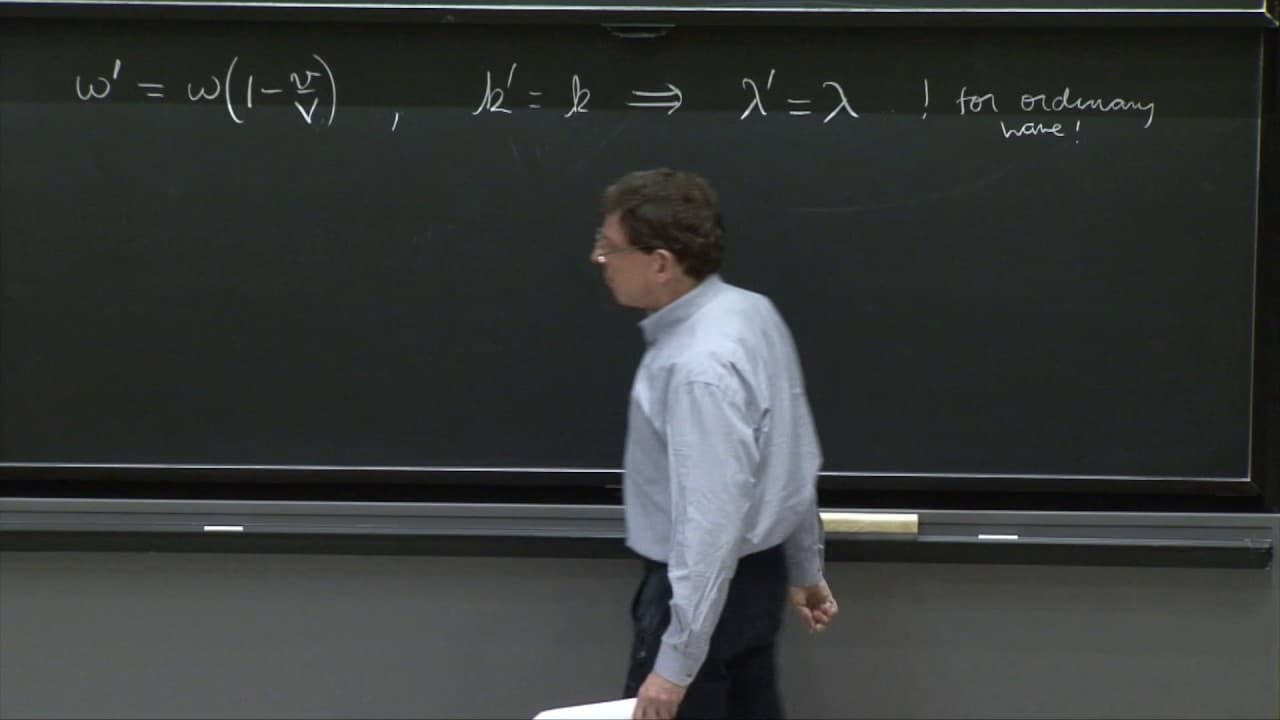
BARTON ZWIEBACH: Do normal wave analysis to demonstrate that indeed these things should not quite happen. So for that, so ordinary waves and Galilean transformations. So when you have a wave, as you've probably have seen many times before, the key object in the wave is something called the phaze of the wave. Phaze, the phaze. And it's controlled by... Read More
Key Insights
- 👋 Wave functions rely on the phase, which determines their behavior.
- 👋 The phase of a wave is a Galilean invariant, ensuring agreement between observers.
- 👋 Wave functions, such as the de Broglie waves, do not follow Galilean invariance.
- 👋 Complex numbers and phases in wave functions are not directly measurable.
- 👋 The differences in wave function measurements highlight the need to understand how measurements can be compared between observers.
- 👋 De Broglie waves are not like normal matter waves that propagate in a medium or simple manner.
- 👋 The Galilean properties of wave functions reveal the complexity of their transformation laws.
Install to Summarize YouTube Videos and Get Transcripts
Explore YouTube Video Summarizer or Get YouTube Transcript Extractor
Questions & Answers
Q: What is the role of the phase in a wave?
The phase of a wave is crucial as it determines the behavior of the wave. It is controlled by the wave number and angular frequency, and all observers will agree on its value.
Q: Why are wave functions not directly measurable?
Wave functions, such as the de Broglie waves, contain complex numbers and phases that cannot be directly measured. Only real numbers can be measured, limiting the measurability of certain aspects of the wave function.
Q: How do wave functions relate to Galilean invariance?
Unlike normal matter waves, wave functions do not follow Galilean invariance. This means that different observers may assign different complex numbers to the same wave function, leading to disagreement in measurements.
Q: What is the significance of the differences in wave function measurements?
The differences in wave function measurements between observers raise questions about how different measurements can be compared. Understanding how wave functions are measured by observers in motion is a task that needs to be addressed.
Summary & Key Takeaways
-
The key object in a wave is the phase, which is controlled by the wave number (k) and angular frequency (omega).
-
The phase of a wave is a Galilean invariant, meaning that observers will agree on its value.
-
Wave functions, such as the de Broglie waves, do not follow Galilean invariance, causing differences in measurement between observers.
Read in Other Languages (beta)
Share This Summary 📚
Summarize YouTube Videos and Get Video Transcripts with 1-Click
Try YouTube Summary with ChatGPT & Claude or YouTube Transcript Generator
Explore More Summaries from MIT OpenCourseWare 📚



Summarize YouTube Videos and Get Video Transcripts with 1-Click
Try YouTube Summary with ChatGPT & Claude or YouTube Transcript Generator