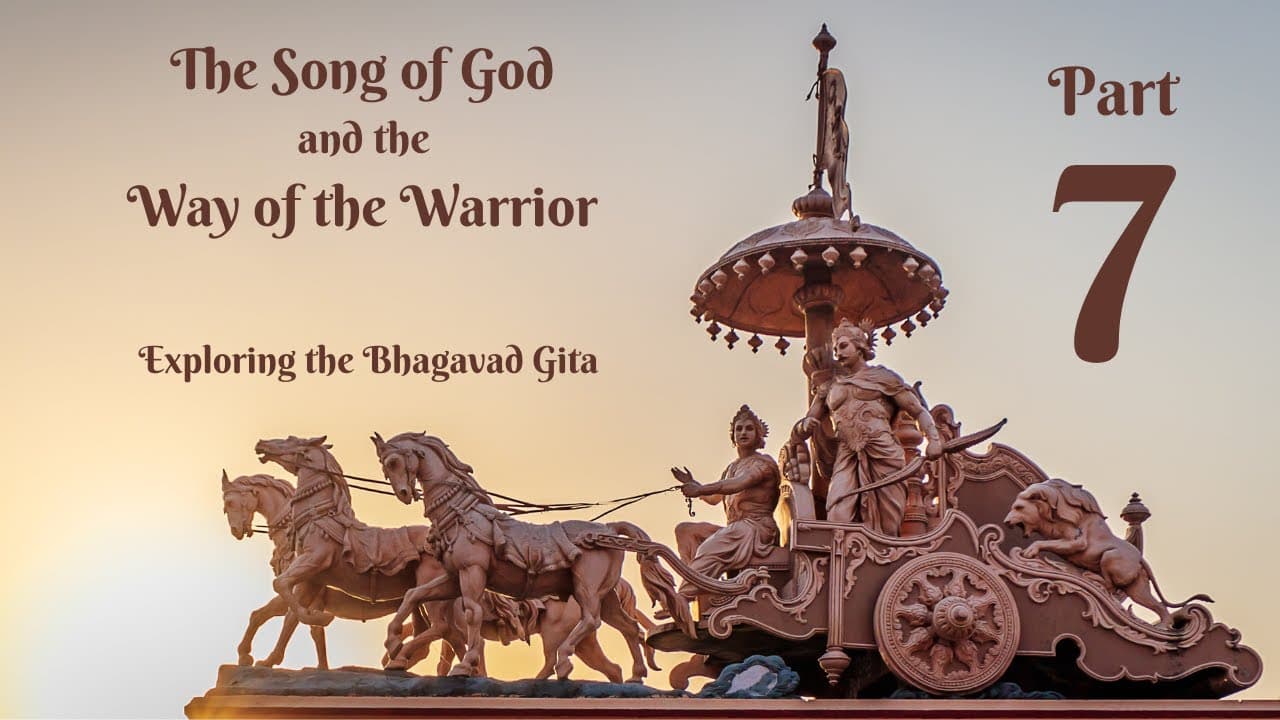
7 - The Song of God and the Way of the Warrior
TL;DR
This discussion centers on Chapter Eight of the Bhagavad Gita, focusing on spiritual freedom and devotion.
Transcript
hey everybody welcome back for another discussion on the bhagavad-gita um before we get started if somebody in the chat can just let me know if the sound is okay because uh in a panic over a spider i knocked my interface off my desk the other week and i'm hoping it still works okay so if you can't hear anything or the sound's too low please let me ... Read More
Key Insights
- 😌 The essence of freedom in the Gita lies in connecting with the eternal self, transcending material existence.
- 🤔 Thought patterns and focus during death significantly impact the nature of the next life, emphasizing the need for a lifelong spiritual practice.
- 🎭 Duty and spirituality are not mutually exclusive; one can perform worldly responsibilities while keeping a constant connection to God.
- 🙂 The paths of light and darkness symbolize the outcomes of one's spiritual state at the time of death and subsequent rebirth.
- ❓ Integrating awareness of God into daily actions transforms mundane activities into spiritual practices, promoting continual devotion.
- 💍 Engaging with multiple translations of texts can clarify comprehension and assist in personal interpretation of complex philosophical ideas.
- 🦻 Detaching from sensory distractions aids concentration and deepens meditation, fostering a more profound spiritual experience.
Install to Summarize YouTube Videos and Get Transcripts
Explore YouTube Video Summarizer or Get YouTube Transcript Extractor
Questions & Answers
Q: What does absolute freedom mean in the context of the Bhagavad Gita?
Absolute freedom, as described in Chapter Eight, means achieving union with the eternal and unchanging self. This union represents liberation from the cycle of birth and rebirth, which is intrinsic to material existence. It implies living a life of devotion to God, ultimately leading to eternal peace and transcendence beyond physical existence.
Q: How does one's state of mind at death influence their next life according to Krishna?
Krishna teaches that the focus of one's thoughts at the time of death affects their next reincarnation. If a person concentrates on God at that moment, they are more likely to achieve a divine state of being. Conversely, if their thoughts are scattered or fixated on worldly desires, they may be reborn according to those attachments.
Q: What practices does Krishna recommend for maintaining focus on God?
Krishna advocates for continuous meditation and remembrance of God throughout daily life. By integrating spiritual practices into one's duties and routines, individuals can cultivate a deep connection with God that persists all day. This approach helps strengthen their ability to think of God even at the time of death.
Q: What are the two paths of dying discussed in Chapter Eight?
Chapter Eight outlines two paths: the path of light and the path of darkness. The path of light, characterized by accurate spiritual understanding, leads to liberation and union with the divine. In contrast, the path of darkness leads to rebirth, as individuals become entangled in material existence and its cyclical nature.
Q: How does the concept of meditation apply to everyday activities according to this discussion?
Meditation is portrayed as a practice that can be embedded in daily activities rather than confined to a set period of formal practice. By maintaining awareness of God while performing mundane tasks, individuals can transform their entire life into a form of meditation, advancing their spiritual practice seamlessly throughout the day.
Q: Why is reading multiple translations of the Gita recommended?
Exploring various translations can enhance understanding as each version may offer unique perspectives or interpretations of difficult passages. Engaging with different commentaries allows readers to grasp complex concepts and derive personal insights, contributing to a richer understanding of the Gita's teachings.
Q: What does closing off the nine gates of the body mean in this context?
The nine gates refer to the human sensory organs. Closing off these gates symbolizes detaching from sensory experiences, thus allowing the mind to focus inwardly. By limiting distractions from the external world, individuals can achieve a deeper state of meditation and connection with God.
Q: How does the discussion address the idea of karma in relation to one's actions and thoughts?
The discussion highlights that actions performed with detachment do not create karma, allowing individuals to navigate their spiritual paths without being bound by the consequences of their deeds. The emphasis is on cultivating a mindset of non-attachment, ultimately freeing oneself from the cycles of karma that typically influence rebirth.
Summary & Key Takeaways
-
The session delves into Chapter Eight of the Bhagavad Gita, emphasizing the concept of absolute freedom as a union with the eternal self, as discussed by Lord Krishna.
-
Arjuna's questions highlight the nature of self, action, and the importance of unwavering devotion to God, especially at the moment of death.
-
The presenter discusses practical aspects of maintaining devotional focus in daily life, suggesting that true spirituality integrates worldly duties with constant remembrance of God.
Read in Other Languages (beta)
Share This Summary 📚
Summarize YouTube Videos and Get Video Transcripts with 1-Click
Try YouTube Summary with ChatGPT & Claude or YouTube Transcript Generator
Explore More Summaries from PhilosophiCat 📚



Summarize YouTube Videos and Get Video Transcripts with 1-Click
Try YouTube Summary with ChatGPT & Claude or YouTube Transcript Generator