Pythagoras’ Theorem (GMAT/GRE/CAT/Bank PO/SSC CGL) | Don't Memorise
TL;DR
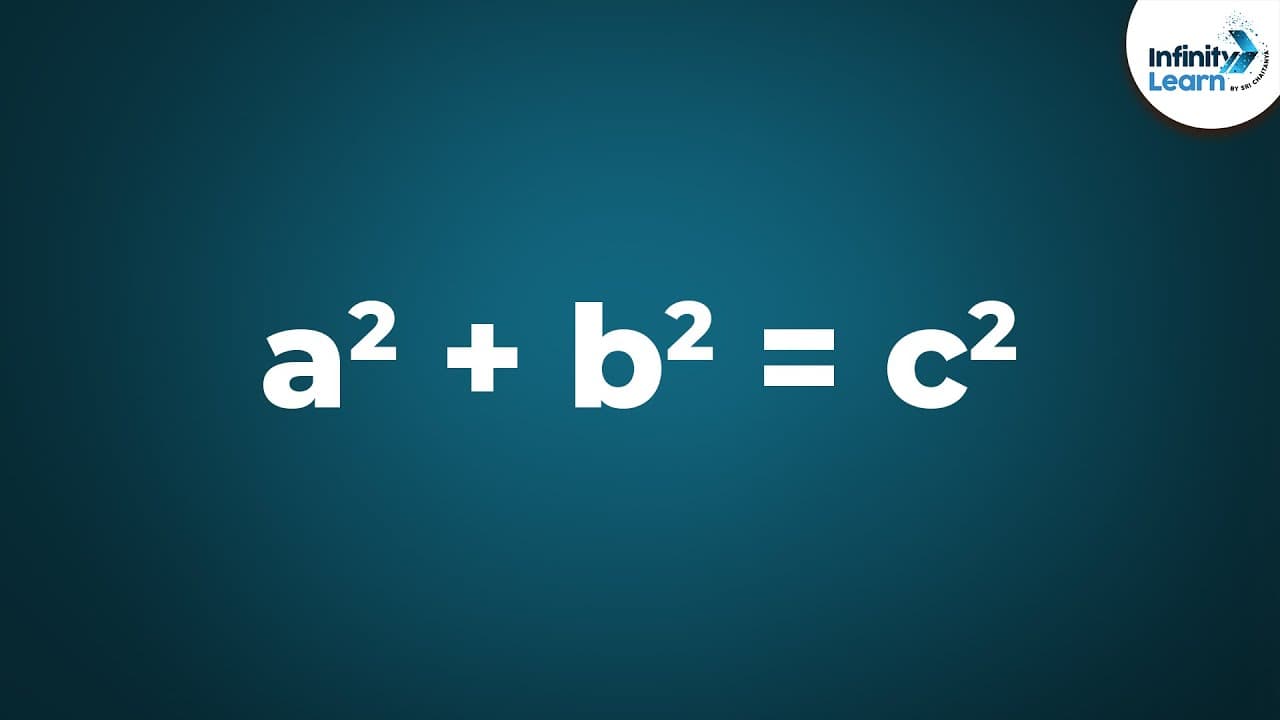
The Pythagorean Theorem allows us to find the length of the unknown side of a right triangle by using the formula a^2 + b^2 = c^2.
Transcript
the Pythagoras Theorem is pretty simple to understand and fortunately a very important topic too it Deals Only with right triangles like this one let the length of its sides Be A B and C in this triangle a 2 + b 2 will equal c² this right here is called the Pythagoras Theorem the side opposite the right angle is called the hypotenuse the square of ... Read More
Key Insights
- 🗯️ The Pythagorean Theorem is a simple but important concept in mathematics that applies to right triangles.
- 🙃 It allows us to find the length of an unknown side when we know the lengths of the other two sides.
- 😫 Pythagorean triples are sets of numbers that form common examples of right triangles.
Install to Summarize YouTube Videos and Get Transcripts
Explore YouTube Video Summarizer or Get YouTube Transcript Extractor
Questions & Answers
Q: How does the Pythagorean Theorem allow us to find the length of an unknown side in a right triangle?
The Pythagorean Theorem states that a^2 + b^2 = c^2, where c is the length of the hypotenuse and a and b are the lengths of the other two sides. By rearranging the formula, we can solve for the unknown side.
Q: What are Pythagorean triples?
Pythagorean triples are sets of three positive integers that form a right triangle. The sum of the squares of two numbers in the set is equal to the square of the third number. For example, 3, 4, and 5 is a Pythagorean triple because 3^2 + 4^2 = 5^2.
Q: Can Pythagorean triples be scaled up or down?
Yes, Pythagorean triples can be multiplied by a constant to form new triples. If you multiply each number in a Pythagorean triple by the same constant, the resulting set of numbers will also be a Pythagorean triple.
Q: What should we be cautious about when using the Pythagorean Theorem?
It is important not to assume that all triangles with the same side lengths are right triangles. The Pythagorean Theorem can only be used if the triangle is known to be right-angled.
Summary & Key Takeaways
-
The Pythagorean Theorem states that the sum of the squares of the two perpendicular sides of a right triangle is equal to the square of the hypotenuse.
-
The theorem can be used to find the length of an unknown side in a right triangle when the lengths of the other two sides are known.
-
There are certain sets of numbers called Pythagorean triples that form common examples of right triangles.
Read in Other Languages (beta)
Share This Summary 📚
Summarize YouTube Videos and Get Video Transcripts with 1-Click
Try YouTube Summary with ChatGPT & Claude or YouTube Transcript Generator
Explore More Summaries from Infinity Learn NEET 📚


Summarize YouTube Videos and Get Video Transcripts with 1-Click
Try YouTube Summary with ChatGPT & Claude or YouTube Transcript Generator